How to Safely Drag a Heavy Sectional Through the Narrowest Aurora Hallways
We’ve all been there. You’ve just found the perfect oversized sectional at a local showroom, or perhaps you’re finally clearing out a basement in a historic home on Aurora’s Near East Side. You’ve got your help lined up, the path cleared, and then you hit the dreaded corner. It’s the “Ross Geller Pivot” nightmare come to life, but without the laugh track. In my years of clearing out Aurora homes – from those tight-quartered Victorians to modern West Side builds with surprisingly narrow corridors – I’ve learned that junk removal aurora isn’t just about muscle; it’s about physics, patience, and a few trade secrets.
I’m Jennifer Hanzlick, and at Clutter Trucker, we’ve spent years “disrupting” the way people think about hoarding and large-scale cleanouts. Moving a massive couch through a space that looks three sizes too small is one of our daily challenges. Whether you are a homeowner tackling a DIY move, a business owner refreshing an office lounge, or a construction manager dealing with site debris, this guide will teach you how to move the unmovable without losing your mind – or your security deposit.
The Pre-Move Audit: Measuring for Success
Before you even think about lifting a corner, you need to perform what we call the “Audit of the Three Dimensions of Doom.” In Aurora, we see a massive variety of architecture. Modern homes often feature standard 32-to-36-inch door frames, but if you’re living in one of our beautiful older neighborhoods, you might be dealing with narrow 28-inch frames or odd-angled entryways that were never designed for a six-piece power-reclining sectional.
First, measure the sectional’s depth, height, and length. Most people forget to measure the “diagonal depth” – the distance from the top back of the frame to the bottom front. This is often the magic number that determines if a couch can “hook” through a door. Next, measure your hallways. Don’t just measure the floor width; measure the width at the narrowest point, which is usually the door trim or a radiator. According to the National Safety Council, many home injuries occur during manual material handling because of poor preparation and cluttered paths.
Clear the “path of travel” entirely. This means taking down the wall art, removing the hanging light fixtures if they are low, and rolling up any rugs that could cause a trip hazard. In the world of furniture removal, a single loose rug is the difference between a successful move and a trip to the ER.
Tools of the Trade: What the Pros Use
If you think you can move a 300-pound sectional with just your bare hands and a “can-do” attitude, you’re in for a long day. Professional junk removal experts rely on a specific kit to make these jobs look easy. While appliance removal often requires heavy-duty hand trucks and straps, furniture removal is all about friction reduction and weight distribution.
- Moving Blankets: These aren’t just for padding; they allow you to “sled” the furniture across hard surfaces.
- Shoulder Dollies: These straps use your legs and shoulders to lift, keeping your back in a neutral position.
- Furniture Sliders: Essential for moving heavy pieces across carpet or hardwood without gouging the floor.
- High-Quality Packing Tape: Use this to secure moving blankets around the sectional corners so they don’t slip mid-pivot.
Using the right tools is the hallmark of a professional junk removal service. It’s the difference between dragging a couch and gliding it.
Step-by-Step: The “Vertical Pivot” and “The Hook”
When the hallway is narrow and the couch is long, you have to stop thinking horizontally. Here is how we handle the toughest “squeezes” in Aurora.
1. Disassembly is Your Best Friend
Never try to move a sectional as one piece. Flip the units over and locate the metal brackets or plastic clips that hold them together. Remove the legs – this usually gains you 2 to 4 inches of clearance, which is often exactly what you need to get through a 30-inch door. Remove all cushions and, if possible, the backrests (many modern recliners have “click-in” backs that slide off with the flip of a lever).
2. The Vertical Pivot
If you hit a tight corner in a hallway, the “Vertical Pivot” is your go-to move. Stand the sectional piece on its end (the sturdiest part of the frame). This allows you to use the height of the hallway (usually 8 feet) to compensate for the length of the couch. As noted in the Allied Van Lines Moving Resources, standing a couch vertically is the most effective way to navigate tight “L” turns in residential corridors.
3. The “Hook” Technique
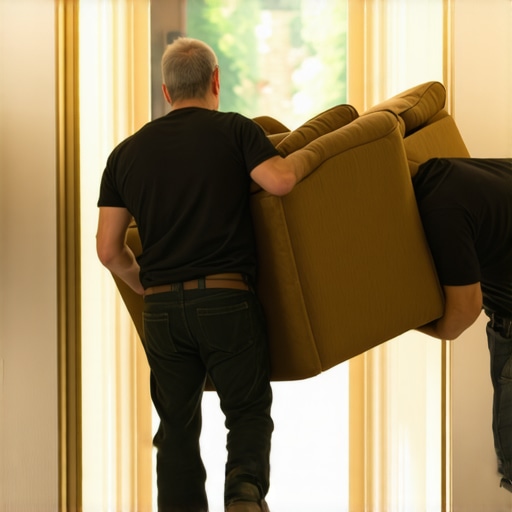
The “Hook” is used for getting a couch through a door that opens into a narrow hallway. You lead with the back of the couch, “hooking” the backrest around the door frame in a curling motion. Once the back is through, you rotate the seat portion through. It’s a rhythmic, circular motion that requires two people working in perfect sync.
Protecting Your Aurora Home
Nothing ruins a move like a massive gouge in your hardwood floors or a “beauty mark” on your freshly painted drywall. In Aurora’s historic districts, protecting the original architecture is paramount. We always recommend laying down thick cardboard (flattened appliance boxes are perfect) along the entire path of travel. This creates a “slipway” that protects the floor and makes sliding the sectional much easier.
Wrap the corners of the sectional in double-layered moving blankets. If you are moving items in a multi-story home, remember that the professional method for hauling a heavy washer and dryer up steep basement stairs involves many of the same protection principles: focus on the “pinch points” where the item is most likely to strike the wall.
Local Aurora Disposal Options: Where Does the Couch Go?
Once you’ve successfully navigated the hallway and the sectional is finally on the curb or in the driveway, you face a new problem: how to get rid of it. Aurora has specific rules regarding bulk waste. You can’t just leave a six-piece sectional on the curb and expect the standard trash pickup to take it without prior arrangement or specific stickers.
Many homeowners find themselves frustrated when their old furniture is left behind. We’ve covered this extensively in our guide on Why Your Old Couch Is Still Sitting There: Aurora’s Toughest Removal Rules. If you want to avoid the headache of municipal schedules, a professional junk removal aurora service can handle the haul-away on your timeline.
If you’re looking for ways to save on the back end of your project, check out Junk Removal in Aurora: 5 Ways to Cut Disposal Costs in 2026.
When to Call a Junk Removal Service
There is a fine line between a challenging DIY project and a dangerous one. Safety should always be your priority. If your sectional weighs over 300 pounds, if you are dealing with a 90-degree turn with zero clearance, or if you have any history of back issues, it is time to call in a professional junk removal service. We have the specialized equipment – and more importantly, the insurance – to handle these high-risk maneuvers.
For more tips on handling the big stuff, read our breakdown of the 7 Best Ways to Handle Large Furniture Removal in Aurora (2026). Sometimes, the best “way” is simply letting someone else do the heavy lifting.
Conclusion
Moving a heavy sectional through a narrow Aurora hallway is a test of patience and technique. By measuring accurately, using the right tools like sliders and blankets, and mastering the vertical pivot, you can save yourself a lot of grief. However, don’t risk your back or your drywall if the job feels beyond your reach. If that sectional won’t budge, call the experts at Aurora IL Junk Removal today for a stress-free haul-away. We’ve got the experience to navigate the tightest squeezes in town.