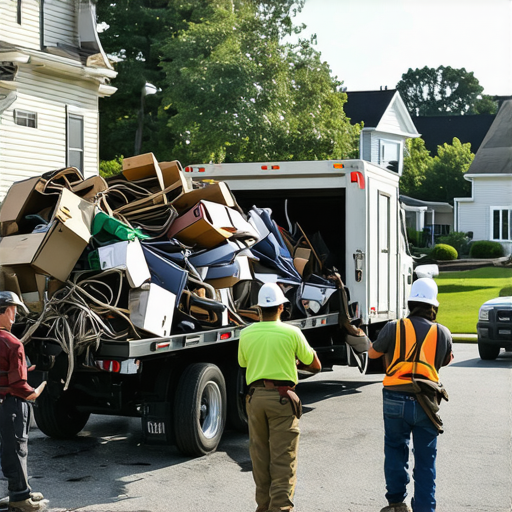
A business owner tried to save $500 by hiring a guy with a pickup truck from a social media ad. Two weeks later, the police called him because his company’s confidential files were found in a ditch near the Fox Valley. Your junk is your liability until it hits the scale at a certified transfer station. I have spent twenty five years watching the fallout of poor waste management. I smell like diesel, hydraulic fluid, and the stale air of a thousand packed attics. Every job is a puzzle of weight and volume. If you do not pack the truck tight, you are burning money. If you pack it wrong, you break an axle. This is the reality of waste logistics in Aurora. We are moving toward a 2026 mandate that changes how you sort your life. The curbside is no longer a catch-all. It is a regulated zone.
The phantom liability of curbside piles
Residential junk removal in 2026 requires source separation of municipal solid waste, e-waste, and organic matter to avoid civil penalties and tipping fee surcharges. You cannot simply drag a couch to the curb and expect it to vanish. The city codes now dictate a strict hierarchy of disposal. If you leave a mattress out without a plastic shroud, the moisture absorption increases the weight by forty percent. That weight translates to higher costs. I have seen rookie haulers try to lift a rain-soaked king mattress and blow out their lumbar discs. The physics do not lie. Water is the enemy of the load. Every cubic inch of air in a truck is a loss of profit. We call it cubing out. You want the truck at maximum density without exceeding the gross vehicle weight rating. This requires a level of sorting that most homeowners ignore until the fine arrives in the mail.
“Waste is merely a resource in the wrong place; professional removal is the science of putting it back where it belongs.” – Disposal Industry Maxim
Why your old sofa is a logistical nightmare
Furniture removal involves the deconstruction of polyurethane foam and treated timber which are often categorized as special waste due to flame retardant chemicals. Modern furniture is mostly glue and sawdust. It is light until it gets wet. Then it becomes a heavy mass of rot. When we perform Junk Removal Aurora, we look for the frame. A solid oak dresser from 1950 has a BTU value that makes it worth the haul. A flat-pack shelf from 2022 is garbage before it hits the truck. The 2026 rules require you to strip the fabric from the frame if you want to avoid the high-cost bulk stream. The labor to do this often exceeds the value of the materials. This is the paradox of the modern economy. It is cheaper to buy new than to dispose of the old correctly. But the landfill does not care about your wallet. It cares about the methane gas produced by decomposing composite boards.
The hidden chemistry of the modern garage
Garage Clean outs reveal hazardous materials like lead-acid batteries, mercury thermometers, and volatile organic compounds that cannot legally enter the Aurora transfer station via standard bins. People hide things. They tuck a half-full gallon of oil-based paint inside a box of old toys. I watched a rookie almost lose his eyebrows because a customer hid a half-full propane tank inside a pile of yard waste. We don’t just lift. We inspect. Every. Single. Item. The chemical leaching from a single car battery can contaminate an entire load of recyclable cardboard. Once that load is contaminated, the diversion rate drops to zero. You are then paying the premium rate for hazardous disposal. The 2026 regulations will use scanners at the scale to detect these anomalies. You need to sort your chemicals now. Put the cleaners in one bin and the lubricants in another. Don’t mix them. The reaction could turn your garage into a hazmat site before we even arrive.
Deciphering the 2026 Aurora disposal codes
Junk Removal Aurora standards for 2026 emphasize material recovery and circular economy principles through mandatory recycling of ferrous metals and high-density polyethylene. The city is tightening the belt. The narrow streets near downtown Aurora mean a 20-yard dumpster is a permit nightmare. You need a live-load truck. We pull up, we load, we leave. There is no time to sort on the street. If you have not sorted your pile, we have to charge for the extra labor minutes. Time is the one thing we cannot recycle. The regional tipping realities are harsh. The landfills in the surrounding counties are reaching capacity. This means the price per ton is climbing. While most people think recycling is always better, the carbon footprint of hauling low-grade plastics 500 miles often exceeds the impact of local, high-efficiency waste-to-energy incineration. We have to be honest about the math. Sometimes the best move is the incinerator, not the recycling center.
| Material Type | Decomposition Time (Years) | 2026 Recovery Rate Target |
|---|---|---|
| Untreated Wood | 10-15 | 85% |
| Polyurethane Foam | 50-100 | 20% |
| Corrugated Cardboard | 0.5 | 98% |
| Mixed Plastics | 450+ | 15% |
Anatomy of a hoarding intervention
A Hoarder Clean Out aurora requires structural assessment and biohazard mitigation because compaction of materials can lead to floor joist failure and mold proliferation. I once cleared a house where the junk wasn’t just stuff. It was a structural hazard. We found the floor joists were bowing under the weight of 40 years of newspapers that had absorbed ten years of basement humidity. The paper had turned into a solid block of cellulose. We had to use chainsaws to break it up. That is not junk removal. That is mining. In these cases, Dumpster Rentals Aurora are often the only solution, but you have to be careful with the placement. A 30-yard bin full of wet paper will crack a residential driveway like an eggshell. We use wooden planks to distribute the weight, but even then, the risk is high. You are moving tons of history. It is emotional, yes, but it is also a massive physical load that requires respect.
“The Resource Conservation and Recovery Act (RCRA) creates the framework for the proper management of hazardous and non-hazardous solid waste.” – EPA Regulatory Summary
The physics of the fifteen yard bin
Dumpster Rentals Aurora efficiency depends on load leveling and void space reduction to ensure the container weight limit is not exceeded during hydraulic lifting. You see a big metal box and you think you can fill it to the brim with concrete. You can’t. Concrete is 150 pounds per cubic foot. A 15-yard dumpster full of concrete weighs over 30 tons. The truck can only lift 10 tons. You just created a permanent monument in your driveway. We teach our clients the art of the load. Heavy items go on the bottom, centered over the axles. Light, bulky items go on top. We call it the pyramid. If you ignore the pyramid, the bin tilts when we winch it onto the rails. That is how you snap a cable. That is how you lose a truck. In the 2026 landscape, we will see more weight-sensors on these bins to stop the over-loading before it happens.
Surviving the white goods purge
Appliance removal necessitates refrigerant recovery and capacitor discharge to comply with Environmental Protection Agency standards regarding ozone-depleting substances. You cannot just throw a fridge into a crusher. The Freon has to be vacuumed out and logged. The copper coils are high-value, but the labor to strip them is intense. If you have an old fridge in Aurora, check the seals. If they are brittle, the unit is leaking gas. That gas is a potent greenhouse agent. When we handle Appliance removal, we treat the unit like a bomb. We don’t drop it. We don’t tilt it more than 45 degrees. The oil in the compressor must stay in the compressor. Once we get it to the yard, the real work begins. We strip the motors, the wire harnesses, and the glass shelving. The remaining steel shell is the only thing that gets melted down. It is a surgical process.
- Lithium-ion batteries (Serious fire risk)
- Propane tanks and pressurized cylinders
- Asbestos-containing insulation or floor tiles
- Lead-based paints and industrial solvents
- Unlabeled biological waste
The floor snapped. That was the sound of a job going wrong in a basement clean out last year. A client had stacked three tons of old ceramic tile in the corner of a room. The subfloor gave way. This is why we insist on professional oversight. You might think you are just cleaning out the garage, but you are managing a logistics operation. The 2026 rules are not there to make your life hard. They are there to stop the landfills from becoming toxic graveyards. Use the right bins. Sort your metals. Keep your papers dry. If you do that, the transition to the new curbside reality will be easy. If you don’t, you will be the one calling me to fix a legal and physical mess that should have never happened. Junk is a resource. Treat it like one.