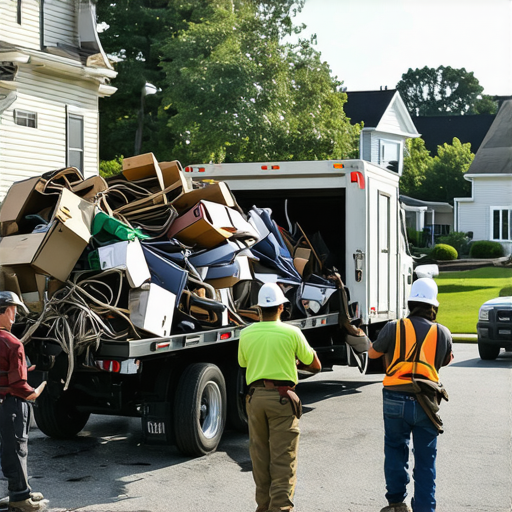

A business owner tried to save €500 by hiring a guy with a pickup truck from a social media ad. Two weeks later, the police called him because his company’s confidential files were found in a ditch. Your junk is your liability until it hits the scale. This is the reality of the waste management industry in Illinois. When you hire for Junk Removal Aurora, you are not just paying for muscle. You are paying for the legal transfer of liability and the technical expertise required to navigate the logistics of Kane and DuPage County disposal regulations. Every load that leaves a driveway in Aurora represents a complex calculation of volume, weight, and environmental compliance.
The illegal dumping trap
Junk Removal Aurora services protect homeowners from legal liability by ensuring all debris reaches licensed transfer stations. Professional haulers provide manifests that prove waste was disposed of at facilities like the Fox Valley Transfer Station. Hiring unlicensed operators often results in fly-tipping, which can lead to massive fines for the original property owner if items are traced back to their address via mail or personal effects. I have seen the fallout of these shortcuts. A homeowner in the Fox River area once faced thousands in remediation costs because their ‘cheap’ hauler dumped old lead-paint canisters in a local wetland. We don’t just move objects. We manage risks. We ensure that every cubic yard of debris is accounted for from the moment it leaves your basement until it is processed at a regional landfill or recycling center. The peace of mind comes from knowing your name won’t appear on a police report because of a curbside cowboy.
The hidden physics of Aurora basement stairs
Basement clean outs require a deep understanding of structural load limits and center-of-gravity physics. Navigating a 300 pound cast iron heater or a water-logged sofa up a narrow flight of wooden stairs in an older Aurora home is a high-risk operation. The physics of ‘cubing out’ a truck start at the bottom of those stairs. We calculate the tread-to-riser ratio to ensure our crew can maintain a three-point contact rule while under load. If a basement has sustained any moisture damage, the integrity of the stairs is the first thing we inspect. I have witnessed floor joists bowing under the weight of decades-old newspaper collections. These collections act like sponges, absorbing humidity and increasing their weight by up to 30 percent over several years. Clearing these spaces is about more than just clearing space. It is about preventing a structural collapse. We use specialized hand trucks and straps that distribute weight across the skeletal structure of the lifter, reducing the impact on the home’s flooring. Every step is a calculated move to prevent damage to drywall and banisters.
“Waste is merely a resource in the wrong place; professional removal is the science of putting it back where it belongs.” – Disposal Industry Maxim
Why your old refrigerator is a hazardous chemical unit
Appliance removal involves the careful extraction of refrigerants and heavy metals that pose significant environmental risks. Old units found in Aurora garages often contain chlorofluorocarbons or hydrochlorofluorocarbons which are potent greenhouse gases. Federal law mandates that these be recovered by certified technicians before the metal can be recycled. When we handle an appliance removal, we are looking for more than just weight. We are looking for the integrity of the cooling coils. A single puncture can release gases that stay in the atmosphere for decades. Furthermore, older chest freezers might still use mercury-containing switches. These are small, but the toxic impact on local groundwater near the Fox River would be devastating if crushed in a standard trash compactor. We treat every appliance as a self-contained hazardous waste unit until it is professionally decommissioned. The scrap value of the steel is secondary to the environmental responsibility of the extraction. We utilize heavy-duty appliance dollies with stair-climbing tracks to move these units without risking a leak or a floor scar.
Managing the hoarder cleanout mountain in Kane County
Hoarder Clean Out aurora projects require a systematic approach to biohazard identification and volumetric reduction. These situations are data overflow errors in physical space. We approach a high-density hoard by first establishing a ‘red zone’ for immediate hazards like expired chemicals or biological waste. The air quality in these homes often contains high concentrations of mold spores and particulate matter. Our crews use respiratory protection because the ‘dust’ is often a mixture of degraded organic material and rodent remains. We look for the structural pathways. We don’t just start grabbing things. We create egress routes to ensure a fast exit if the unstable piles shift. The goal is to maximize the diversion rate. We separate the clean paper, the scrap metal, and the general municipal solid waste on-site. This reduces the tipping fees at the landfill and ensures that the maximum amount of material is recovered for recycling. It is a grueling, forensic process that transforms a liability into a clean slate.
The cold math of dumpster rentals versus full service
Dumpster Rentals Aurora options provide a cost-effective solution for DIY projects but require the customer to manage all labor and loading logistics. When you rent a 20-yard container, you are paying for the volume and a specific weight allowance. The hidden cost is your time and the risk of ‘dead air.’ Most people don’t know how to pack a dumpster. They throw items in haphazardly, creating massive air pockets. You end up paying for a half-empty bin because you reached the top rail without actually filling the space. In contrast, a full-service junk removal crew uses the ‘tetris’ method. We break down furniture and stack items to ensure there is zero wasted space. This maximizes your value per cubic yard. Here is a breakdown of the logistical differences:
| Feature | Dumpster Rental | Full-Service Removal |
|---|---|---|
| Labor | Customer provided | Professional crew included |
| Loading Efficiency | Low (often 40% air) | High (95% density) |
| Permit Needs | Often required for street | None (truck stays on site) |
| Liability | Customer responsibility | Hauler handles everything |
| Timeframe | 7 to 10 days usually | 1 to 4 hours typically |
The toxic reality of forgotten garage chemicals
Garage Clean outs frequently reveal a cocktail of volatile organic compounds and flammable liquids that require specialized handling. In Aurora, we often find old cans of oil-based paint, pesticides from the 1990s, and lead-acid batteries. These items cannot go into a standard landfill. While most people think recycling is always better, the carbon footprint of hauling low-grade plastics 500 miles often exceeds the impact of local, high-efficiency waste-to-energy incineration. However, for chemicals, the rules are absolute. We identify these items and segregate them. Lithium batteries are a particular nightmare. If they are crushed in the back of a hydraulic pack-truck, they can ignite a fire that is almost impossible to extinguish with standard equipment. We have a strict protocol for these items to ensure our truck and the transfer station remain safe. Every garage we clear is a search-and-rescue mission for hazardous materials that have been forgotten for decades. We ensure they are routed to the proper household hazardous waste collection sites.
“The goal of modern waste management is the total elimination of the concept of waste through precise logistical intervention.” – SWANA Technical Manual
Disposal sites that matter in the Aurora region
Local disposal logic dictates that we utilize the most efficient transfer station to minimize fuel consumption and carbon emissions. We primarily use facilities that offer high diversion rates for the Aurora area. The Fox Valley Transfer Station is a key node in our logistics network. By knowing the specific tipping fees for different material types at various Kane County sites, we can offer better pricing for Furniture Removal. For example, if we have a load that is 90 percent clean wood, we can route that to a different facility than a load of mixed municipal waste. This logistical agility is what separates professionals from the curbside cowboys. We also stay updated on the municipal bulky-item pickup schedules in Aurora to advise clients when they might be able to save money on single-item removals. Our knowledge of local geography and waste ordinances ensures that we are not just hauling junk. We are optimizing a regional waste stream.
Items the law forbids us to touch
Federal and state regulations like the Resource Conservation and Recovery Act define specific materials that standard junk removal companies cannot transport. We are not licensed as hazardous waste haulers. This means there are certain things we cannot legally put in our trucks. If a hauler says they will take anything, they are likely lying to you and potentially breaking the law. Here is the mandatory checklist of items we cannot touch:
- Ammunition and explosives
- Bio-medical waste (sharps, infectious materials)
- Pressurized tanks (propane, oxygen) that are not empty
- Radioactive materials (older smoke detectors in bulk)
- Raw sewage or septic waste
- Fuel-contaminated soil
If you have these items, we provide the contact information for the specialized agencies that handle them. We don’t take risks with our crew’s safety or the legality of our operation. Every load is inspected to ensure compliance with these rules. This transparency is why we have remained a leader in the Aurora waste management industry for so long. We value the technical reality of the job over a quick profit. Clearing a basement fast is easy. Clearing it safely, legally, and ethically is where the true expertise lies.