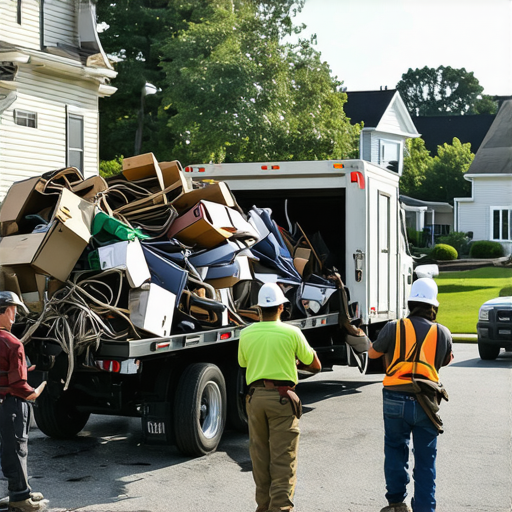

The green waste trap under the Aurora sun
Professional junk removal in Aurora involves the systematic extraction of organic and inorganic debris to maintain property safety and environmental compliance. Effective garden clearing requires identifying hazardous hidden items, calculating the cubic-yard density of wet biomass, and ensuring all materials reach a licensed transfer station rather than an illegal dumping site.
I watched a rookie almost lose his eyebrows because a customer hid a half-full propane tank inside a pile of harmless yard waste. We do not just lift. We inspect. Every. Single. Item. The logistics of residential junk removal Aurora often start in the backyard, where homeowners assume a pile of branches is just wood. In reality, that pile is a micro-ecosystem of moisture, weight, and potential liability. When a storm rolls through Aurora, it leaves more than just broken limbs. It leaves a logistical puzzle that can cube out a fifteen yard truck in forty minutes if the loader does not understand the tetris of the load. I have spent twenty five years smelling diesel and hydraulic fluid while managing these loads. I see a cluttered garden as a failure of spatial management. A single cubic yard of wet soil and root balls can weigh over two thousand pounds. If you put that at the tail of the truck, you lift the front wheels off the pavement. This is the science of the haul.
“Waste is merely a resource in the wrong place; professional removal is the science of putting it back where it belongs.” – Disposal Industry Maxim
The physics of the load in Aurora
Calculating the volume and weight of garden debris is the primary challenge for any junk removal Aurora operation because moisture content fluctuates wildly. A dry pile of brush occupies massive volume with little weight, while a rain-soaked pile of grass clippings creates a high-density sludge that challenges hydraulic lift systems.
The narrow streets of Aurora mean a twenty yard dumpster is often a permit nightmare. You need a live-load truck that can get in, pack the debris, and get out before the traffic backs up. When we talk about Junk Removal, we are talking about air space. Air space is the enemy of profit and the friend of the lazy hauler. We crush the brush. We break down the branches. We ensure that every cubic inch of that truck bed is filled with material, not oxygen. This is particularly vital during a Garage Clean outs project where old lawnmowers still contain stale gasoline. That gas is a VOC nightmare in a closed truck. We drain the fluids. We stack the decks. We treat the truck like a puzzle. If you hire a guy with a pickup, he will leave half your junk on the curb because he does not understand the weight limits of his axles. He will dump it in a ditch. Your junk is your liability until it hits the scale at the transfer station. We provide the manifest to prove it got there.
| Material Type | Weight per Cubic Yard | Disposal Strategy | Decomposition Rate |
|---|---|---|---|
| Dry Brush | 300 lbs | Chipping/Mulching | 2-3 Years |
| Wet Grass | 800 lbs | Composting | 6 Months |
| Concrete Debris | 2,000 lbs | Aggregate Recycling | Indefinite |
| Old Furniture | 400 lbs | Material Recovery | Variable |
The structural math of a garage clean out
Garage clean outs in Aurora require a tactical approach to separate recyclable metals from hazardous household waste and general debris. A professional team must evaluate the load-bearing capacity of the driveway and the physical dimensions of the garage door to prevent structural damage during heavy appliance removal.
I have seen concrete driveways crack under the weight of a poorly placed dumpster. People do not realize that a fifteen yard bin filled with old shingles and garden dirt can weigh ten tons. That is why Dumpster Rentals Aurora services must be handled by someone who knows where the water lines and septic tanks are buried. During a Garage Clean outs, we often find the artifacts of a life lived without a trash filter. Old tires are a specific headache. Landfills in our region will not touch them because they trap methane and float to the surface of a landfill cell. We have to take those to specialized rubber processors. Then there is the Furniture Removal aspect. Modern particle board furniture is essentially compressed sawdust and glue. When it gets damp in a garage, it loses all structural integrity. It becomes a heavy, sodden mess that requires flat-shoveling. It is a far cry from the solid oak pieces we used to haul thirty years ago. The industry has shifted from moving objects to moving bulk fiber.
Hidden chemistry in the junk pile
Environmental safety in residential junk removal depends on the strict identification of prohibited materials such as lead-acid batteries, mercury thermometers, and pressurized cylinders. These items require specialized handling under the Resource Conservation and Recovery Act to prevent groundwater contamination in the Aurora watershed.
While most people think recycling is always better, the carbon footprint of hauling low-grade plastics five hundred miles often exceeds the impact of local, high-efficiency waste-to-energy incineration. This is a contrarian truth that the industry rarely discusses. We focus on the most efficient diversion. For an Appliance removal job, we are looking for the copper and the steel. A refrigerator is a gold mine of recyclable metal, but it is also a bomb of CFCs if the cooling lines are snapped by an amateur. We use recovery pumps. We seal the systems. In a Hoarder Clean Out aurora situation, the chemistry gets even more complex. You are dealing with biohazards, mold spores, and the chemical breakdown of ammonia from years of neglect. You need respirators. You need a crew that understands that they are not just moving trash, they are remediating a site. The floor joists in some of these homes are bowing under the weight of forty years of newspapers that have absorbed ten years of basement humidity. That paper becomes a solid block of cellulose that weighs more than concrete.
“The mismanagement of residential organic waste contributes significantly to methane production in anaerobic landfill environments.” – EPA Waste Management Fact Sheet
- Unspent ammunition and explosives
- Lead-acid car batteries
- Unsealed containers of oil or antifreeze
- Propane and butane tanks
- Medical sharps and biohazardous waste
- Fluorescent light ballasts containing PCBs
The logistics of a twelve ton day
Managing a high-volume junk removal operation in Aurora requires a deep understanding of tipping fees and diversion rates to remain economically viable. A twelve ton day involves multiple trips to the transfer station, precise logging of weights, and the constant maintenance of hydraulic systems under extreme pressure.
Every time the truck bed lifts, the hydraulic fluid is screaming. The seals are holding back thousands of pounds of pressure. This is the reality of Junk Removal. It is not just a man and a van. It is a logistical engine. When we handle an Appliance removal, we are thinking about the weight distribution. We are thinking about the time it takes to strip the components. If we are doing a Hoarder Clean Out aurora, we are thinking about the psychological toll on the crew and the sheer volume of material that needs to be sorted. We do not just throw everything in the pit. We sort at the source. Wood goes one way. Metal goes another. E-waste is handled separately. This reduces the tipping fees at the Aurora transfer station and ensures we stay within the legal limits of our hauling permits. The local landfills are reaching capacity. If we do not maximize our diversion rates, the price of trash will double in the next five years. That is the heavy cost of keeping everything. We are the pressure valve for a society that produces too much and keeps it too long. We clear the space so the property can breathe again.