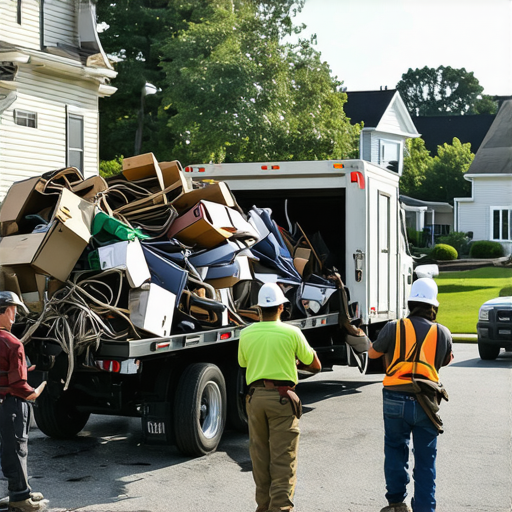

The storage unit trap and the illegal dumping hazard
Junk Removal Aurora requires a strategic approach to volumetric density and local disposal laws to clear a storage unit fast. Success depends on the rapid identification of recyclable metals, hazardous household waste, and the logistical coordination of a high-capacity hauling vehicle. Professional teams prioritize the removal of large obstructions first to create a staging area within the unit. I once watched a business owner try to save 500 dollars by hiring a guy with a pickup truck from a social media ad. Two weeks later, the police called him because his company confidential files were found in a ditch. Your junk is your liability until it hits the scale at a certified transfer station. This is the reality of the hauling industry. If you hire an unvetted operator, you are legally responsible for where that material ends up. In Aurora, the authorities do not take illegal dumping lightly. If your name is on the mail inside a bag of trash found in a ravine, the fines will dwarf whatever you thought you saved on labor costs. Professional Junk Removal Aurora involves more than just lifting heavy objects. It involves a chain of custody. We track every cubic yard from the moment it leaves the storage facility until it is processed at the Denver Arapahoe Disposal Site or a local recycling facility. This ensures that environmental regulations are met and your legal exposure is zero. The storage unit industry thrives on the inertia of the owner. Most people pay monthly rent for years on items that have a total market value of less than one month of that rent. Breaking that cycle requires a cold, logistical mindset. You have to view the contents not as memories, but as mass and volume. Every minute spent debating the sentimental value of a broken lamp is another minute of rental fees accrued.
The physics of the fifteen yard packout
Optimizing truck space during Junk Removal Aurora involves maximizing the load factor by eliminating dead air through strategic item nesting. Professional loaders treat the truck bed like a three dimensional grid where every gap represents a loss in profit and efficiency. We start with the heaviest, flattest items against the bulkhead to maintain vehicle stability and weight distribution. A storage unit is essentially a compressed vault of chaotic geometry. To clear it fast, you must understand the math of the pack. If you are dealing with a 10×10 unit, you have 100 square feet of floor space. If that unit is stacked eight feet high, you are looking at 800 cubic feet of material. A standard 15-yard junk truck holds approximately 405 cubic feet. This means a full 10×10 unit will require at least two full truckloads if the material is packed with zero air gaps. In reality, due to the irregular shapes of furniture and appliances, it often takes three. This is where Appliance removal and Furniture Removal become specialized tasks. You cannot just throw a refrigerator into a truck. It is a hollow box. We fill that refrigerator with smaller items like books or clothes to ensure we are not hauling air. This is what we call nesting. It is the only way to keep Junk Removal costs down for the consumer. When you look at a pile of junk, we see a puzzle. We see the potential for high-density compaction. The goal is always to hit the maximum weight limit of the vehicle exactly when the volume is filled. This is the gold standard of waste logistics. Anything less is a waste of fuel and time.
“Waste is merely a resource in the wrong place; professional removal is the science of putting it back where it belongs.” – Disposal Industry Maxim
Items your hauler cannot legally touch
Federal and state regulations like the Resource Conservation and Recovery Act prohibit standard junk removal companies from transporting hazardous materials without specific permits. These items require specialized handling at designated household hazardous waste facilities to prevent environmental contamination and truck fires. In Aurora, specific items are flagged immediately upon inspection. We cannot take paints, chemicals, or pressurized tanks. If we find a propane tank hidden in a pile of yard waste, the job stops. I once saw a rookie almost lose his eyebrows because a customer hid a half-full propane tank inside a pile of harmless debris. The friction of the hydraulic ram on a packer truck can easily puncture a thin metal cylinder, leading to a catastrophic flash fire or explosion. Below is a checklist of common prohibited items.
- Lead-acid batteries and lithium-ion cells
- Wet paint, solvents, and industrial thinners
- Propane tanks, oxygen cylinders, and fire extinguishers
- Pesticides, herbicides, and concentrated fertilizers
- Biohazardous waste and medical sharps
- Fluorescent light ballasts containing PCBs
- Gasoline, diesel, and used motor oil
- Aerosol cans that are not completely empty
If you have these items in your storage unit, they must be separated. We can often provide advice on where to take them, but they cannot go into the general waste stream. This is not us being difficult. It is about the safety of the crew and the integrity of the local ecosystem. Aurora disposal sites have strict monitoring systems. If a load is found to be contaminated with hazmat, the entire truckload can be rejected, and the hauling company faces massive surcharges.
Volumetric pricing versus weight based reality
Professional junk removal pricing in Aurora is typically based on the volume the items occupy in the truck rather than the raw weight. This protects the consumer from high costs associated with heavy but compact items while accounting for the logistical reality of truck capacity. However, some specialized jobs like Garage Clean outs involving concrete or dirt are priced by weight because they can quickly exceed the structural load limits of the truck suspension. Understanding the difference is vital for budgeting. Most customers underestimate the volume of their junk by forty percent. They see a pile and think it is half a truck, but once you break down the furniture and remove the air gaps, it often fills the whole thing. Here is a breakdown of how different materials impact disposal logic.
| Material Type | Estimated Weight (lbs/cu yd) | Decomposition Time | Disposal Difficulty |
|---|---|---|---|
| General Household Trash | 250 – 300 | 20 – 50 Years | Low |
| Upholstered Furniture | 150 – 200 | 50 – 80 Years | Medium |
| Demolition Debris (Drywall) | 500 – 700 | 10 – 20 Years | High |
| Scrap Metal (Appliances) | Varies | 100+ Years | Low (Recyclable) |
| Green Waste (Yard Debris) | 300 – 450 | 1 – 3 Years | Medium |
While most people think recycling is always better, the carbon footprint of hauling low-grade plastics 500 miles often exceeds the impact of local, high-efficiency waste-to-energy incineration. This is a contrarian view in the industry, but the data supports it. We focus on high-value diversion. Metals, clean wood, and certain electronics have established recycling paths in Aurora. Low-grade mixed plastics are often better off in a modern, lined landfill where they can be sequestered rather than shipped overseas on heavy-fuel oil freighters only to be burned in open pits.
The logistical nightmare of a hoarder clean out aurora
A Hoarder Clean Out aurora requires a different tactical approach involving heavy duty personal protective equipment and a multi stage sorting process. These jobs are not just about volume; they are about biohazards, structural integrity, and the psychological complexity of the site. In a hoarding situation, the material is often compressed by its own weight over decades. I once cleared a house where the junk was not just stuff. It was a structural hazard. We found the floor joists were bowing under the weight of 40 years of newspapers that had absorbed ten years of basement humidity. The paper had turned into a solid, damp block of cellulose that weighed thousands of pounds. This is why Hoarder Clean Out aurora is a specialized service. You cannot just start pulling items from the bottom of the pile. You have to work from the top down, similar to how a mining engineer manages a rock face. We look for signs of pest infestation, mold, and structural rot. The ammonia levels from animal waste in some hoarding cases can be high enough to require respirators. This is the gritty reality that the television shows do not always capture. It is a slow, methodical process of reclaiming space while ensuring that the structure itself does not collapse. We often use Dumpster Rentals Aurora in these cases to provide a constant receptacle on-site, allowing the crew to sort and toss in real time. This minimizes the double-handling of material, which is the biggest time killer in any large-scale removal project.
Why your cheap hauler is a legal time bomb
Hiring unlicensed junk removal services in Aurora creates significant legal risks for the property owner including liability for environmental fines and personal injury claims. Legitimate companies carry general liability insurance and workers compensation to protect both their employees and the client during high risk maneuvers like Appliance removal. Think about the weight of a 1970s era cast iron stove. If a cut-rate hauler drops that on your hardwood floor or, worse, their own foot, you are the one who will be talking to lawyers. In the waste industry, we have a saying: the cheapest price is often the most expensive mistake. A professional firm will provide a clear estimate, a contract, and a receipt from the transfer station upon request. This is your proof of proper disposal. Without it, you are part of the illegal dumping chain. Aurora has specific ordinances regarding the transport of waste. Vehicles must be tarped to prevent littering. Loads must be secured. Professional Junk Removal Aurora services use specialized equipment like heavy-duty straps and custom built sideboards to ensure that not a single piece of debris hits the road. We also understand the local tipping fees at the transfer stations. If a guy offers to haul a full truck for 100 dollars, he is lying to you. The tipping fees alone in this region would eat most of that. The only way he makes money is by dumping your items in a forest or behind a grocery store dumpster. Do not be the person whose old couch becomes a local eyesore and a legal headache.
“The Resource Conservation and Recovery Act (RCRA) gives EPA the authority to control hazardous waste from the cradle-to-grave. This includes the generation, transportation, treatment, storage, and disposal of hazardous waste.” – Environmental Protection Agency Guidance
The heavy cost of keeping everything
The psychological and financial burden of maintaining a storage unit in Aurora often outweighs the replacement cost of the stored items within eighteen months. Real estate in the storage industry is priced by the square foot, and in a growing market like Aurora, those rates are constantly climbing. People often fall into the sunk cost fallacy. They feel that because they have already paid for three years of storage, they cannot get rid of the items now. From a logistical perspective, this is a failure of asset management. If you are not using an item, it is not an asset; it is a liability. It is consuming capital every month. When we perform Junk Removal at a storage facility, we often see items that have been untouched so long they are covered in a thick layer of industrial dust and spider webs. The items have often degraded due to temperature fluctuations. Particle board furniture swells. Fabrics absorb odors. Electronics become obsolete. By the time the owner decides to clear it out, the items are often unsalvageable. The fast way to clear a unit is to make a binary choice for every item: keep or toss. There is no maybe pile. A maybe pile is just junk that you are moving twice. We recommend clients bring a small kit of essentials to their storage unit cleanout: heavy gloves, a utility knife, and a permanent marker. Mark the large items for the haulers and clear the small debris into contractor bags. This allows the Junk Removal Aurora team to move at maximum speed, saving you money on labor hours.
Specific chemistry of Aurora disposal and recycling
Waste processing in the Aurora region involves a sophisticated sorting mechanism designed to divert heavy metals and organic matter from the primary landfill cells. This process relies on the initial segregation of materials during the loading phase to ensure that high value recyclables do not get contaminated by general refuse. When we talk about Appliance removal, we are talking about a specific chemical recovery process. Older refrigerators contain freon, a refrigerant that must be recovered by a certified technician to prevent ozone depletion. We don’t just smash these units. We transport them to facilities that can safely evacuate the gases. Similarly, Furniture Removal involves the assessment of treated woods. Many modern pieces use formaldehyde-based glues or flame retardant chemicals in the foam. When these items are disposed of, they need to be handled in lined landfills that capture the leachate. This prevents these chemicals from entering the local groundwater. The soil chemistry around Aurora is unique, and protecting the watershed is a primary goal of local waste management ordinances. By hiring a professional Junk Removal Aurora service, you are participating in a regulated system that prioritizes long term environmental health over short term convenience. We understand the BTU potential of recovered wood waste and how it can be diverted to biomass plants. We know which scrap yards are currently paying a premium for copper versus aluminum. This knowledge allows us to provide a more efficient and ethically sound service. Clearing out a storage unit is not just about making space; it is about the responsible redistribution of materials back into the industrial cycle. The next time you look at that cluttered unit, do not see a mess. See a logistical challenge that requires an expert hand to resolve safely, legally, and quickly.“