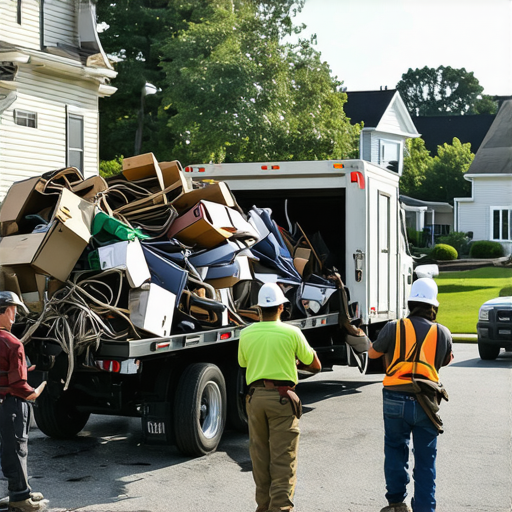

The structural reality of extreme clutter
Hoarder Clean Out Aurora operations require a deep understanding of structural load limits and material density. Professional teams must evaluate the pounds per square foot exerted on residential flooring to prevent catastrophic joist failure during the extraction process. Success depends on calculating the total volumetric weight before the first item moves.
I once cleared a house where the junk wasn’t just stuff. It was a structural hazard. We found the floor joists were bowing under the weight of 40 years of newspapers that had absorbed ten years of basement humidity. The air smelled of wet cellulose and stagnant history. Every step was a gamble. We had to shore up the basement with temporary jacks before we could even begin the extraction. This is the reality of waste management at the edge of physics. It is not just about lifting. It is about engineering a safe path for removal while respecting the physical limits of the architecture. A veteran hauler knows that 100 stacks of damp National Geographic magazines can exceed the load rating of a standard 1970s suburban floor. We look for signs of sagging, wall cracks, and door frames that no longer sit square. These are the red flags of a high density hoard.
Hidden toxins in the Fox Valley garage
Garage clean outs in Aurora frequently uncover hazardous materials that require specific legal disposal protocols under the Resource Conservation and Recovery Act. Professionals must identify lead acid batteries, pressurized cylinders, and volatile organic compounds before they enter the general waste stream. Identification is the first step in environmental protection.
The garage is often a graveyard for forgotten chemistry. We see it every day. A homeowner forgets about the half gallon of pool chlorine sitting next to a jug of ammonia. In the industry, we call that a localized disaster waiting to happen. During a standard garage clean out, my team performs a tier one hazmat sweep. We look for the telltale signs of corrosion on metal shelving. We check for leaking containers that have bonded to the concrete floor. If we find a 20 pound propane tank buried under a pile of scrap wood, we stop. We do not throw that into the back of a hydraulic packer. One spark from the metal ram hitting a steel tank can ignite the entire load. It happens fast. Your junk is a collection of chemical signatures that must be separated and neutralized according to Illinois state law and Kane County environmental ordinances.
“Waste is merely a resource in the wrong place; professional removal is the science of putting it back where it belongs.” – Disposal Industry Maxim
- Lithium ion batteries (Fire hazard)
- Lead acid car batteries (Toxic heavy metals)
- Full or partial propane cylinders (Explosion risk)
- Wet paint and chemical solvents (Leaching hazard)
- Biohazardous waste or medical sharps (Pathogen risk)
- Aerosol cans under pressure (Projectile risk)
Mathematical failures of the amateur hauler
Junk Removal Aurora services thrive on the efficiency of the load. Amateurs often fail to account for the air gap tax which is the wasted space in a truck that increases tipping fees and operational costs. Maximizing the cubic yard density is the difference between profit and a logistical loss.
The logistics of the truck are a game of high stakes Tetris. If you leave 30 percent air in your 15 yard dump truck, you are burning fuel and time for nothing. We call this cubing out. When we perform furniture removal, we do not just toss a sofa into the bed. We break it down or use it as a base for heavy, flat items like tabletops or disassembled shelving. Every cubic inch must be accounted for. We analyze the weight distribution over the rear axle to ensure the truck remains within the legal Gross Vehicle Weight Rating. A heavy load of concrete from a driveway tear out occupies very little space but can easily exceed the weight limit. Conversely, a load of old mattresses will fill the volume but weigh almost nothing. Balancing these two factors is how a master hauler operates. You need the right ratio of density to volume to stay efficient at the transfer station.
| Material Type | Estimated Density (lbs/cu yd) | Disposal Strategy |
|---|---|---|
| Mixed Household Junk | 250 to 300 | Standard Transfer Station |
| Construction Debris | 500 to 1000 | Heavy Load C&D Facility |
| Loose Yard Waste | 100 to 150 | Composting Site |
| Dense Paper/Books | 800 to 1200 | Recycling Center |
| Concrete/Brick | 2000 to 3000 | Inert Fill Site |
The logistical nightmare of a dead piano
Appliance removal and heavy instrument extraction involve center of gravity calculations and mechanical advantage tools. Professionals use specialized dollies and straps to prevent structural damage to the property and orthopedic injury to the crew. Gravity is a constant adversary in Aurora clean outs.
An old upright piano weighs between 500 and 800 pounds. It is top heavy and sits on tiny casters that will shred a hardwood floor in seconds. When we handle appliance removal, specifically old chest freezes or refrigerators, we are dealing with awkward dimensions and shifting weights. If a unit still contains a compressor, we must verify the Freon has been recovered by a certified technician. You cannot just cut the lines. That is a violation of the Clean Air Act. We use high friction moving blankets and multi point harness systems. We treat every heavy object like a potential wrecking ball. The momentum of an 800 pound object on a staircase is immense. You do not muscle it. You use leverage. You use physics. You use the mechanical advantage of a 4 to 1 pulley system if necessary. We have seen what happens when an amateur tries to move a cast iron bathtub alone. The floor loses every time.
“The Resource Conservation and Recovery Act (RCRA) creates the framework for the proper management of hazardous and non-hazardous solid waste.” – EPA Guidelines
Why Aurora residents miscalculate dumpster size
Dumpster Rentals Aurora customers frequently underestimate the expansion of loose debris once it is disturbed. Excavated junk can occupy 40 percent more volume than it did when it was packed in a basement or attic. This volumetric expansion leads to overfilled containers and safety violations.
People see a 10 yard dumpster and think it is huge. Then they start throwing in old furniture and it fills up in twenty minutes. This is due to the lack of compaction. When stuff is in your attic, it has been compressed by years of gravity and other items sitting on top. Once you move it, it expands. We call this the fluff factor. If you are doing a full Hoarder Clean Out Aurora project, you need to plan for at least 20 percent more volume than you think you have. Also, you must consider the local permit laws. Placing a 30 yard roll off on an Aurora street requires a specific permit and reflective marking to prevent traffic accidents. If you block a fire hydrant or a neighbor’s driveway, the city will shut your project down before the truck even leaves. We manage these logistics so the homeowner doesn’t have to deal with the Kane County court system over a trash pile.
Sensitivity training for the heavy lift professional
Hoarder Clean Out Aurora tasks are not just about physical labor; they require a psychological framework for debris management. Understanding the emotional attachment to items prevents conflict and ensures the project reaches completion without traumatic stoppages. Professionalism is measured in patience and technical skill.
Every piece of trash in a hoarding situation has a story attached to it. For the owner, a broken toaster is not junk. It is a memory of a Sunday morning from 1982. If a hauler walks in and starts calling things garbage, the client will shut down. The project fails. We train our teams to use neutral language. We do not say throw it away. We say we are transitioning this item to the recovery stream. We focus on the goal of a safe living environment. We use a triage system. Green items are keepers. Yellow items are for donation or further review. Red items are for disposal. We move slowly on the first day to build trust. By the second day, once the client sees the floor for the first time in a decade, the momentum shifts. The logistics of the mind are just as complex as the logistics of the truck. You cannot have one without the other in this business. We are heavy load specialists, but we are also environmental stewards and logistical navigators for people in crisis.