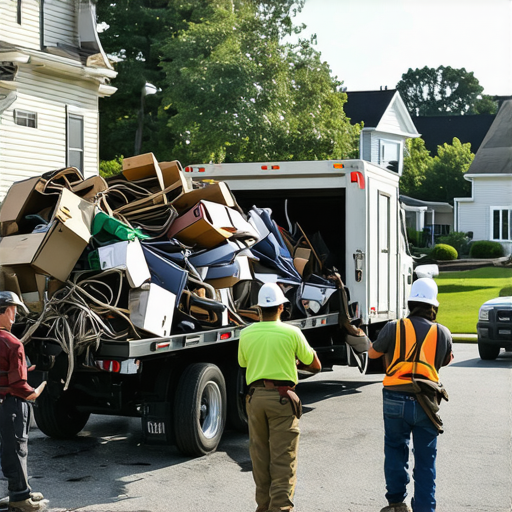

The anatomy of a hazardous cleanout
I once cleared a house where the junk wasn’t just stuff. It was a structural hazard. We found the floor joists were bowing under the weight of 40 years of newspapers that had absorbed ten years of basement humidity. The air smelled of wet cellulose and hydraulic fluid as we stabilized the floor with jacks before we could even start the haul. This is the reality of waste management at the extreme end. Every pound of material has a weight and a consequence. My lungs burned from the particulate matter as we began the systematic extraction of what used to be a living room but had become a biological and physical fortress. Junk removal is not just about lifting. It is about the logistics of mass, volume, and safety. Each cubic foot of wet paper weighs roughly 35 pounds. When you multiply that by a thousand, you realize the house is literally collapsing under its own weight.
Why your Aurora home became a structural liability
Hoarder Clean Out Aurora involves more than just trash removal. It requires engineering assessments to identify load-bearing debris and biological hazards. Professional teams mitigate risks of collapse and respiratory issues caused by particulate matter and stagnant air pockets that accumulate over decades of unchecked accumulation in confined spaces. We look at the load limits of the floor. We look at the ingress and egress points. In Aurora, the older homes near the Fox River often have narrow stairwells that were never meant to support the weight of industrial-scale debris removal. We have to calculate the pivot points for furniture removal and the structural integrity of the porch. If you ignore the physics, you break the house. That is the truth the curbside guys will never tell you. They just see a pile. I see a logistical puzzle where the wrong move causes a localized earthquake in your crawlspace.
“Waste is merely a resource in the wrong place; professional removal is the science of putting it back where it belongs.” – Disposal Industry Maxim
The physics of appliance removal and hazardous chemicals
Appliance removal requires specialized handling because of refrigerants like Freon and heavy metals in components. Professionals must manage the heavy lifting and the legal disposal of ozone-depleting substances to protect the local groundwater and soil in the Kane County area from permanent chemical contamination. An old refrigerator is a metal box of hazards. The compressor contains oil and refrigerant. If you tip it the wrong way, the oil migrates into the coils. If you puncture the line, you release gases that the EPA monitors with extreme scrutiny. We use appliance dollies with stair-climbing treads. We distribute the weight across the axle. A standard top-load washer weighs about 150 pounds, but an old cast-iron tub or a professional-grade range can exceed 400 pounds. You do not just lift that. You manage the momentum. One slip on a basement step and you are not just looking at a broken appliance, you are looking at a hole in your foundation or a broken leg.
The math behind the haul
We calculate disposal by volume and weight. The density of your junk determines the tipping fee at the transfer station. Here is how the costs break down when you compare different disposal methods for residential projects.
| Disposal Method | Cubic Yard Limit | Weight Sensitivity | Labor Included |
|---|---|---|---|
| Full Service Junk Removal | 15 to 20 Yards | High | Yes |
| 10-Yard Dumpster Rental | 10 Yards | Medium | No |
| 20-Yard Dumpster Rental | 20 Yards | Medium | No |
| Bag-Style Solutions | 3 Yards | Very Low | No |
While most people think recycling is always better, the carbon footprint of hauling low-grade plastics 500 miles often exceeds the impact of local, high-efficiency waste-to-energy incineration. We aim for high diversion rates, but we also respect the reality of the carbon cycle. If a material is too contaminated to be recovered, it must be disposed of in a lined landfill that captures methane. This is the heavy cost of keeping everything. Eventually, everything has a price, whether it is in dollars paid to a hauler or in the degradation of the environment from improper dumping.
Garage clean outs and the density of forgotten lives
Garage Clean outs are technical operations that involve separating hazardous automotive fluids from recyclable metals and general debris. This process restores functional space while ensuring that volatile chemicals like gasoline, oil, and old paints are transported according to strict hazmat safety protocols. Most people treat the garage as a graveyard for things that might be useful someday. I see it as a fire hazard. We find old cans of lacquer thinner sitting next to piles of dry cardboard. That is a flashpoint waiting for a spark. We sort everything on-site. The steel goes to the scrap yard. The chemicals go to a specialized facility. The rest is cubed out in the truck. Cubing out is the art of filling every empty inch of the truck bed. We do not leave air gaps. Air gaps are lost money. We stack the heavy stuff on the bottom and the light stuff on top. It is Tetris with higher stakes.
The heavy cost of keeping everything
Furniture Removal focuses on the logistical challenges of oversized items and the material recovery of wood and metal. Professionals navigate tight spaces and structural barriers to remove bulky items without damaging the home or risking personal injury to the occupants and the removal crew. Modern furniture is mostly particle board and glue. It has no structural integrity once it gets damp. It is basically compressed sawdust that expands and crumbles. Older furniture is heavy oak or maple. It lasts forever but it weighs a ton. We have to decide if we can take it out in one piece or if we need to disassemble it. Disassembly is often faster and safer. We use reciprocating saws to break down sofas that were built into basements. We do not struggle with the stairs if the math says the sofa is three inches wider than the door frame. We solve the problem with physics and force.
Why your cheap hauler is a legal time bomb
Junk Removal Aurora depends on licensed professionals who follow the Resource Conservation and Recovery Act guidelines for waste disposal. Using unlicensed haulers risks legal liability if your items are found illegally dumped in local parks or private property across the Aurora region. Your junk is your liability until it hits the scale at a licensed facility. If you hire a guy with a truck and he dumps your old water heater in a ditch, the city will find your address on a piece of mail in that pile. You will get the fine. We provide a manifest. We show you exactly where the waste went. We pay the tipping fees at the transfer station on Route 31. We follow the rules because the rules protect the watershed. The