
The basement that breathed
I once cleared a house where the junk wasn’t just ‘stuff.’ It was a structural hazard. We found the floor joists were bowing under the weight of 40 years of newspapers that had absorbed ten years of basement humidity. In Aurora, the Fox River valley air is heavy, and that moisture turns newsprint into a literal brick of solid cellulose. We measured the deflection in the beams at nearly three inches. The floor didn’t just creak. The floor groaned like a dying animal. Every step was a gamble with gravity. This is why professional Junk Removal Aurora teams do not just walk in with boxes. We walk in with structural levels and moisture meters. We are not just movers. We are forensic logisticians analyzing the decay of a domestic ecosystem.
Triage in the front foyer
Hoarder Clean Out aurora operations begin with a tactical assessment of the primary egress points and the load-bearing capacity of the immediate flooring. Hallways in older Aurora homes are often narrow, restricted by plaster-and-lath walls that cannot withstand the impact of heavy furniture removal. Before the first bag is filled, the team must identify ‘Load Level 1’ hazards which include unstable stacks over four feet high and biological contaminants. We establish a path of travel that is exactly 42 inches wide to accommodate a standard heavy-duty dolly. If the hallway is narrower, we pivot to a ‘manual relay’ system. The air quality is the first concern. We use industrial HEPA scrubbers to manage the particulate matter that rises the moment you disturb a decade of dust. This is the science of the sweep. You do not just pull items. You excavate them in layers to prevent a vertical collapse of the surrounding debris. We look for the ‘angle of repose’ in every pile. If a stack of magazines is leaning at more than 10 degrees, it is an active slide risk. Logistics dictates that we clear from the top down and the door inward. Any other way is a trap.
“Waste is merely a resource in the wrong place; professional removal is the science of putting it back where it belongs.” – Disposal Industry Maxim
The physics of the heavy lift
Furniture Removal in a hoarding situation is a study in material density and structural integrity. Most people see an old dresser. I see 200 pounds of particle board that has absorbed ambient moisture, effectively doubling its weight and halving its tensile strength. When we move these pieces through a cleared Aurora hallway, we are calculating the PSI of the floorboards. Older homes in the 60505 zip code often have original hardwood that has become brittle. We use 1/4 inch masonite sheets to create a ‘temporary road’ through the house. This distributes the weight of a 400-pound oak armoire across a larger surface area. It prevents the wheels of the dolly from punching through a soft spot in the subfloor. Appliance removal adds another layer of complexity. An old refrigerator is not just metal. It is a sealed system of pressurized refrigerants. If you tilt a vintage unit more than 45 degrees, you risk a compressor oil migration that can cause a leak. In Aurora, we follow strict EPA guidelines for Freon recovery. We do not just toss it. We manifest it. We track every BTU of potential energy and every gram of hazardous gas. This is not about ‘tossing’ junk. This is about managing a technical liability.
| Material Category | Cubic Yard Weight (lbs) | Aurora Disposal Difficulty | Recovery Potential |
|---|---|---|---|
| Mixed Paper/Newsprint | 400-600 | Medium (Moisture issues) | High (Pulp) |
| Demolition Debris | 1,200-1,500 | High (Weight limits) | Low (Landfill) |
| Upholstered Furniture | 200-300 | Low (Bulk issues) | Low (Incineration) |
| Electronic Waste | 150-250 | High (Legal mandates) | High (Metal) |
The math of the truck bed
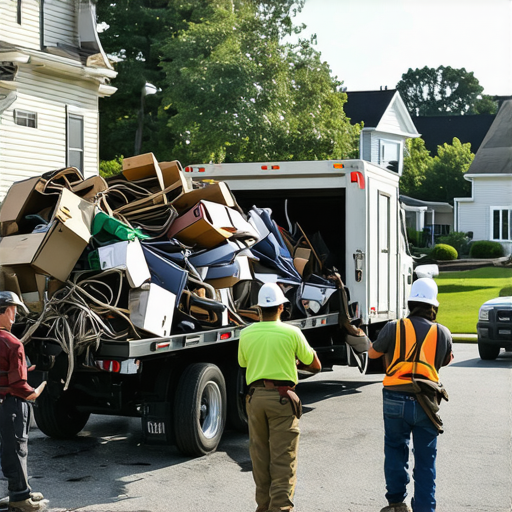
Junk Removal is a game of Tetris played with high stakes and expensive fuel. A 15-yard truck has a volume of 405 cubic feet. If my crew leaves even 10% air space in that load, we are losing money and increasing the carbon footprint of the haul. We ‘cube out’ the truck by breaking down furniture into flat planes. A couch is 80% air. We strip the cushions and stack the frames. Garage Clean outs present the best opportunity for high-density loading. Metal shelving, old bicycles, and garden tools are heavy but compact. We use the ‘heavy on bottom’ rule to keep the truck’s center of gravity low for the drive to the transfer station on Route 25. The tipping fees at the Aurora scale house are calculated by the ton, but my profit is calculated by the yard. If I bring in a truck that is half-full of air, I am failing the logistics of waste management. We use a hydraulic ram to compact the load on-site when possible, increasing our density by a factor of 2.1. This reduces the number of trips, which reduces the diesel consumption. It is a mathematical certainty that efficient loading saves the client money. Curbside cowboys do not understand density. They just see a pile. We see a puzzle that needs to be solved to the millimetre.
“The Resource Conservation and Recovery Act (RCRA) gives the EPA the authority to control hazardous waste from the ‘cradle-to-grave.’ This includes the generation, transportation, treatment, storage, and disposal of hazardous waste.” – Environmental Protection Agency Policy
Why cheap haulers leave you in court
Dumpster Rentals Aurora might seem like a cost-effective DIY solution, but for a hoarding situation, it is often a legal time bomb. When you rent a bin, you are the ‘Generator of Record.’ If a neighbor tosses a lead-acid battery or a gallon of old lacquer thinner into your bin and the driver takes it to the landfill, you are the one the EPA calls. I have seen homeowners fined thousands of dollars because their ‘cheap’ hauler dumped a load in a Kane County forest preserve. Your junk is your legal responsibility until it is officially processed at a licensed facility. We provide a full manifest of every load. We show exactly where the appliances went for decommissioning. We show the weight tickets from the transfer station. We protect the client from the ‘secondary liability’ of waste. A hoarding clean out often involves decades of accumulated chemicals. Old pesticides from the 1970s, now banned, are common in Aurora basements. These cannot go in a dumpster. They require a hazardous waste manifest and specialized handling. If you hire a guy with a pickup truck, he is going to hide those chemicals under a pile of old blankets. If he gets caught, the paper trail leads back to your front door. The law does not care that you didn’t know. The law cares about the chain of custody.
- Lead-Acid Automotive Batteries
- Unlabeled Pressurized Cylinders (Propane, Oxygen)
- Friable Asbestos Siding or Pipe Insulation
- Bio-medical Waste and Sharps
- Liquid Paint and Volatile Solvent Containers
- Radioactive Smoke Detectors
The end of the line for the hoard
The final stage of clearing the hallways is the ‘Deep Decontamination.’ In a hoarding environment, the walls and floors have been starved of airflow for years. This creates micro-climates where mold thrives. Once the bulk Junk Removal Aurora is complete, we address the ‘ghost’ of the hoard. This is the lingering odor and the microscopic spores. We use ozone generators and botanical disinfectants to stabilize the environment. A successful clean out is not when the house is empty. It is when the house is safe. We track our diversion rates for every project. Our goal is always 60% or higher. This means more than half of what we pull from an Aurora home stays out of the landfill. The wood is ground for mulch. The metal is melted for rebar. The paper is pulped for cardboard. This is how we fight the throwaway culture. We treat every item as a raw material that has simply lost its way. When the hallways are finally clear, the house breathes again. You can feel the change in the air pressure. The structural load is gone. The liability is neutralized. The logistics are complete. The trucks are washed. The hydraulic fluid is checked. We prepare for the next load. The cycle of waste management never stops. It only moves from one location to the next. We are the gatekeepers of the landfill, and we take our job with the gravity it deserves.