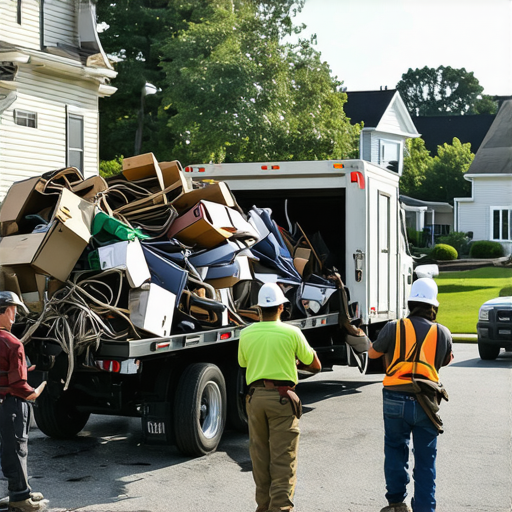

The legal trap of the cut-rate hauler
Furniture removal requires a firm understanding of liability and logistics to avoid environmental fines and property damage during the extraction process. Professional junk removal in Aurora involves more than just lifting; it necessitates a strategic breakdown of complex items like sectional sofas, wardrobes, and heavy entertainment centers to maximize truck space.
A business owner in Aurora tried to save 500 dollars by hiring a guy with a pickup truck from a social media ad. Two weeks later, the police called him because his company’s confidential files and several broken desks were found in a ditch near a local creek. Your junk is your liability until it hits the scale at a licensed transfer station. The smell of diesel and hydraulic fluid is the scent of accountability. When you see a truck cubing out, every inch of air space is a loss of profit. I have spent twenty five years watching people treat waste like it disappears once it leaves their sight. It does not. If your furniture ends up in a forest preserve, the city inspectors will find your mail or a serial number and come knocking. This is why we focus on the physics of the load. We strip the particle board down to its base components. We pull the staples. We ensure that every piece of a 2026-era modular sofa is flat-packed before it even touches the liftgate.
Tools for the structural breakdown
Effective furniture disassembly depends on a specific kit including impact drivers, hex keys, and pry bars designed for high-torque fasteners. Modern furniture often uses proprietary cam-lock systems that require precise pressure to release without shattering the fragile medium-density fiberboard, which creates a hazardous dust cloud if handled improperly.
You cannot walk into a furniture removal job with just a hammer. The modern toolkit for 2026 involves cordless impact drivers with a full range of Torx and Pozidriv bits. Many manufacturers have moved away from standard Phillips heads because they strip too easily under high-volume assembly. When we tackle a massive armoire in a third-floor apartment in Aurora, we start by removing all glass inserts. Glass is the enemy of the logistics manager. It breaks, it hides in the carpet, and it ruins tires. We use blue painter’s tape to cross the panes before removal to prevent shattering. Next, we address the back panels. These are usually stapled or tacked with 18-gauge brads. A thin-profile pry bar is necessary here. You want to save the structural integrity of the frame until it is staged for the truck. If you collapse the frame in the hallway, you have a logistical nightmare that blocks the exit. The weight of solid oak versus the brittleness of MDF determines our approach. We treat them differently. One is a heavy lift. The other is a crumbly mess that requires immediate bagging.
“Waste is merely a resource in the wrong place; professional removal is the science of putting it back where it belongs.” – Disposal Industry Maxim
The physics of the sectional sofa
Sectional sofas require the disconnection of heavy-duty steel brackets located at the base of each modular unit before any attempt at transport. Failure to decouple these points can result in structural failure of the wooden frame or severe strain on the operators due to the uneven weight distribution.
The sectional is the king of wasted truck space. Most amateurs try to carry the whole thing. We look for the gator clips. These are the steel teeth that hold the pieces together. Once those are unlatched, we flip the unit. We remove the feet. This sounds small but removing 4-inch feet from a three-piece sectional saves nearly half a cubic yard of space when you are stacking the truck. This is the math of the haul. In Aurora, tipping fees are calculated by weight or volume depending on the facility. If I can fit two more houses into one 15-yard dumpster because I removed the legs from every couch, I just doubled my efficiency. We also check the cushions for hidden hazards. People hide things in sofas. We have found lithium-ion batteries, which are a massive fire risk in the back of a compactor. One spark from a grinding metal frame and the whole load goes up in chemical flames. We inspect every fold.
Furniture disassembly and material recovery standards
Material recovery standards dictate that furniture should be stripped of its upholstery and foam to separate organic wood from synthetic polymers. This process increases the diversion rate at Aurora recycling centers and ensures that high-value materials like steel springs do not contaminate clean wood waste streams.
| Material Type | Disassembly Difficulty | Disposal Method | Recovery Value |
|---|---|---|---|
| Solid Oak/Maple | High | Reclamation | High |
| Particle Board (MDF) | Low | Landfill | Zero |
| Steel Bed Frames | Medium | Scrap Metal | Moderate |
| Upholstered Foam | Medium | Waste-to-Energy | Low |
While most people think recycling is always better, the carbon footprint of hauling low-grade plastics 500 miles often exceeds the impact of local, high-efficiency waste-to-energy incineration. We have to be honest about the chemistry. The glues in modern flat-pack furniture are loaded with formaldehyde. When you cut into them, you are aerosolizing those resins. We wear N95 masks not just for the dust but for the chemical off-gassing of broken furniture. The Aurora transfer stations have strict rules about what constitutes clean wood. If it is painted or treated, it goes into the general pile. If it is raw timber, we can divert it. This is why we disassemble. We want to separate the chrome legs from the plastic shells. We want the copper wiring from the power-reclining chairs. A power recliner is a 200-pound beast of electronics and heavy steel. You cannot just toss that. You have to harvest the motor first.
The heavy cost of keeping everything
Hoarding situations and garage clean outs in Aurora require a different logistical cadence involving systematic sorting and rapid volume reduction. Stagnant items in a basement absorb moisture over years, increasing their weight by up to thirty percent and compromising the structural safety of the removal path.
I once cleared a house where the junk wasn’t just stuff. It was a structural hazard. We found the floor joists were bowing under the weight of 40 years of newspapers that had absorbed ten years of basement humidity. The paper had turned into a solid, heavy block of cellulose. We had to use chainsaws to get it out. This is the reality of a hoarder clean out in Aurora. You aren’t just moving boxes. You are managing a collapsing environment. We use a staging area. Nothing goes into the truck until it is cataloged. We look for the red flags. Ammonia smells, damp floors, and pest infestations. When we handle a garage clean out, we are looking for the hazardous stuff people hide in the back. Old cans of oil, half-empty jugs of antifreeze, and the dreaded lead-acid batteries. These items cannot go into your dumpster rental. They require a hazmat manifest.
“The Resource Conservation and Recovery Act (RCRA) creates a framework for the proper management of hazardous and non-hazardous solid waste to protect human health and the environment.” – EPA Regulatory Summary
- Mercury-containing thermostats and old thermometers.
- Lithium-ion batteries from cordless tools or laptops.
- Aerosol cans that are not completely empty.
- Fluorescent light tubes containing mercury vapor.
- Propane tanks and pressurized cylinders.
- Wet paint, solvents, and industrial adhesives.
Aurora disposal regulations and transfer station protocols
Local ordinances in Aurora require all furniture haulers to secure their loads with heavy-duty tarps and industrial-grade tie-downs to prevent road debris. Compliance with the local transfer station’s peak-hour schedule is mandatory to avoid additional idling fees and to ensure efficient processing of bulky items.
The narrow streets in some older Aurora neighborhoods mean a 20-yard dumpster is a permit nightmare. You often need a live-load truck where we park, load, and leave within an hour. This puts the pressure on the disassembly crew. We have to be fast. We use the two-man carry for everything over 50 pounds. We use appliance dollies with straps for the heavy dressers. If we are doing an appliance removal, we check the coolant lines. Old refrigerators have Freon. You cannot just cut the line. That is a federal violation. We have to recover the refrigerant. This is the difference between a professional crew and a couple of kids with a truck. We know the law. We know the tipping fees at the Orchard Hill Landfill and the local transfer stations. We calculate the turn-around time. Every minute the truck sits in traffic is a minute it is not making money. We optimize the route to avoid the schools during drop-off hours. We know the city like the back of our grease-stained hands.
The ghost in the garage
Garage clean outs often reveal items that have been forgotten for decades, requiring a specialized approach to identify potential antiques versus actual refuse. Professional junk removal teams must distinguish between high-value scrap metal and low-grade domestic waste to provide accurate pricing and maximize recycling potential.
The garage is where the heavy items go to die. We find cast iron radiators, old engine blocks, and stacks of tires. Tires are a problem. Most landfills will not take them unless they are shredded. We have a specific partner for tire recycling. When we see a garage full of junk, we see a puzzle. We start from the front and work back. We clear a path. We use high-visibility tape to mark structural hazards. If the garage door spring is rusted, we do not touch it. Those things are killers. They are under thousands of pounds of tension. We focus on the furniture. The old workbench that is bolted to the wall. The shelving units that are rusted together. We use penetrating oil on the bolts. We wait ten minutes. Then we use the impact driver. The floor snapped once under a heavy safe we were moving. We had to bridge the gap with steel plates. That is the kind of problem solving you only get after twenty years in the dirt. We do not just haul. We engineer the exit. Every item has a destination. Some go to the scrap yard. Some go to the donation center. Most go to the scale. But everything is handled with the same logistical precision. We cube the truck. We tarp the load. We move to the next site. That is the job. That is the science of junk removal in 2026. No wasted moves. No wasted space. No legal risks.
Reading this detailed overview really underscores how critical proper disassembly and handling are in furniture removal—especially in a busy city like Aurora with strict regulations. I’ve often found that rushing through the process to save time or money can lead to costly legal issues or hazardous mishaps down the line. For example, I once saw a rental property where someone had just dumped old furniture in a back alley, which not only caused environmental concerns but also brought fines when it was discovered. It made me think about how important proper planning and understanding local disposal laws are for avoiding such problems. Do others in the community have suggestions on how to streamline disassembly without sacrificing safety or compliance? I’d love to hear tips on managing difficult pieces or handling hazardous materials in residential cleanouts.