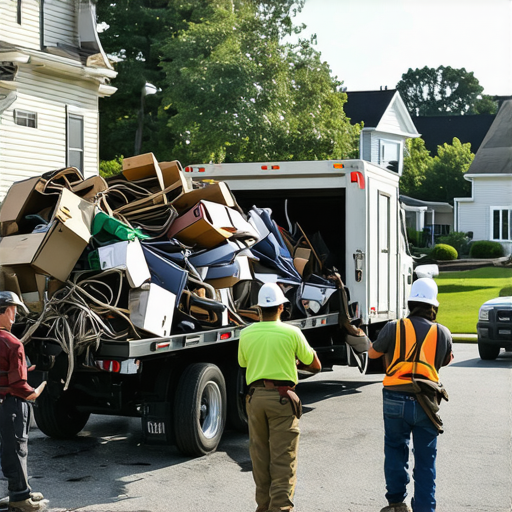

The hidden logistics of Aurora furniture disposal and local recycling strategies
A business owner in the Fox Valley area once tried to save five hundred dollars by hiring a guy with a beat-up pickup truck he found on a social media marketplace. Two weeks later, the Aurora Police Department called him because his company’s confidential files and several old office chairs were found scattered in a drainage ditch near Eola Road. Your junk remains your legal liability until it hits the scale at a certified transfer station or is signed for by a legitimate non-profit. This is the reality of waste management in Kane County. When you look at a sofa, you see a piece of decor. I see thirty pounds of chemically treated foam, twelve pounds of seasoned hardwood, and five pounds of high-tensile steel springs that will destroy a hydraulic ram if not compressed correctly. Junk removal Aurora services are not just about lifting heavy objects. It is a science of volume, weight distribution, and environmental stewardship.
The phantom of the curbside and the risk of illegal hauling
Furniture removal in Aurora requires a deep understanding of local ordinances and the true cost of disposal per cubic yard. Many residents assume that placing an old recliner on the curb is the end of their responsibility. However, Aurora municipal codes and Kane County environmental regulations dictate specific protocols for bulky items. If a non-permitted hauler dumps your items illegally, the paper trail leads back to your front door. Professional junk removal Aurora teams operate with high-value insurance policies because the physics of moving a three-hundred-pound armoire down a narrow staircase in a historic Near East Side home involves significant structural risk. We calculate the load-bearing capacity of the stairs and the pivot point of the furniture to avoid drywall damage. It is a tactical operation every single time.
“Waste is merely a resource in the wrong place; professional removal is the science of putting it back where it belongs.” – Disposal Industry Maxim
Strategic donation hubs for quality local decor
Donating old decor in Aurora preserves landfill space and supports local community initiatives through the circular economy. Not every item belongs in a dumpster. Aurora offers several high-capacity donation centers that specialize in furniture recovery. The Habitat for Humanity ReStore on Route 59 is a primary destination for building materials and high-quality furniture. They require items to be in good structural condition because the cost of repairing particle board often exceeds its resale value. Wayside Cross Ministries is another pillar of the community that accepts furniture to support their recovery programs. When you choose donation over disposal, you are effectively diverting hundreds of pounds of solid waste from the Orchard Hills Landfill. This reduces the methane production caused by decomposing organic materials in anaerobic environments.
The mathematical realities of a fifteen yard bin
Dumpster rentals Aurora pricing depends on the density of the material and the specific tipping fees at regional transfer stations. When we talk about dumpster rentals Aurora residents must understand the concept of cubing out a load. A fifteen-yard dumpster can hold roughly four to five pickup truck loads, but the weight limit is the true constraint. A load of heavy construction debris from a garage clean out will hit the weight limit long before the volume is filled. Conversely, furniture is bulky and filled with dead air. Our job is to break down items to maximize every square inch of the container. We remove legs from tables and dismantle sectional sofas to ensure you are not paying to haul oxygen. The logistical efficiency of a load determines the profit margin and the environmental impact of the trip.
| Material Type | Decomposition Time | Recyclability Potential |
|---|---|---|
| Solid Oak Wood | 10 to 15 Years | High (Reclamation) |
| High-Density Foam | 50 to 100 Years | Low (Energy Recovery) |
| Steel Springs | 20 to 50 Years | 100% (Scrap Metal) |
| Particle Board | 20 to 30 Years | Zero (Contains Glues) |
Structural integrity and the heavy piano problem
Appliance removal and heavy furniture extraction require specialized equipment like shoulder dollies and stair-climbing hand trucks. The average upright piano weighs between four hundred and nine hundred pounds. This is not a task for a weekend warrior with a dolly from a big-box store. The center of gravity is deceptively high, and the internal cast-iron plate is under thousands of pounds of tension. If the frame cracks during a clumsy move, it can be a safety nightmare. We treat these items as high-risk logistical units. Similarly, appliance removal involves managing refrigerants and heavy compressors. Old refrigerators contain CFCs or HCFCs that must be recovered according to EPA Section 608 protocols. You cannot simply toss a 1990s freezer into a landfill without risking a massive fine for the venting of ozone-depleting substances.
The hazardous inventory within the drywall
Garage clean outs often reveal legacy toxins like lead-acid batteries and old pesticides that require specialized hazmat handling. During a standard garage clean out, we often find what I call the chemical graveyard. Residents tuck away old paint cans, car batteries, and jugs of RoundUp in the dark corners behind the lawnmower. These items are strictly regulated under the Resource Conservation and Recovery Act. You cannot mix these with general municipal solid waste. If a lithium-ion battery from an old cordless drill gets crushed in the back of a packer truck, it can trigger a thermal runaway fire that consumes the entire vehicle in minutes. We inspect every pile for these hidden dangers. We do not just lift, we audit.
- Lead-acid automotive batteries
- Propane tanks and pressurized cylinders
- Liquid oil-based paints and thinners
- Industrial grade pesticides and herbicides
- Biohazardous materials or medical waste
- Large quantities of specialized electronics (E-waste)
The heavy cost of keeping everything
Hoarder clean out Aurora projects are complex logistical puzzles that involve biohazard mitigation and massive volume management. A hoarder clean out Aurora scenario is a different beast entirely. We are not just moving furniture, we are managing decades of accumulated mass that has often reached a state of structural compaction. The bottom layers of a hoarding pile often show signs of moisture absorption and fungal growth. This changes the weight of the material significantly. Wet paper is three times heavier than dry paper. We have to calculate the total tonnage to ensure the floor joists of the Aurora home do not fail during the extraction process. It is a grueling, tactical operation that requires respirators and heavy-duty PPE to protect against particulate matter and allergens.
“Landfills are not bottomless pits but finite topographical features that require precise engineering to manage.” – SWANA Technical Report
Why your cheap hauler is a legal time bomb
Junk removal Aurora professionals provide a chain of custody that protects the homeowner from environmental litigation. When you hire a professional, you are paying for the peace of mind that your old dishwasher or sofa is being handled according to Illinois EPA standards. The cheaper alternative often involves someone who skips the transfer station fees and dumps the load in a rural Kane County field. If the local authorities find a piece of mail with your address on it in that pile, you are the one receiving the summons. Our trucks are weighed at the gate and weighed at the exit. We have the manifests to prove where every ounce of your waste went. In the world of waste management, documentation is just as important as the physical labor of the haul.
Deciphering the Kane County tipping fee
Local disposal costs in Aurora are driven by the regional scarcity of landfill space and the rising costs of diesel fuel. Tipping fees at local facilities like the Veolia Orchard Hills Landfill fluctuate based on market demand and regulatory changes. When we calculate a quote for a garage clean out, we are looking at the projected weight and the time it takes to navigate the traffic on Orchard Road or Route 31. We also account for the labor required to sort materials on-site. While some people think recycling is always better, the carbon footprint of hauling low-grade plastics five hundred miles often exceeds the impact of local waste-to-energy incineration. We make those calls based on current market data and environmental impact studies to provide the most efficient disposal path possible. This is the difference between a guy with a truck and a waste management strategist.