The dangerous chemistry of Aurora paint disposal
Eco-friendly waste disposal at Aurora paint recycling centers requires a strict understanding of chemical stabilization and material recovery protocols. Professional haulers must separate latex and oil-based resins to prevent groundwater contamination. Aurora residents should utilize authorized collection points to ensure hazardous volatile organic compounds are neutralized or repurposed into secondary fuels.
I watched a rookie almost lose his eyebrows because a customer hid a half-full propane tank inside a pile of ‘harmless’ yard waste. We don’t just lift. We inspect. Every. Single. Item. This happened right off Montgomery Road here in Aurora. The scent of pressurized gas hitting the summer air is a smell you never forget. It marks the difference between a professional junk removal crew and a kid with a trailer. This industry is built on the physics of weight and the chemistry of hazard. When you talk about paint recycling in Kane County, you are talking about managing liquid liabilities. Latex paint is not technically a hazardous waste once solidified, but oil-based stains and alkyd paints are a different beast. They are flammable. They are toxic. They require a manifest under the Resource Conservation and Recovery Act (RCRA) guidelines if they originate from a commercial source. In a residential setting, they represent a fire risk to the truck and the transfer station. The logistics of moving fifty cans of half-full paint involves more than just a strong back. It involves understanding the specific gravity of the liquid and the integrity of the seals. We cube out our trucks based on volume, but liquid weight can quickly put a 15-yard vehicle over its gross vehicle weight rating (GVWR). If that happens, the brakes can fail on the steep inclines near the Fox River. This is the reality of the load. We see every garage clean out as a puzzle of density and danger. You look at a pile of old paint cans. I see four hundred pounds of liquid mass that can shift during a hard turn. That shift causes kinetic energy transfer that can flip a poorly loaded trailer. We treat every gallon with the respect it demands. We ensure it reaches the proper Aurora processing facility where the resins can be filtered and the pigments repurposed.
“Waste is merely a resource in the wrong place; professional removal is the science of putting it back where it belongs.” – Disposal Industry Maxim
Why your garage is a logistical bottleneck
Garage clean outs in Aurora involve managing high-density material clusters that often exceed the structural load limits of residential concrete. Professional removal services focus on vertical stacking and material segregation to optimize truck space. Effective clearing requires identifying recyclables, hazardous chemicals, and bulky items to minimize tipping fees and landfill impact.
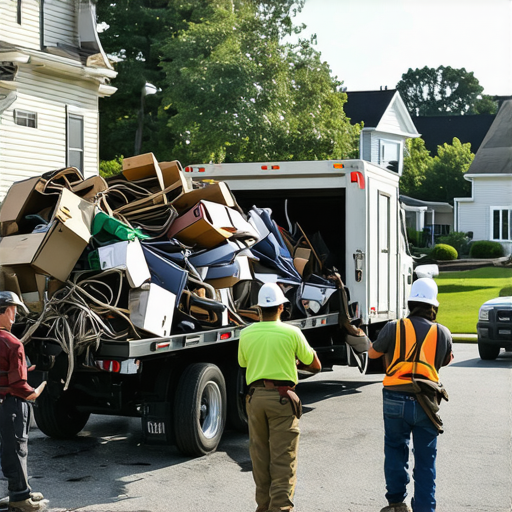
A garage is rarely just a place for cars. It is the graveyard of failed hobbies and unfinished renovations. When we handle junk removal Aurora calls for, the garage is usually the primary theater of operations. We start with the floor. We look for signs of hydraulic fluid leaks or old lead-acid batteries. If a battery has been sitting on concrete for five years, there is likely a bloom of lead sulfate underneath it. That is not just dust. It is a health hazard. We use the tetris method for loading. Heavy items like old weight benches or scrap iron go on the bottom to lower the center of gravity. Lighter items like cardboard and plastic bins go on top. We hate wasted air. If I see a truck driving through Aurora with gaps in the load, I see a manager who does not understand profit margins. Every cubic inch of that truck costs diesel and man-hours. We pack it tight. We use heavy-duty moving blankets for furniture removal to ensure we do not gouge the customer’s walls, even if the item is headed for the scrap heap. Professionalism does not end until the item is off the property. The psychology of a garage is a data overflow error. People stop seeing the clutter. They just see a wall of gray. We break that wall down. We categorize. We haul. The local Aurora transfer stations have strict rules about what can be mixed. If we bring a load of clean wood mixed with treated lumber, the tipping fee triples. We save the customer money by being obsessed with the details of the sorting process. [image_placeholder_1]
The heavy lifting of Aurora appliance extraction
Appliance removal in Aurora involves the extraction of heavy-gauge metals and the recovery of pressurized refrigerants like R-134a or R-600a. Federal law mandates that CFCs and HCFCs are captured before disposal to prevent ozone depletion. Professional haulers use specialized equipment to navigate narrow basements and protect the structural integrity of the home.
Taking a 1980s chest freezer out of a basement is an exercise in structural engineering. Those units were built with heavy steel and dense insulation. They often weigh over three hundred pounds. If you do not know where the center of gravity is, you will lose a finger or a floor joist. We use appliance dollies with stair-climbing tracks. This is not just about strength. It is about leverage. The refrigerants inside these old units are the real concern. If a curbside cowboy just cuts the lines to save weight, they are committing a federal offense. We recover the gas. We extract the copper coils. We recycle the steel. This is the circular economy in action. In Aurora, the municipal bulky item pickup often has limits on units with compressors. That is where we come in. We handle the units that the city leaves behind. We know the exact BTU potential of the recycled metals. We understand the scrap market fluctuations. When the price of copper drops, the illegal dumping of refrigerators increases. It is a disgusting cycle. We maintain our integrity by ensuring every appliance goes to a licensed processor. This is the back door logistics of the junk world. It is dirty, it is heavy, and it is necessary for the health of our local environment. We do not just toss things. We dismantle with purpose. We treat every appliance as a collection of raw materials that need to be returned to the supply chain.
| Material Type | Decomposition Time | Recycling Potential | Aurora Disposal Difficulty |
|---|---|---|---|
| Latex Paint | 10-15 Years | High (Reprocessed) | Medium |
| Steel Appliances | 50-100 Years | 100% (Infinite) | Low (Pro Handling) |
| Treated Lumber | 20-30 Years | Zero (Toxic Ash) | High |
| Polyurethane Foam | 500+ Years | Very Low | Medium |
| Lithium Batteries | 1000+ Years | High (Critical) | Extremely High |
Navigating the legalities of dumpster rentals in Illinois
Dumpster rentals in Aurora require adherence to local zoning permits and strict weight-limit protocols for street placement. Overloading a container can lead to pavement damage and safety violations during transport. Renters must avoid prohibited materials like hazardous waste and electronics to comply with Illinois environmental protection standards and avoid significant fines.
A business owner once tried to save five hundred dollars by hiring a guy with a pickup truck from a social media ad. Two weeks later, the police called him because his company’s confidential files were found in a ditch. Your junk is your liability until it hits the scale. This is why professional dumpster rentals Aurora residents trust are essential. When we drop a 20-yard bin on a driveway, we use wooden planks to protect the asphalt. The heat in Illinois summers makes residential driveways soft. Without protection, a full bin will sink three inches into the ground. That is a permanent scar on the property. We also have to be the bad guys sometimes. We have to tell people no. You cannot put tires in the dumpster. You cannot put wet paint in the dumpster. You cannot put mattresses in some containers without a surcharge. The landfill charges us per ton. If a customer hides concrete under a layer of household trash, the weight of the truck can spike to 40,000 pounds. That is a massive fine at the weigh station. It also puts the driver at risk. We educate our clients. We tell them that the air space in the bin is not the only limit. The weight is the invisible wall. We monitor the load. We use GPS to track the bin. We ensure that every piece of waste is accounted for. This is the science of disposal. It is not just about throwing things away. It is about the chain of custody. When you rent from a professional, you are buying a legal shield. You are ensuring that your waste does not end up in a local creek or a forbidden field.
- Lead-acid and Lithium-ion batteries (Fire Hazard)
- Unsolidified oil-based paints and thinners
- Propane tanks and pressurized canisters
- Fluorescent light tubes containing mercury
- Biohazardous materials or medical waste
- Industrial solvents and degreasers
Structural integrity during heavy furniture removal
Furniture removal in Aurora demands precise physical coordination to prevent damage to residential drywall and flooring systems. Large sectional sofas and solid oak armoires often require partial disassembly to pass through standard door frames. Professionals prioritize weight distribution and path clearing to ensure a safe exit from the property without compromising the building’s interior.
Modern furniture is often a logistical nightmare. It is made of medium-density fiberboard (MDF) that breaks if you look at it wrong. It is heavy but fragile. Old furniture is different. It is solid oak or maple. It is heavy and stubborn. When we handle a hoarder clean out Aurora homes often require, the furniture is the biggest obstacle. It is often buried under layers of paper and cloth. We have to excavate. We check the structural integrity of the stairs before we move a 400-pound dresser down them. If the wood is soft from humidity, we do not risk it. We use straps. We use ramps. We use our heads. We see furniture as a volume problem. A couch takes up a lot of space but doesn’t weigh much relative to its size. We call this a low-density item. To make the load efficient, we have to break it down or stack it vertically. We use the empty space inside a wardrobe to store smaller boxes. This is how you win the Tetris game of the truck. While most people think recycling is always better, the carbon footprint of hauling low-grade plastics 500 miles often exceeds the impact of local, high-efficiency waste-to-energy incineration. We look at the data. We decide the best path for every item. Sometimes that is the thrift store. Sometimes that is the scrap yard. Sometimes it is the waste-to-energy plant. We are the filters of the community. We decide where the physical history of a family goes. It is a heavy responsibility. We don’t take it lightly. We move the past so the customer can have a future in their space.
“The Resource Conservation and Recovery Act (RCRA) is our roadmap for protecting the environment from the unintended consequences of modern convenience.” – Waste Management Protocol
The hidden environmental cost of hoarder situations
Hoarder clean outs in Aurora present unique biohazard risks and complex waste streams that require professional intervention. These projects involve sorting through massive quantities of contaminated materials to recover salvageable items while neutralizing safety threats like mold or pests. Logistical planning is essential to manage the high volume of debris and minimize the ecological footprint of the cleanup.
I once cleared a house where the junk wasn’t just stuff. It was a structural hazard. We found the floor joists were bowing under the weight of 40 years of newspapers that had absorbed ten years of basement humidity. The weight was astronomical. Every stack of paper was like a block of concrete. In Aurora, the older homes near the downtown area are prone to this. The basements are damp. The paper rots. The air becomes toxic. We wear respirators. We wear Tyvek suits. This is not just junk removal. This is a recovery operation. We look for the backdoor logistics of the site. We find the easiest path to the truck. We clear a staging area. We do not just start grabbing. We sort at the source. This prevents cross-contamination. If we find a leaking bottle of ammonia, we stop. We neutralize. We proceed. The environmental cost of a hoarding situation is high. The soil around the house can be contaminated if chemicals have leaked through the foundation. We are the first line of defense. We remove the threat. We ensure the materials are disposed of according to Kane County health regulations. The bottom line is this. Your waste is a reflection of your life, but it doesn’t have to be a burden on the earth. By choosing a professional who understands the science of the truck and the chemistry of the landfill, you are doing your part. We keep Aurora clean, one cubic yard at a time. We are the heavy lifters. We are the waste strategists. We are the end of the line for the things you no longer need.