
Why Aurora residents risk fines for hidden hazards
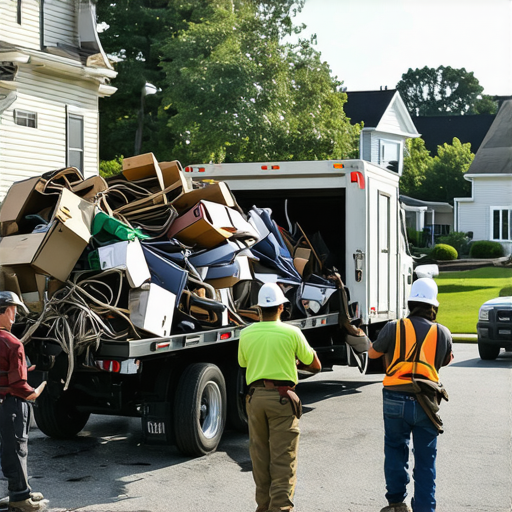
Eco-friendly waste disposal in Aurora requires strict adherence to Kane and DuPage county regulations regarding hazardous materials like lithium batteries, paints, and pressurized tanks. Failure to identify these items before a Junk Removal team arrives can lead to rejected loads, heavy municipal fines, or dangerous chemical reactions inside the truck hopper. Understanding the chemistry of your waste is the first step toward environmental stewardship. [IMAGE_PLACEHOLDER]
I watched a rookie almost lose his eyebrows because a customer hid a half-full propane tank inside a pile of ‘harmless’ yard waste. We don’t just lift. We inspect. Every. Single. Item. That day on a residential street in Aurora, the hydraulic ram was inches away from crushing that tank. If it had ruptured, the spark from the metal friction would have turned that 15-yard dump truck into a bomb. This is why we preach about load integrity. Professional Junk Removal Aurora isn’t just about brawn. It is about hazardous material identification. Most people see an old garage as a weekend project. I see it as a collection of volatile organic compounds, unstable structural loads, and biological hazards. When you call for Garage Clean outs, you are hiring a waste strategist to navigate the complex world of post-consumer disposal.
The physics of the load and cubing out the truck
Load density and volumetric efficiency determine the carbon footprint and cost of every junk removal job performed in the Fox Valley area. Maximizing the space in a 15-yard or 20-yard container, known as cubing out, ensures fewer trips to the transfer station on Sullivan Road and lower fuel consumption. Proper stacking prevents air pockets that waste your money and increase emissions. The math is simple. A truck that is 70 percent full but poorly packed requires the same diesel to move as a truck packed at 100 percent efficiency. We look at the geometry of your old dresser. We see the void spaces inside the drawers. We see the gaps between the legs. Every cubic inch of air is a failure in logistics. Furniture Removal is a game of Tetris where the stakes are your budget and the planet’s health. We break down particle board because it is low-density fluff. We preserve solid oak because it has salvage value. This is the gristle of the industry.
“Waste is merely a resource in the wrong place; professional removal is the science of putting it back where it belongs.” – Disposal Industry Maxim
Hazardous waste versus general debris in Aurora homes
Distinguishing between municipal solid waste and household hazardous waste is the primary legal obligation for every homeowner during a clean out. Items like mercury thermostats, lead-acid batteries, and old pesticides cannot enter the general waste stream at the Orchard Hills Landfill. These materials require specialized handling at designated collection sites to prevent leachate from contaminating local groundwater. The Resource Conservation and Recovery Act (RCRA) sets the baseline, but local Aurora ordinances are even tighter. If you toss a gallon of old pool chemicals into a Dumpster Rentals Aurora bin, you are creating a toxic soup. When rain hits that bin, those chemicals leach out. They hit the pavement. They enter the storm drains. They end up in the Fox River. Your junk is your liability until it hits the scale and is signed for by a licensed facility.
| Material Type | Decomposition Time | Disposal Difficulty |
|---|---|---|
| Treated Lumber | 20+ Years | High (Arsenic/Chromium) |
| Steel Appliances | 50+ Years | Low (Recyclable) |
| Drywall (Gypsum) | 10-15 Years | Moderate (H2S Gas) |
| Latex Paint | N/A | High (Requires Solidification) |
| Corrugated Cardboard | 2-3 Months | Very Low (Revenue Stream) |
The heavy cost of appliance removal and Freon recovery
Safe appliance removal in Aurora involves the certified recovery of refrigerants like R-12 or R-134a to prevent ozone depletion and atmospheric warming. Federal law under Section 608 of the Clean Air Act mandates that only licensed technicians can cut coolant lines. Simply dumping an old fridge in a ditch is a federal offense. The compressors in these units contain oil that is often laced with PCBs if the unit is old enough. We look at the data plate. We check the manufacture date. If that fridge was born before 1979, we handle it like a biohazard. Appliance removal is not just about moving weight. It is about chemical containment. We use recovery pumps. We seal the lines. We ensure the scrap metal is clean before it hits the shredder. This is how we protect the Aurora ecosystem while clearing your basement.
Furniture removal and the death of solid wood
Modern furniture removal has become a logistical nightmare due to the prevalence of low-grade medium-density fiberboard which lacks structural integrity for second-hand markets. Old growth oak or maple furniture can be diverted to refurbishers, but the modern ‘flat-pack’ items are essentially glue and sawdust destined for the landfill. This shift has changed the tipping fees for Furniture Removal. We used to find value in the wood. Now, we find weight and bulk. Particle board absorbs moisture like a sponge. If your garage has a leak, that cheap bookshelf now weighs twice as much as it did when you bought it. It becomes a breeding ground for mold. We wear respirators for a reason. We see the spores. We see the structural decay. We don’t just carry it out. We mitigate the risk.
- Wet Paint (unless solidified with cat litter or sawdust)
- Large Propane Tanks (must be empty and valves removed)
- Asbestos-containing insulation or floor tiles
- Automotive fluids like motor oil or transmission fluid
- Industrial chemicals and unknown powders
- Biohazardous waste or medical sharps
- Ammunition and explosives
“Proper management of household hazardous waste is not an option; it is a necessity for the protection of human health and the environment.” – EPA Waste Management Bulletin
Hoarder clean out strategies in older Aurora builds
A hoarder clean out in Aurora requires a forensic approach to waste management to deal with stratified layers of debris and potential structural collapses. In older neighborhoods near downtown Aurora, the floor joists were not designed to hold 50,000 pounds of saturated newspapers and magazines. We have seen floors sagging four inches in the center. This is a physics problem. We start at the top. We clear paths. We assess the load-bearing walls. Hoarder Clean Out aurora is a specialized operation. We deal with the ‘data overflow’ of a life. We sort through the detritus to find the hazardous needles in the haystack. We find the hidden cleaning supplies that have leaked and eaten through the floorboards. We find the rodent infestations that turn a simple junk haul into a hazmat situation. We treat every item as a potential hazard until proven otherwise.
The environmental impact of local dumpster rentals
Optimizing dumpster rentals in Aurora involves choosing the right size to prevent overweight surcharges and ensure that the debris can be processed at a sorting facility. A 10-yard dumpster filled with concrete will exceed the lifting capacity of most roll-off trucks. You need to understand the density. Concrete is roughly 4,000 pounds per cubic yard. A 10-yard bin of concrete weighs 40,000 pounds. Most trucks max out at 20,000 to 26,000 pounds of payload. You ‘weight out’ before you ‘cube out.’ If you overfill, the driver legally cannot haul it. The debris falls on the highway. It breaks windshields. It causes accidents. We guide Aurora residents on the math. We ask what is going in. We calculate the tare weight. We ensure the Dumpster Rentals Aurora experience is seamless and safe. This is the science of the haul.
This post really highlights the complexity and responsibility involved in proper waste management, especially for hazardous materials. I was particularly struck by the example of the propane tank—it’s a common oversight but could have serious consequences if overlooked. From my experience volunteering at a recycling center, I’ve seen how even small quantities of chemicals like latex paint or old pesticides can cause issues if they aren’t handled correctly. It makes me wonder, how do Aurora residents typically get educated about these hazards, especially those who are doing quick clean-outs or yard projects? Perhaps more community workshops or clear labeling on disposal centers could help reduce accidental mishandling. The emphasis on load safety and chemical containment really underscores the importance of trained professionals rather than just a general hauling service. Have others encountered similar hazards during home renovations or cleanouts, and what precautions do you recommend to ensure safety while also adhering to regulations?