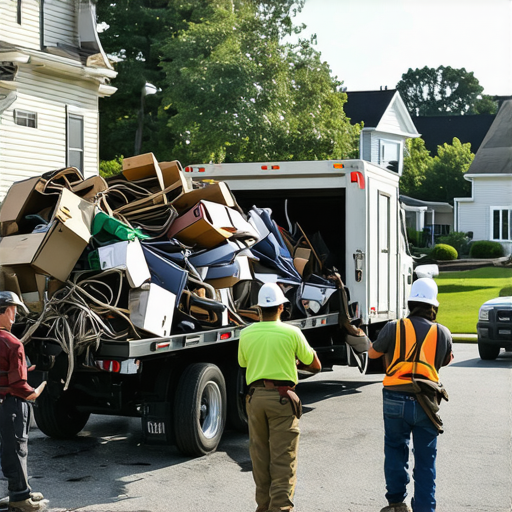

The shadow economy of illegal hauling
A business owner tried to save five hundred dollars by hiring a guy with a pickup truck from a social media ad. Two weeks later, the police called him because his company’s confidential files and broken office furniture were found in a drainage ditch. Your junk is your liability until it hits the scale at a certified transfer station. Junk removal Aurora operations demand more than just a truck and a strong back. It requires a legal chain of custody. When you hire for furniture removal or appliance removal, you are paying for the peace of mind that your old sofa or refrigerator will not end up blocking a local waterway. I have spent twenty five years watching these curbside cowboys undercut legitimate businesses only to leave the homeowner holding the bag for environmental cleanup fines. The logistics of waste are cold and unforgiving. If a price seems too low, it is because the disposal fee is being bypassed through illegal means. In Aurora, the cost of tipping at a regional landfill is fixed. Fuel prices are constant. Labor has a floor. Any quote that defies these mathematical realities is a red flag for future legal trouble. Your waste contains your identity and your environmental footprint.
The true burden of organic waste diversion
Eco-friendly waste disposal in Aurora involves a technical understanding of carbon to nitrogen ratios and the chemical breakdown of cellulose based debris. Aurora composting for junk specifically targets organic materials like untreated wood, yard waste, and certain paper products that otherwise take up valuable airspace in landfills. When we talk about garage clean outs, people assume everything is trash. A specialist sees the raw material. We look at the dry weight of the debris. We calculate the volume in cubic yards. A standard twelve foot by eight foot truck bed filled four feet high is exactly fourteen point two cubic yards. If that load is purely organic, it can be diverted to a composting facility where it transforms into a soil amendment. If it is contaminated with plastics or treated wood, it is destined for the landfill. The diversion rate is the only metric that matters in modern waste management. We strive for a sixty percent diversion rate on every residential haul. This reduces the methane production caused by anaerobic decomposition in the landfill environment. The physics of a compost pile require specific heat thresholds to kill pathogens. This is not just a pile of dirt. It is a biological reactor.
| Material Category | Decomposition Time | Diversion Potential |
|---|---|---|
| Untreated Lumber | 10 to 15 Years | High (Mulch) |
| Polyurethane Foam | 100 Plus Years | Zero (Landfill) |
| Ferrous Metals | 50 Years | Total (Scrap) |
| Gypsum Board | Unknown | Moderate |
The geometry of a fifteen yard dumpster
Dumpster rentals Aurora services rely on the principle of volumetric efficiency to ensure that customers do not pay for hauling air. Junk removal is a game of Tetris played with heavy, awkward objects. If you toss a treadmill on top of a pile of loose boxes, you create massive voids. Those voids represent wasted money. We teach our crews to break down every box and stack flat items like tabletops or drywall sheets against the walls of the container. Junk removal Aurora projects often fail because the user does not understand the weight limits of the hydraulic lifts on the truck. A twenty yard bin filled with wet sod or concrete will exceed the legal road weight limits. This leads to dry runs and extra fees. You must balance the density. Heavy materials like masonry go on the bottom. Light, bulky items like insulation or plastic toys go on top. This maintains a low center of gravity for the transport vehicle. The friction between the items also prevents shifting during transit. A shifting load is a dangerous load. We use load binders and heavy duty tarps to ensure that not a single gram of your waste escapes onto the highway. The air resistance on an open top bin can pull light debris right out of the truck if it is not packed with structural integrity.
Toxic elements hiding in plain sight
Appliance removal involves the careful extraction of hazardous components that the average homeowner ignores. Old refrigerators contain chlorofluorocarbons or hydrofluorocarbons that must be recovered by a certified technician. Junk removal Aurora experts know that cutting a coolant line is a federal offense under the Clean Air Act. We also look for capacitors in old electronics that might contain PCBs. During a hoarder clean out Aurora, the risks multiply. We encounter biological hazards and chemical stashes hidden behind towers of newspapers. The newspapers themselves are a fire accelerant. When they get damp, they become a breeding ground for mold spores. We wear respirators for a reason. The structural load on a floor joist in a hoarding situation can reach three hundred pounds per square foot. That is double the design capacity of most residential buildings. We have seen floors bow and snap under the weight of accumulated paper. Furniture removal in these environments requires a tactical approach. We clear paths of egress first. We never work alone in a confined space. Safety is not a suggestion. It is a survival requirement in the heavy load industry.
- Lead acid batteries found in old garage corners.
- Unspent ammunition or flares hidden in tackle boxes.
- Pressurized propane tanks from old grills.
- Asbestos containing pipe insulation or floor tiles.
- Liquid chemicals including paints and pool chlorine.
Aurora landfill protocols and tipping fees
Junk removal Aurora logistics are dictated by the proximity to the Denver Arapahoe Disposal Site or similar regional transfer points. Every trip to the scale costs time and money. The tipping fee is the price per ton charged by the facility to accept the waste. These fees fluctuate based on regional demand and remaining landfill capacity. Professional haulers must account for these costs in their initial quotes. If you are doing a garage clean out, the weight is usually manageable. If you are doing a hoarder clean out Aurora, the weight can be staggering. We have pulled forty tons of material out of a single family home. That is eighty thousand pounds. At fifty dollars per ton, the disposal cost alone is two thousand dollars. This does not include labor or fuel or insurance. Understanding the math of waste helps set realistic expectations. Furniture removal is generally more about volume than weight. A sectional sofa is light but takes up a third of a truck. An appliance removal is heavy but compact. We calculate the mix to optimize our route. We often combine multiple small pickups to justify the fuel burn to the landfill. Efficiency is the only way to keep prices competitive while staying profitable.
The myth of the complete clean out
Junk removal Aurora is not just about clearing space. It is about the ethical redistribution of resources. While many think recycling is always the superior choice, the carbon footprint of hauling low grade plastics five hundred miles often exceeds the impact of local high efficiency waste to energy incineration. We make real time decisions on the truck. Can this table be donated. Can this metal be scrapped. Should this wood be chipped for Aurora composting for junk programs. We act as the gatekeepers of the waste stream. Every item we toss into the landfill is a failure of the circular economy. However, some items are simply beyond salvage. Water damaged particle board is useless. It has no structural integrity and cannot be recycled. It is a composite material held together by formaldehyde resins. We must be honest about what can and cannot be saved. Eco-friendly waste disposal means being pragmatic. It means knowing when a material has reached the end of its life cycle. We do not participate in wish cycling. That is the act of putting non recyclable items in the recycling bin and hoping for the best. It only contaminates the clean stream and increases costs for everyone. We provide the hard truth about your junk. We handle the heavy lifting and the heavy decisions. Your home becomes a sanctuary again. The waste becomes a memory.
This post really highlights the importance of proper waste management and the hidden dangers of cutting corners with trash disposal. I’ve seen firsthand how illegal hauling can lead to environmental damage and hefty fines, often impacting innocent homeowners who thought they were saving money. The emphasis on organic waste diversion is especially relevant in our efforts to combat methane emissions in landfills. I’m curious, how does Aurora’s program handle contaminated materials that aren’t suitable for composting or recycling? Are there initiatives to educate residents on how to properly separate their waste to maximize diversion rates? Personally, I’ve started organizing yard waste into separate bins for composting and am advocating more community awareness on hazardous materials. It feels like a collective effort is needed to really improve waste practices. What strategies have others here found effective in promoting sustainable disposal habits in their neighborhoods?