The illusion of the weekend warrior
Garage clean outs in Aurora represent a significant logistical challenge because residents frequently underestimate the tipping fees at the Denver Arapahoe Disposal Site (DADS) and the pure physical volume of accumulated junk removal. Most homeowners view their garage as a storage unit, but for a waste strategist, it is a high-density zone of mixed-commodity waste. A business owner once tried to save five hundred dollars by hiring a guy with a pickup truck from a social media ad. Two weeks later, the police called him because his company confidential files were found in a ditch near Tower Road. Your junk is your liability until it hits the scale and you receive a certified weight ticket. This is the reality of the industry. The curbside cowboys do not have the insurance or the legal disposal contracts to protect you from illegal dumping fines. In Aurora, the municipal code is strict regarding the accumulation of refuse on residential properties. If you start a DIY project and leave a 15-yard pile on your driveway for more than forty-eight hours, you are begging for a code enforcement citation. The math of a garage clean out is not just about moving boxes. It is about the cubic yardage of the load. A standard one-car garage can hold approximately twenty to thirty cubic yards of loosely packed debris. A standard pickup truck bed holds about two and a half cubic yards if you stack it dangerously high. You are looking at ten to twelve trips to the transfer station. Factor in the fuel, the gate fees at the landfill, and the value of your own time. The DIY route often costs double what a professional crew would charge for a single-day liquidation.
The physics of the 15-yard tetris
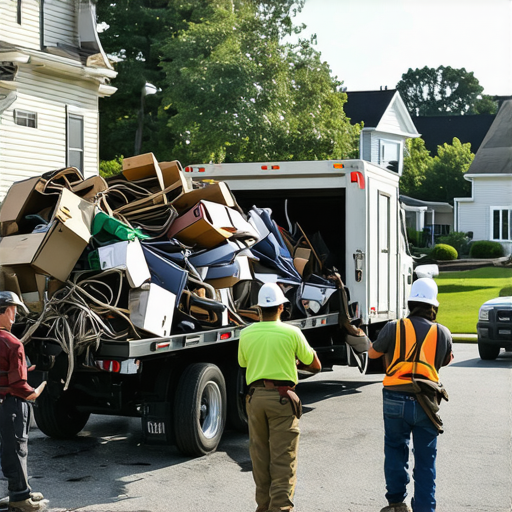
Junk Removal Aurora professionals focus on load density and cubing out the truck to minimize the carbon footprint of every trip to the Aurora Transfer Station. When we pull up to a site, we are not looking at trash. We are looking at a three-dimensional puzzle. Wood waste goes in first to create a flat deck. Heavy items like old refrigerators or washing machines are positioned over the axles to maintain vehicle stability. We call this the science of the load. If you throw items in haphazardly, you are paying for air. Professional haulers use heavy-duty 14-gauge steel containers that can handle the sheer force of a hydraulic lift. If you are doing this yourself with a rented trailer, you risk blowing a tire or snapping an axle because you do not understand weight distribution. A single old-style CRT television can weigh eighty pounds and contains four to eight pounds of lead. This is not just junk. This is a regulated hazardous material. In Aurora, you cannot simply toss these into the general waste stream. They require specialized e-waste handling. Failure to segregate these items at the source results in rejected loads at the scale house. This leads to additional labor costs as you are forced to hand-sort a contaminated pile in the middle of a dusty landfill lot. The heat in Colorado summers makes this work grueling. The risk of heat exhaustion for an untrained homeowner is high. Professionals are conditioned for the physical toll of Appliance removal and the repetitive stress of hauling heavy furniture.
“Waste is merely a resource in the wrong place; professional removal is the science of putting it back where it belongs.” – Disposal Industry Maxim
The heavy cost of keeping everything
Hoarder Clean Out aurora projects require a different level of logistical planning because the structural integrity of the home may be compromised by decades of compaction. I once cleared a house where the junk was not just stuff. It was a structural hazard. The floor joists were bowing under the weight of forty years of newspapers that had absorbed ten years of basement humidity. This is the extreme end of the spectrum, but even a standard garage can have hidden dangers. When you stack boxes to the ceiling, you are creating a fire load that would overwhelm a residential sprinkler system in seconds. The density of the fuel in a typical Aurora garage is staggering. We find old paint cans, half-full propane tanks, and jars of unidentifiable chemicals from the 1970s. These are the items that cause landfill fires. Professionals know how to identify these hazards before they hit the truck. We have seen what happens when a lithium-ion battery gets crushed in a hydraulic packer. It creates a thermal runaway event that can melt a sixty-thousand-dollar truck in minutes. This is why we inspect every single pile. We are not just movers. We are risk managers. The Junk Removal process is a systematic deconstruction of a chaotic environment. We categorize materials into wood, metal, plastic, and true trash. This diversion strategy is what allows us to keep costs down. If we can sell the scrap metal from your old appliances, we can offset the high tipping fees of the landfill. A DIYer loses all that value because they lack the relationships with local recycling centers.
| Disposal Method | Estimated Cost | Time Investment | Legal Risk |
|---|---|---|---|
| DIY Pickup Truck | $450 – $700 | 15 – 20 Hours | High (Illegal Dumping Risk) |
| Dumpster Rental | $550 – $900 | 8 – 12 Hours | Medium (Permit Issues) |
| Professional Hauling | $600 – $1,200 | 2 – 4 Hours | Zero (Licensed & Insured) |
Why your old fridge is a chemical time bomb
Appliance removal involves the recovery of refrigerants and the management of heavy metals which are strictly regulated under the Clean Air Act. You cannot just drop a fridge at the curb in Aurora and hope it disappears. The City of Aurora has specific bulky item pickup schedules, but they often exclude items with Freon. If you hire a pro, they ensure the CFCs are captured by a certified technician. If these gases leak, they contribute significantly to ozone depletion. The mechanical components of an old refrigerator are also high-value scrap. The copper coils and the compressor motor are worth more than the steel shell. However, the labor required to extract those materials is high. A professional crew can strip an appliance in minutes, whereas a homeowner might spend hours with a hacksaw and end up with twenty dollars worth of copper. It is an inefficient use of resources. Then there is the matter of the weight. A vintage refrigerator can weigh over three hundred pounds. Moving that down a flight of stairs or out of a tight garage corner requires specialized straps and dollies. I have seen homeowners suffer permanent back injuries trying to prove they do not need help. A professional team uses leverage and physics rather than raw muscle. We know how to pivot a heavy load to avoid damaging your door frames or scratching your epoxy garage floor. The cost of a professional is an investment in your own physical health and the preservation of your property.
The secret life of the Denver Arapahoe Disposal Site
Dumpster Rentals Aurora are governed by tonnage limits and prohibited item lists that most residents fail to read before they start loading. When you rent a dumpster, you are signing a contract that makes you liable for every ounce of material inside it. If your neighbor sneaks a couple of tires into your bin overnight, you are the one who pays the surcharge at the landfill. Landfills in the Aurora area charge extra for tires because they do not stay buried. They have a tendency to float to the surface of the waste cell over time due to methane gas pockets. This disrupts the landfill cap and causes environmental issues. We call it tire migration. A professional junk removal service avoids this by taking tires to specialized shredding facilities. We also handle Furniture Removal by identifying items that can be donated rather than buried. The furniture in modern homes is often made of particle board and cheap glues. When this material breaks down in a landfill, it releases formaldehyde. We try to divert high-quality solid wood pieces to local Aurora charities. This reduces the total weight of the load we take to the landfill, which saves you money. The logistics of waste management is a game of ounces. We track every pound because that is where the profit margin lives. If we are inefficient with our routes or our loading techniques, we lose money. That is why we are faster and better than a DIYer. We have a financial incentive to be perfect.
“Modern waste management is not about throwing things away; it is about the precise movement of materials through a regulated lifecycle.” – SWANA Technical Report
The logistical checklist for Aurora residents
Furniture Removal and Garage clean outs require a pre-removal manifest to ensure all hazardous materials are handled according to RCRA guidelines. Before you clear a single box, you need to know what you are dealing with. Here is a checklist of items that most professional haulers cannot or will not touch without special permits, and which you should never put in a general trash bin:
- Lead-acid car batteries and lithium-ion power tool batteries.
- Open or leaking containers of oil-based paints and stains.
- Pesticides, herbicides, and concentrated garden chemicals.
- Industrial-grade cleaning solvents and degreasers.
- Pressurized cylinders including propane, oxygen, and fire extinguishers.
- Biohazardous materials or medical waste including sharps.
- Fluorescent light ballasts and mercury-containing thermostats.
If you find these items in your Aurora garage, you must contact the local household hazardous waste (HHW) program. Mixing these with general debris is a violation of federal law. While most people think recycling is always better, the carbon footprint of hauling low-grade plastics five hundred miles often exceeds the impact of local high-efficiency waste-to-energy incineration. In the waste industry, we look at the lifecycle analysis of every material. Sometimes, the most ethical thing to do with contaminated junk is to bury it in a lined, managed landfill like DADS where the methane can be captured and converted to electricity. This is the contrarian truth that the general public often misses. We are not just cleaning a garage. We are managing the end-of-life for products that should never have been made to be disposable. The next time you look at your cluttered garage, do not see a weekend project. See a logistics operation that requires a veteran strategist. The peace of mind that comes with a professional certificate of disposal is worth every penny of the fee. You get your space back, and you stay on the right side of the law. In Aurora, that is the professional standard.
Reading this post really highlights the complexities behind garage cleanouts in Aurora that many residents might overlook. I’ve seen firsthand how attempting a DIY cleanout can quickly become more costly in terms of time, money, and even safety—especially when dealing with hazardous materials like old refrigerants or contaminated chemicals. It’s impressive how professionals approach this with a systematic, risk-aware mindset, that not only saves money but also ensures compliance with local regulations. I appreciate the emphasis on load density and chemical hazard management; these are crucial aspects that most homeowners don’t consider. Personally, I’ve struggled with finding a balance between DIY efforts and professional help, especially when trying to keep costs down. But after seeing what can go wrong, I’m leaning more towards professional services for any sizeable projects. Has anyone here faced unexpected hazards during a garage cleanout and how did you handle them? It would be great to hear practical tips from different experiences.