The ghost of the cubicle farm
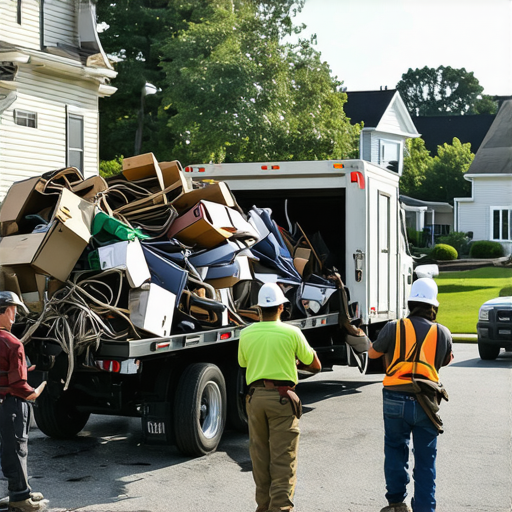
A business owner in Aurora tried to save 500 dollars by hiring a guy with a pickup truck from a social media ad. Two weeks later, the police called him because his company’s confidential files and broken furniture were found in a ditch near the Fox River. Your junk is your liability until it hits the scale at a licensed transfer station. I have spent 25 years watching these curbside cowboys undercut legitimate operators only to leave the client holding a massive legal bill. In the commercial disposal world, the cheap option is almost always the most expensive mistake you can make. We handle thousands of pounds of steel, fabric, and particle board every week. We see the reality of waste. It is heavy, it is dirty, and it requires a mathematical approach to logistics that most people simply do not understand. When you are clearing out a 10,000 square foot office in Aurora, you are not just moving furniture. You are managing a multi-ton logistical operation that involves hazardous components and strict municipal regulations.
The hidden anatomy of a modular office
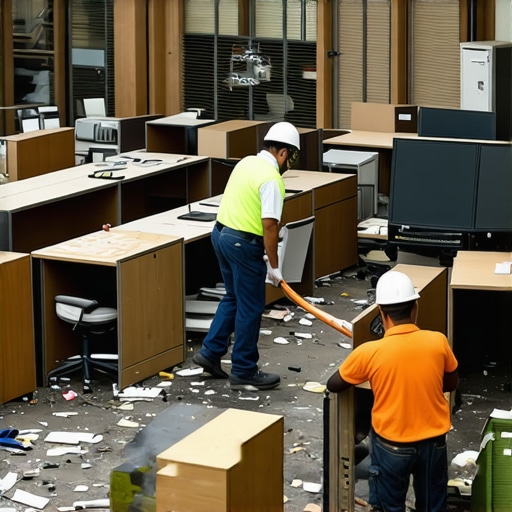
Office cubicles are complex multi-material assemblies comprising powder-coated steel frames, high-density particle board, fiberglass insulation, and electrical harnesses. Professional removal in Aurora requires the systematic separation of these components to satisfy Illinois EPA environmental standards and minimize tipping costs through high-percentage material recovery. Most people see a desk. I see a 12-gauge steel skeleton held together by tension clips and hex bolts that have been seized by twenty years of office humidity. To remove these properly, you cannot just swing a sledgehammer. The dust from the particle board cores contains urea-formaldehyde resins. If you smash them in an unventilated space, you are creating a respiratory hazard for everyone in the building. We use impact drivers to back out the fasteners. We stack the panels by density to ensure the truck does not tip during a sharp turn on Orchard Road. [image_placeholder_1]
“Waste is merely a resource in the wrong place; professional removal is the science of putting it back where it belongs.” – Disposal Industry Maxim
The arithmetic of Kane County tipping fees
Tipping fees at local Aurora transfer stations are calculated by weight or volume depending on the specific material stream. Understanding the difference between a 15-yard dump and a 40-yard roll-off is the key to managing a commercial budget without overpaying for empty air space. The physics of the load matter. If you throw cubicle walls into a truck haphazardly, you are paying to haul Aurora air. We practice cubing out. This is the process of stacking flat panels with zero gap. A standard 15-yard truck can hold the remnants of twenty workstations if the loader understands geometry. If the loader is lazy, that same truck will be full after five workstations. The cost difference is thousands of dollars. We also track the current market rate for scrap steel. If the steel frames are separated from the fabric panels, we can often offset the disposal cost by taking the metal to a local secondary processor. This is the difference between a junk man and a waste strategist.
| Material Type | Recycling Potential | Disposal Complexity | Weight Density |
|---|---|---|---|
| Steel Frames | High (98%) | Low | Heavy |
| Fabric Panels | Low (15%) | High | Medium |
| Particle Board | Zero (0%) | Medium | Very Heavy |
| Electrical Wiring | High (90%) | High | Light |
The phantom liability of the low bid
Commercial entities in Aurora are legally responsible for their waste under the Resource Conservation and Recovery Act until a certified disposal facility accepts the load. Hiring an unlicensed hauler creates a chain of custody break that can lead to massive fines and environmental remediation costs. Every time a truck leaves your dock, you should receive a manifest. If the guy you hired doesn’t know what a manifest is, fire him. I have seen the Illinois EPA track down businesses based on a single discarded mailer found in an illegal dump site. The fines start in the thousands and go up based on the volume of the material. Furthermore, the physical act of removal is a high-risk activity. One slip of a dolly on a set of stairs can result in a workers compensation claim that dwarfs the cost of the entire cleanout. Professional teams carry high-limit general liability insurance because they know that even the best crews can have an accident when moving 300-pound lateral file cabinets.
“Proper management of commercial solid waste is a fundamental requirement for maintaining the structural and environmental integrity of our urban centers.” – Solid Waste Association of North America (SWANA)
The local path to the Orchard Road transfer station
Navigating the Aurora waste stream requires intimate knowledge of local facilities such as the Aurora Transfer Station and regional recycling hubs that handle e-waste and specialized commercial debris. Logistics must account for traffic patterns on Route 59 and the weight limits of suburban side streets. When we plan a cubicle removal, we look at the clock. We avoid the morning rush on I-88. We know which loading docks in downtown Aurora require small-radius trucks because a standard tractor-trailer will get stuck. We also understand the specific requirements for appliance removal. If your office kitchen has a refrigerator, we have to deal with the refrigerants. You cannot just throw a fridge in a dumpster. It requires a certified technician to recover the Freon. This is the law. We follow it because the alternative is a poisoned local water table and a massive fine for our clients.
- Wet lead-acid batteries from UPS systems
- Unlabeled industrial cleaning chemicals
- Propane cylinders from warehouse heaters
- Fluorescent ballasts containing PCBs
- Medical or bio-hazardous waste
- Tires and pressurized containers
The structural death of the open floor plan
The trend of removing modular cubicles in favor of open floor plans creates a massive surge in local waste volume that requires precise staging and removal strategies to avoid business disruption. Most offices attempt to clear space while still operating, necessitating after-hours logistics and silent removal techniques. We work when your employees are gone. The smell of old dust and the sound of impact wrenches do not belong in a productive work environment. We use floor protection. We use corner guards. We treat your office like a laboratory. The goal is to make the furniture disappear without leaving a single scratch on the elevators or the walls. This is why we focus on the physics of the load. We calculate the point load of our dollies to ensure we do not crack the tiles in your lobby. Commercial junk removal is a game of inches and pounds. It is not a job for the weak or the uneducated. It is a job for those who understand that every piece of debris has a cost and a destination.