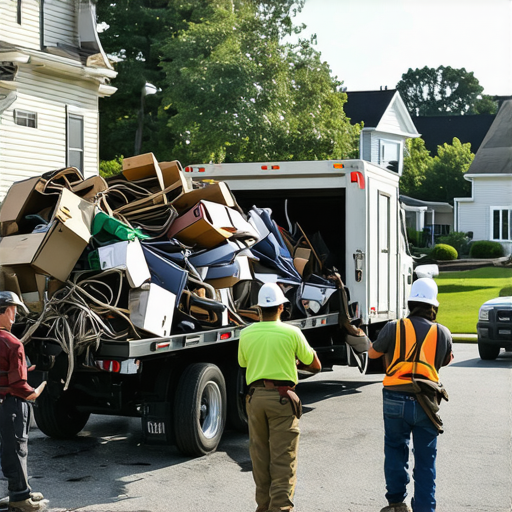

Beyond the Hard Hat. Why Aurora Construction Sites Fail the Logistics Test
The smell of diesel and hydraulic fluid defines my morning. Every construction site in Aurora tells a story through its debris pile. Most project managers see a mess. I see a logistical puzzle where every misplaced beam and uncompacted pile of drywall represents a leak in the profit margin. Waste management is not just about moving dirt. It is about the physics of density and the legalities of the scale.
A business owner tried to save 500 dollars by hiring a guy with a pickup truck from a social media ad. Two weeks later, the police called him because his company’s confidential files and site debris were found in a ditch near the Cherry Creek spillway. Your junk is your liability until it hits the scale at a licensed transfer station. That is the reality of the illegal dumping trap. When you cut corners on junk removal Aurora, you are not saving money. You are gambling with your professional reputation and local environmental laws. I have seen sites shut down because a curbside cowboy dumped hazardous lead-based materials into a general waste stream. We do not just lift. We inspect. Every. Single. Item.
The phantom cost of a messy site
Commercial Junk Disposal and Aurora Construction Site Cleanup require precise coordination between general contractors and waste specialists. Junk Removal Aurora involves more than just lifting heavy objects. It requires understanding C&D waste diversion, tipping fees at the Denver Arapahoe Disposal Site, and the Resource Conservation and Recovery Act (RCRA) standards for material handling.
The logistics of a site cleanup depend on the flow of materials. When debris piles up, it creates a bottleneck. Subcontractors spend twenty percent of their time moving trash out of their way instead of installing flooring or framing walls. This is the hidden tax of poor waste management. A clean site is a fast site. I have watched crews lose two hours a day simply navigating around piles of unmanaged scrap. That loss of productivity far exceeds the cost of a professional dumpster rental or a scheduled junk removal service.
“Waste is merely a resource in the wrong place; professional removal is the science of putting it back where it belongs.” – Disposal Industry Maxim
Aurora disposal maps and the logic of the local dump
Dumpster Rentals Aurora must account for the specific geography of the I-225 corridor and the various transfer stations scattered through the metro area. Junk Removal in this region is governed by Aurora Municipal Code, which dictates how Furniture Removal and Appliance removal must be handled to prevent groundwater contamination from refrigerants and heavy metals.
The geography of waste in Colorado is unforgiving. We deal with high wind speeds that can turn a loose construction site into a neighborhood hazard in minutes. This is why we insist on lidded containers or immediate removal. If you are operating a site near the High Line Canal, the environmental stakes are higher. One loose pile of insulation can migrate into the waterway. We track the wind. We track the haul routes. We ensure that your debris reaches the landfill, not the local park. The logistics manager knows that the shortest route to the dump is rarely the most efficient if it involves heavy traffic during the morning rush on Colfax Avenue.
| Material Type | Bulk Density (lbs/yd) | Disposal Priority | Diversion Potential |
|---|---|---|---|
| Mixed C&D Debris | 350-500 | High | 30% |
| Clean Concrete | 2000-2400 | Critical | 100% |
| Scrap Metal | 250-400 | Low | 95% |
| Drywall (Gypsum) | 400-600 | Medium | 15% |
Physics of the fifteen yard load
Junk Removal is a game of Tetris played with five-ton weights and hydraulic rams. Commercial Junk Disposal relies on maximizing the cubic-yard density of every truckload to minimize tipping fees. In Aurora, weight limits on residential streets mean we must balance the load distribution to avoid cracking the very pavement we are trying to clear.
A fifteen yard dumpster contains roughly four hundred cubic feet of potential space. If you toss materials haphazardly, you lose thirty percent of that volume to air pockets. We call this the air tax. Professional loaders use a technique called nesting. We place heavy, flat materials like plywood or drywall on the bottom. We fill the voids with smaller debris. We save the heavy concrete for the center of the load, directly over the axles. This prevents the truck from fishtailing or damaging the lift mechanism. The engine groans under the weight, but the load is secure. We use every inch. We waste nothing. Air is for tires, not for dumpsters.
Why your appliance removal requires a hazmat mindset
Appliance removal and Garage Clean outs often reveal items that are legally classified as hazardous waste. Hoarder Clean Out aurora situations frequently involve bio-hazards, lithium batteries, and lead-acid cells that can cause landfill fires or toxic leaching. You cannot simply throw a refrigerator into a roll-off without verifying the removal of CFCs.
Every appliance is a chemical cocktail. Older units contain mercury switches and PCBs in the capacitors. If we crush these in the back of a pack-body truck, we release those toxins into the local air. I have seen rookies ignore a small puddle of oil under a compressor. That is a mistake. That oil often contains refrigerants that require specialized recovery equipment under Section 608 of the Clean Air Act. We don’t just haul. We mitigate risk. When we perform a garage clean out, we look for the hidden threats. We look for the half-full propane tanks buried under old rags. We look for the leaking cans of pesticide that can eat through the floor of a steel container.
“The Resource Conservation and Recovery Act (RCRA) creates the framework for the proper management of hazardous and non-hazardous solid waste.” – EPA Waste Management Guidelines
The heavy cost of keeping everything
Hoarder Clean Out aurora projects are structural autopsies. Garage Clean outs reveal the compaction of time, where twenty years of Furniture Removal neglect has resulted in floor joists bowing under the sheer tonnage of paper and forgotten memories. This is not just junk. It is a structural liability.
I once cleared a house where the junk was not just stuff. It was a structural hazard. We found the floor joists were bowing under the weight of 40 years of newspapers that had absorbed ten years of basement humidity. The paper had turned into a solid, heavy mass resembling wet concrete. We had to use chainsaws to break it into manageable blocks. The sheer physics of the load meant we could only fill the truck halfway before hitting the weight limit. This is the reality of the hoarder clean out. It is a slow, methodical extraction. We look for the data overflow in physical space. We find the backdoor logistics to get the weight out without collapsing the porch. Every step is a calculation of risk and weight.
- Lead-acid batteries (Automotive batteries)
- Propane tanks and pressurized cylinders
- Liquid paint and chemical solvents
- Bio-hazardous waste or medical sharps
- Tires (Requires specialized recycling permits)
- Asbestos-containing materials
The structural reality of dumpster rentals aurora
Dumpster Rentals Aurora are often the first step in a major Commercial Junk Disposal project. Selecting the right size is a volumetric science. A 10-yard bin is for heavy solids like dirt or concrete. A 40-yard bin is for light, bulky debris like cardboard and wood scrap. Using the wrong bin leads to overweight fines or wasted space.
The street permits in Aurora are strict. You cannot just drop a 30-yard roll-off on the sidewalk without paperwork. We coordinate with the city to ensure the placement does not block fire hydrants or line-of-sight for drivers. We consider the PSI of the stabilizers on our trucks. If we drop a heavy bin on a fresh asphalt driveway in the Colorado summer heat, the metal feet will sink right through. We use wooden planks to distribute the pressure. We respect the property. We understand the metallurgy of the bin and the geology of the ground beneath it. Junk removal is not a brute force operation. It is an engineering task performed with heavy machinery and a sharp eye for detail.