The liability trap for local businesses
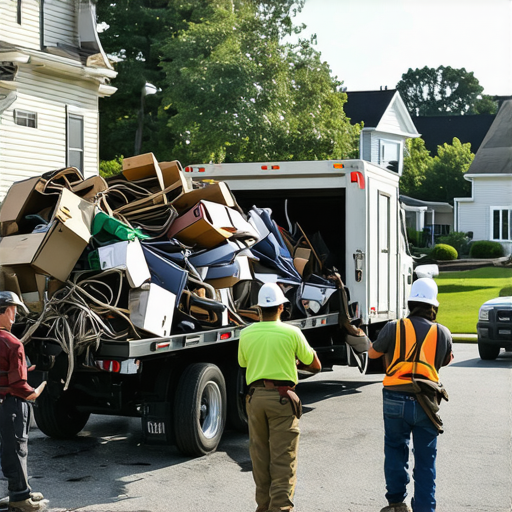
Commercial junk disposal in Aurora requires a strict chain of custody for E-waste management. Businesses often fail to realize that confidential files, hard drives, and proprietary hardware remain their legal responsibility until a certified waste management professional issues a destruction manifest. A business owner tried to save 500 dollars by hiring a guy with a pickup truck from a social media ad. Two weeks later, the police called him because his company’s confidential files were found in a ditch near Cherry Creek. Your junk is your liability until it hits the scale at a regulated transfer station. My boots have walked through enough illegal dump sites to know that cheap labor costs the most in the end. I smell diesel and hydraulic fluid every morning. It is the smell of accountability. If you do not see a DOT number on the side of the truck, you are looking at a lawsuit waiting to happen. The logistics of waste are cold and calculated. We measure success in diversion rates and cubic yard density. Anything else is just driving trash around. [IMAGE_PLACEHOLDER]
The physics of cubic yard density
Junk Removal Aurora operations depend entirely on the logistics of truck volume and weight distribution. When we pull up to a commercial site, we are not just looking at a pile of furniture, we are calculating the displacement of air and the structural integrity of the load. Every cubic inch of wasted space in a 15-yard dump bed is money evaporating through the exhaust pipe. We call it cubing out. To maximize efficiency, we break down office desks and cubicle partitions into their flat-pack components. This increases the bulk density of the load. A loose pile of office chairs might only weigh 200 pounds but take up 5 yards of space. That is a failure. We nest them. We remove the casters. We turn the frames. We treat the truck like a 3D puzzle where the pieces are heavy and covered in dust.
“Waste is merely a resource in the wrong place; professional removal is the science of putting it back where it belongs.” – Disposal Industry Maxim
The mathematics of a Hoarder Clean Out aurora are even more complex. You are dealing with compacted layers of material that have absorbed ambient humidity. A stack of 1990s newspapers in an Aurora basement can weigh three times its original weight because of water absorption. This shifts the center of gravity for the truck. If you load too much weight over the rear axle, the front tires lose traction. If you load too much on the tongue, you risk snapping the hitch. We calculate these variables before the first item leaves the threshold.
The hidden chemistry of electronic waste
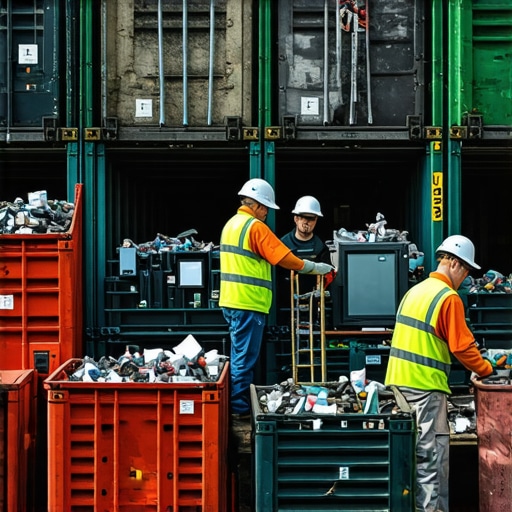
E-Waste Management in 2026 involves the recovery of rare earth metals and the neutralization of toxic heavy metals. A single server rack contains a cocktail of lead, mercury, cadmium, and hexavalent chromium. If these items hit a standard landfill like the Denver Arapahoe Disposal Site, they become an environmental nightmare. The leachate from crushed circuit boards can penetrate groundwater liners over decades. We see the Resource Conservation and Recovery Act not as a set of rules, but as a blueprint for survival. The 2026 standards require lithium-ion battery isolation. These batteries are thermal runaway bombs. If a laptop battery gets crushed by the hydraulic ram of a packer truck, it can reach temperatures of 1,200 degrees Fahrenheit in seconds. We inspect every device. We pull the batteries. We tape the terminals. It is tedious. It is necessary. The BTU potential of a fire in a waste truck is enough to melt the aluminum siding off a nearby house.
“Electronic waste is the fastest growing stream of municipal solid waste in the world.” – EPA
| Material | Decomposition Time | Recovery Potential |
|---|---|---|
| Paper and Cardboard | 2 to 6 weeks | High |
| HDPE Plastics | 450 years | Medium |
| Lithium-Ion Units | Never | High Risk |
| Steel and Aluminum | 50 to 200 years | Very High |
The heavy cost of keeping everything
Garage Clean outs and Furniture Removal often reveal the emotional inertia of Aurora homeowners. People hold onto appliances thinking they will fix them. They won’t. A 1980s refrigerator is a chlorofluorocarbon hazard. The refrigerant must be recovered by a certified technician before the steel shell can be recycled. We use vacuum recovery pumps to ensure zero atmosphere venting. The compressor itself is a heavy lump of copper and steel. It is worth money, but only if you have the volume to justify the transport. Most people see an old fridge. I see 40 pounds of high-grade copper and a potential 10,000 dollar fine from the EPA if the Freon isn’t handled correctly. The physics of removal also involves static load limits. When moving a cast iron bathtub or a piano from a second story in a commercial building, we have to calculate the PSI on the stair treads. One wrong step and the structural loading exceeds the timber capacity. The floor snapped. I have seen it happen. We use load-spreading plates and high-tension straps to manage the descending force.
Why your cheap hauler is a legal time bomb
Dumpster Rentals Aurora might seem like a DIY solution, but the logistical burden shifts to the user. If you put hazardous materials in a roll-off container, the landfill will reject the load. You will pay for the re-sorting, the transport, and the environmental surcharge. Here is a checklist of items a professional hauler cannot legally touch without a hazmat manifest:
- Wet lead-acid batteries from vehicles
- Pressurized propane or oxygen cylinders
- Liquid oil-based paints and thinners
- Asbestos-containing floor tiles or pipe wrap
- Bio-medical waste and used sharps
In the Aurora region, the transfer stations are getting stricter. They use radiation sensors at the gates. If you throw away an old smoke detector with an Americium-241 source, the alarms go off. The truck gets quarantined. The bills start piling up. Appliance removal is not just about muscle. It is about regulatory compliance. We manage the paperwork so you don’t have to face the municipal code enforcement officers. The waste stream is a river of data. We track every ton. We know where the E-waste goes. We know which scrap yard pays the best for low-grade aluminum. We turn junk into logistics. If you want it gone, do it right the first time. The alternative is a ditch, a fine, and a stain on your business reputation. That is the reality of the waste industry in 2026.