
The hidden weight of the Aurora hoarding crisis
Hoarder clean out aurora projects require specialized logistical planning to address structural load limits and biohazardous risks. Professional crews must evaluate the cubic yard density of accumulated materials to prevent floor joists from failing. By 2026, Aurora waste protocols demand strict separation of hazardous household waste from standard municipal streams. I once cleared a house where the junk was not just stuff. It was a structural hazard. We found the floor joists were bowing under the weight of 40 years of newspapers that had absorbed ten years of basement humidity. The paper had turned into a solid, moldy block of cellulose that weighed four times its original dry mass. We had to shore up the basement with steel jacks before a single box could be moved. This is the reality of extreme hoarding. It is a battle of physics and biology. You are not just moving boxes. You are managing a site that has been compromised by the sheer tonnage of neglected possessions.
The ghost in the garage
Garage clean outs involve the removal of forgotten chemicals and heavy equipment that can contaminate the local groundwater. Technicians must identify old paints, solvents, and lead-acid batteries that have likely leaked into the concrete pad. These materials require manifest tracking to ensure they reach a designated Aurora hazardous waste facility. Junk removal aurora services often encounter the residue of 1970s automotive repairs. Think about the BTU potential of recovered wood waste versus the toxic legacy of treated lumber. When we pull a pile of scrap from a garage, we look for the green tint of chromated copper arsenate. That stuff cannot hit a standard landfill. It has to be isolated. The logistics of the load are unforgiving. Every wasted inch in the truck is a financial leak. We pack the heavy steel at the bottom. We stack the light cardboard at the top. This is the Tetris of the waste industry. If the load shifts during transit to the transfer station, the hydraulic systems on the truck face uneven stress. That leads to maintenance downtime. Precision matters.
“Waste is merely a resource in the wrong place; professional removal is the science of putting it back where it belongs.” – Disposal Industry Maxim
The heavy cost of keeping everything
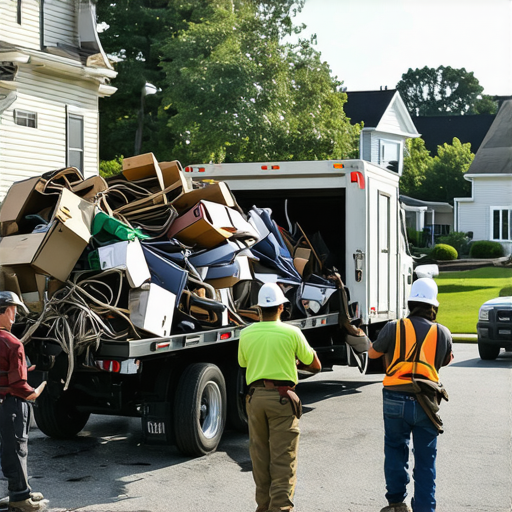
Appliance removal and furniture removal costs are dictated by weight, volume, and the complexity of extraction from the residence. Modern bulky item disposal requires a granular understanding of secondary material markets for steel, aluminum, and high-density polyethylene. The labor involved in navigating a sofa through a narrow Aurora hallway often exceeds the actual disposal fee. Consider the physical mechanics of a 1990s projection television. It is a nightmare of glass and heavy metals. We do not just toss it. We lift with the legs. We use specialized straps. We account for the center of gravity. If a rookie misses the balance point, he ends up in the emergency room. Your junk is your liability until it hits the scale. This is why the guy with the rusty pickup truck is a danger. If he dumps your old washing machine in an Aurora ditch, the city traces the serial number back to you. The legal fines under the Resource Conservation and Recovery Act are not suggestions. They are hammers. [image_placeholder_1]
Logistics of a successful dumpster rental
Dumpster rentals Aurora residents utilize must account for city permit requirements and the physical footprint of the delivery vehicle. Placing a 20 yard roll off container on a public street requires specific signage and often a temporary occupancy permit from the local public works department. You cannot just drop ten tons of steel on an asphalt driveway in mid-August without protection. The heat softens the bitumen. The weight of the dumpster will sink four inches into your property. We use wooden planks to distribute the load. We calculate the PSI. Most people think a dumpster is just a box. It is a highly engineered container that must be balanced. If you load all the concrete at the front, the truck cannot lift it. The front wheels will come off the ground. That is a physics failure that costs money and time. You need a strategy for the fill. Heavy materials go flat on the bottom. Light debris goes on top to act as a stabilizer.
| Disposal Method | Cubic Yard Capacity | Average Weight Limit | Local Environmental Impact |
|---|---|---|---|
| Standard Pickup | 2.5 Yards | 1,500 lbs | High Fuel per Ton |
| 15-Yard Dumpster | 15 Yards | 4,000 lbs | Moderate |
| 20-Yard Roll-Off | 20 Yards | 6,000 lbs | Efficient Bulk Transfer |
| Box Truck (Live Load) | 12-18 Yards | Varies by Axle | Low (Professional Sort) |
The legal time bomb of illegal hauling
Junk removal professionals must verify the final destination of every load to protect the client from environmental litigation. Fly tipping is a growing problem in the Aurora region where unlicensed haulers avoid tipping fees by dumping in rural areas or industrial zones. This creates a chain of liability that starts with the homeowner. Every load we take is logged. We get a receipt from the transfer station. We know the diversion rate. We know how much of that load was recycled. Most people think recycling is always better. However, the carbon footprint of hauling low grade plastics 500 miles often exceeds the impact of local, high efficiency waste to energy incineration. We look at the data. We make the call based on the current market for recycled commodities. It is a volatile business. One day cardboard is worth fifty dollars a ton. The next day you have to pay to get rid of it. We manage that risk so you do not have to.
Prohibited items at the transfer station
Regulatory compliance dictates that certain materials must be excluded from general junk removal streams to prevent landfill fires. Local ordinances in Aurora strictly forbid the commingling of volatile chemicals with standard household debris. You must separate these items before the crew arrives to avoid service delays or additional hazmat surcharges.
- Lithium-ion batteries from old electronics
- Propane tanks and pressurized cylinders
- Liquid oil-based paints and industrial solvents
- Asbestos-containing floor tiles or pipe insulation
- Untreated medical waste or sharps
- Lead-acid automotive batteries
“Proper waste management is the first line of defense for public health and environmental integrity.” – Solid Waste Association of North America
The structural risks of appliance removal
Removing an old refrigerator or stove from an Aurora basement requires an assessment of the stairwell integrity and load capacity. Heavy appliances exert concentrated pressure on wooden stairs that may have been weakened by humidity or pest infestation. A professional team uses appliance dollies with pneumatic tires to minimize point-load stress. We check the tread. We check the riser. If we see signs of dry rot, we do not move the unit until a ramp system is installed. It is about the physics of the descent. A 300 pound fridge has significant momentum on a 45 degree angle. We use mechanical advantages. We use levers. We use brains over brouwn. Junk removal is a trade of increments. You move two inches. You reset. You move two more. This prevents the wall damage that amateurs always leave behind. We respect the envelope of the building.
The digital future of Aurora waste management
In 2026 the junk removal industry utilizes real time weight sensors and GPS tracking to optimize disposal routes and reduce carbon emissions. We no longer guess the weight of a load. The truck scales tell us exactly how much we are hauling. This allows for precise pricing. No more flat rates that overcharge the customer. You pay for what you dispose of. The density matters. A load of feathers costs less than a load of bricks. It is simple math. We are moving toward a circular economy. We identify items that can be refurbished. We work with local Aurora charities to divert usable furniture from the landfill. This is not just about throwing things away. It is about resource management. We are the gatekeepers of the landfill. We decide what gets buried and what gets reborn. It is a heavy responsibility. We take it seriously every single day. The floor snapped. That was the sound of a rookie trying to move a safe without a plate. We do not make those mistakes. We are the pros. We know the load. We know the road.
Reading through this detailed overview of Aurora’s waste management challenges really highlights how complex and multi-faceted the junk removal industry has become. I was particularly struck by how much physics and logistics are involved—things I hadn’t fully appreciated before, like load balancing and the importance of proper placement in dumpsters. My own experience with hoarder cleanouts was that identifying structural hazards early on really saves time and prevents accidents, especially when dealing with older buildings that might have been compromised by humidity or pests. It makes me wonder, with the push toward more accurate weight sensing and GPS tracking, how do you see technology further evolving to enhance safety and efficiency? Are there emerging tools or methods that could make these processes even safer or more cost-effective? It seems the industry is really heading toward a smarter, more responsible future, which is encouraging considering the environmental and safety stakes involved.