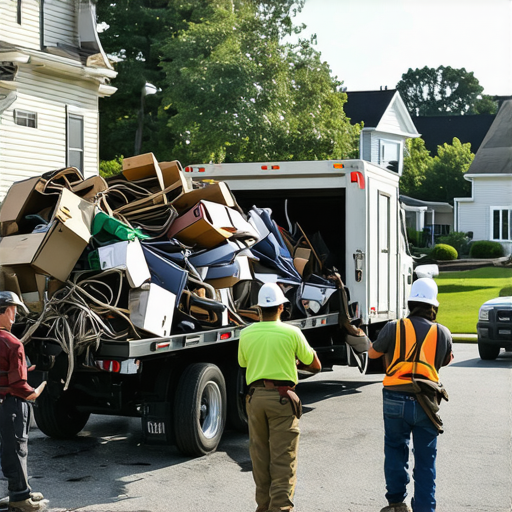

The debris field left behind
Junk Removal Aurora services after a renovation require a strict logistical assessment of volume, weight, and material classification to ensure legal compliance and site safety. Professional recovery involves segregating gypsum, masonry, and metals to avoid heavy tipping fees at local transfer stations while maintaining a clean environment.
A business owner tried to save $500 by hiring a guy with a pickup truck from a social media ad. Two weeks later, the police called him because his company’s confidential files and renovation debris were found in a ditch. Your junk is your liability until it hits the scale at a licensed facility. I have seen this scenario play out dozens of times in Aurora. The lack of a waste manifest is a legal trap that ends in fines far exceeding the cost of a professional crew. When you strip a room to the studs, you are creating a complex waste stream. It is not just trash. It is a mixture of hazardous treated lumber, potentially leaded paint chips, and sharp fasteners. The physics of the load dictate the price. A pile of drywall might look small, but once it is smashed and loaded, the density changes. It cubes out a truck faster than furniture. We calculate the load by the cubic yard. A standard 15-yard truck can only handle so much heavy masonry before the hydraulics complain. If you are doing a hoarder clean out Aurora project, the density increases exponentially as materials have compressed over years of accumulation. We look for the air pockets. We look for the weight. We look for the hazardous surprises hidden in the bottom of the pile.
“Waste is merely a resource in the wrong place; professional removal is the science of putting it back where it belongs.” – Disposal Industry Maxim
[IMAGE_PLACEHOLDER]
Drywall dust and the weight of progress
Furniture Removal and construction debris in Aurora demand an understanding of local tipping rates and the specific gravity of waste materials. Removing drywall requires specialized masks and containment strategies to prevent fine particulates from infiltrating the HVAC system of a newly renovated residential or commercial property.
Drywall is heavy. A single 4×12 sheet of half-inch drywall weighs about 80 pounds. If you have a stack of thirty sheets after a basement renovation, you are looking at over a ton of weight. Most residential driveways are not rated for the point-load pressure of a 40-yard dumpster filled with masonry. This is why we often recommend smaller, more frequent loads or specialized dumpster rentals Aurora residents can use that distribute weight more evenly. The chemistry of gypsum is also a factor. When drywall gets wet in a landfill, it produces hydrogen sulfide gas. This is why many local Aurora transfer stations have strict rules about mixing construction debris with general household waste. We separate it at the source. It saves the client money and it keeps the landfill managers happy. The logistical tetris of the truck is a skill. You put the heavy, flat items on the bottom. You stack the furniture removal items on top to utilize the vertical space. You do not leave air. Air is wasted money. If I see a truck with gaps in the load, I see a failure in management. We want the highest density possible without exceeding the Gross Vehicle Weight Rating of the truck. This protects the equipment and ensures we are not making extra trips that burn diesel and waste time.
The hidden danger in appliance removal
Appliance removal involves the careful extraction of heavy units while managing hazardous refrigerants and electronic waste components that are banned from Aurora landfills. Licensed technicians must handle the decommissioning of cooling units to prevent the release of harmful ozone-depleting substances into the atmosphere.
A refrigerator is more than just a steel box. It contains compressor oil and refrigerant gases like R-134a or the older R-12. If you just toss a fridge into a dumpster, you are breaking federal law. We use specialized equipment to tap the lines and recover the gas. The same goes for old televisions found during garage clean outs. Those old CRT monitors contain up to eight pounds of lead. If the glass breaks, you have a hazmat situation on your hands. We treat every appliance as a technical recovery mission. We check for capacitors. We check for mercury switches in old thermostats. The goal is 100 percent diversion from the landfill for metals and e-waste. This is the difference between a curbside cowboy and a professional waste strategist. We know the metallurgy. We know which alloys are worth the trip to the scrap yard and which ones are just destined for the shredder. When we perform a garage clean out Aurora homeowners often do not realize that the old paint cans and car batteries they have stored are a ticking clock of environmental liability. Acid leaks. Fumes build up. We neutralize and transport according to RCRA standards.
| Service Type | Average Cost Basis | Ideal For | Disposal Method |
|---|---|---|---|
| Full-Service Removal | Cubic Yardage | Post-Renovation Cleanups | Professional Sorting/Diversion |
| Dumpster Rentals | Flat Rate + Tonnage | Long-term DIY Projects | Direct Landfill/Transfer |
| Appliance Pickup | Per Unit Item | Individual Replacements | Specialized Recycling |
| Hoarder Clean Out | Hourly + Tonnage | Extreme Accumulation | Multi-phase Extraction |
The logistical reality of hoarder clean out Aurora
Hoarder clean out Aurora projects require a tactical approach to debris management where the volume of material often exceeds the structural capacity of the building. Success depends on a multi-phase extraction plan that prioritizes exit paths and fire safety during the removal process.
I once cleared a house where the junk was not just stuff. It was a structural hazard. We found the floor joists were bowing under the weight of 40 years of newspapers that had absorbed ten years of basement humidity. Every step was a risk. In these situations, you cannot just start grabbing bags. You have to stabilize the path. You have to understand the load-bearing nature of the hoard. It is like an archaeological dig but with much higher stakes. We use a method called the wall-out. We clear a path to the furthest point and work our way back to the exit. This ensures that if a pile shifts, the crew has a clear escape route. We also look for biohazards. Rodent droppings and mold are common in high-volume hoards. We wear P100 respirators. We do not take chances. The psychology of the hoard is one thing, but the physics of it is my concern. We have to calculate the total weight to ensure we do not overload the floor. If a house has 30 tons of material in it, you cannot just drag it all to one side of the room. You have to balance the load during the extraction. It is a slow, methodical process that requires a veteran’s eye for structural stress.
“Modern waste management is the frontline of urban sustainability; without precision logistics, the city would drown in its own consumption.” – Solid Waste Association of North America
Items your hauler cannot legally touch
Understanding the limitations of a junk removal Aurora service is vital for project planning and environmental safety. Most haulers are prohibited by law from transporting hazardous liquids, pressurized tanks, or volatile chemicals without specific hazardous materials licensing and equipment.
- Propane tanks and pressurized cylinders
- Liquid paint and thinners (must be dried or hardened)
- Motor oil and transmission fluid
- Biohazardous waste and medical sharps
- Asbestos-containing materials (requires abatement)
- Lead-acid batteries (specialized handling required)
- Pesticides and herbicides
- Explosives or ammunition
While most people think recycling is always better, the carbon footprint of hauling low-grade plastics 500 miles often exceeds the impact of local, high-efficiency waste-to-energy incineration. This is a hard truth many do not want to hear. In Aurora, we try to keep the miles low. We look for the closest transfer station that has a high diversion rate. If we have to drive three hours to recycle a bag of plastic film, we are doing more harm than good. We focus on the high-impact materials. Steel. Aluminum. Copper. Clean wood waste. These are the items that have a legitimate second life. The wood can be ground into mulch or used for biomass fuel. The metals are infinitely recyclable. The goal is to minimize the mass that ends up in a hole in the ground. Every renovation project is an opportunity to recover value from the waste stream. We are not just movers. We are recovery agents. We look at a pile of old floorboards and see the BTU potential or the reclaimed timber value. We look at old cabinets and see the particle board that can be processed into new materials. This is the science of disposal. It is about logistics, chemistry, and a deep respect for the land. When we finish a garage clean out, the floor is swept and the air is clear. That is the standard of a professional veteran. We leave the site better than we found it. We handle the heavy lifting so the homeowner can focus on the beauty of their new renovation. The junk is gone, the liability is gone, and the materials are back in the economy where they belong.