
The liability of the low bid
Professional junk removal Aurora services require strict adherence to local disposal regulations and environmental safety protocols. Hiring unlicensed haulers often leads to illegal dumping, which remains the legal responsibility of the original waste generator. Verification of insurance and disposal manifests is the only way to mitigate this significant financial risk.
I smell like diesel and hydraulic fluid. This is not a hobby. I have spent 25 years watching the physics of waste. A business owner once tried to save five hundred dollars by hiring a guy with a pickup truck from a social media ad. Two weeks later, the police called him because his company confidential files were found in a ditch. Your junk is your liability until it hits the scale. This is the reality of the industry. People think they are paying for muscle. They are actually paying for the transfer of legal liability. If that waste ends up in a creek, the EPA does not care that you paid a guy in cash. They care whose name is on the letterhead found in the pile. We see this every month. The curbside cowboys take the easy money and dump the problem on the public. It is a logistical failure and a moral one.
The cubic yard math of a fifteen yard truck
Calculating the density of junk removal Aurora loads involves understanding the volumetric weight of mixed debris versus inert materials. A fifteen yard truck reaches its weight capacity long before it cubes out if the load consists of concrete or soil. Strategic loading requires placing heavy items on the floor to maintain a low center of gravity.
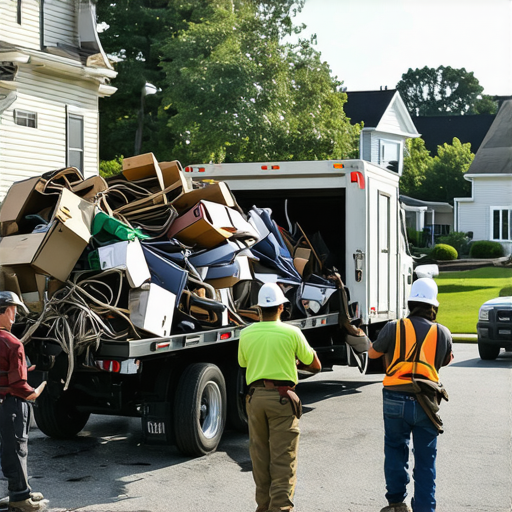
Waste management is a game of Tetris with high stakes. You have a truck bed that measures 14 feet long, 8 feet wide, and 5 feet high. That is approximately 20 cubic yards. If you are hauling old furniture, you are hauling air. I hate wasted air space. We break down every dresser. We pull the legs off tables. We stack mattresses vertically to compress the load. When we handle garage clean outs, we are looking at the cubic yard density. A loose pile of cardboard might take up five yards but weigh only 200 pounds. A pile of shingles might take up two yards but weigh 4,000 pounds. The truck has a gross vehicle weight rating. If you exceed it, you blow a hydraulic seal. You ruin the leaf springs. Professional junk removal is about the math of the haul. We maximize the BTU potential of recovered wood waste by keeping it dry. Wet wood is heavy and worthless at the waste to energy plant. We manage the moisture content like it is a science because it is.
| Material Type | Decomposition Time | Disposal Path | Hazard Level |
|---|---|---|---|
| Untreated Wood | 3-10 Years | Mulching/Biomass | Low |
| High-Density Polyethylene | 500+ Years | Specialized Recycling | Medium |
| Lead-Acid Batteries | Never | Hazmat Recovery | Extreme |
| Textiles/Clothing | 50-200 Years | Fiber Recovery | Low |
| Electronic Waste | Indefinite | Rare Earth Extraction | High |
“Waste is merely a resource in the wrong place; professional removal is the science of putting it back where it belongs.” – Disposal Industry Maxim
Hazardous chemistry in the suburban garage
Identifying hazardous household waste is the most critical step in garage clean outs and general junk removal Aurora projects. Items such as lithium batteries, old fertilizers, and lead-based paints require specialized handling at authorized Aurora bio-waste sites. Mixing these chemicals in a standard dumpster rental Aurora unit creates a volatile environment prone to spontaneous combustion.
I watched a rookie almost lose his eyebrows because a customer hid a half-full propane tank inside a pile of harmless yard waste. We do not just lift. We inspect. Every single item. The modern garage is a chemical warehouse. You have old herbicides that have been banned for twenty years. You have lithium-ion batteries that are one puncture away from a thermal runaway event. When we do junk removal Aurora, we pull those items first. We do not toss them in the back. They go in a dedicated secondary containment bin. The RCRA, or Resource Conservation and Recovery Act, defines how we must track this stuff. If you throw a car battery into a general waste stream, the acid leaches out. It eats through the truck floor. It hits the landfill and poisons the leachate. While most people think recycling is always better, the carbon footprint of hauling low-grade plastics 500 miles often exceeds the impact of local, high-efficiency waste-to-energy incineration. We look for the shortest path to the most stable state.
- Propane and Oxygen Tanks
- Lead-Acid and Lithium Batteries
- Industrial Solvents and Thinners
- Bio-Medical Waste and Sharps
- Asbestos-Containing Materials
- Ammunition and Explosives
The structural physics of hoarding
Executing a hoarder clean out Aurora involves assessing the load-bearing capacity of the residential structure before removal begins. Decades of accumulated materials can weigh several tons, often causing floor joists to bow or crack. Removing these items too quickly can cause sudden shifts in the building’s structural integrity.
I once cleared a house where the junk was not just stuff. It was a structural hazard. We found the floor joists were bowing under the weight of 40 years of newspapers that had absorbed ten years of basement humidity. Paper is a sponge. A single stack of wet newspapers can weigh as much as a concrete block. When we handle a hoarder clean out aurora, we treat it like a demolition site. We wear respirators. We check for mold. We check for structural failure. You cannot just run in there and start grabbing. You have to offload the weight strategically. If you clear the center of the room first, the remaining weight at the walls can cause a cantilever effect. We work from the top down and the outside in. We calculate the pounds per square foot. We ensure our crew is not standing under a ceiling that is holding up three tons of old clothes on the floor above. This is why a cheap guy with a truck cannot do this. He does not understand the physics of the load. He only sees the pile.
“The management of solid waste is a public health necessity that requires technical precision and environmental stewardship.” – Solid Waste Association of North America
Appliance removal and the refrigerant protocol
Safe appliance removal Aurora requires the certified recovery of refrigerants and the separation of mercury-containing components. Modern environmental laws mandate that chlorofluorocarbons be captured before the metal chassis is recycled. Failure to follow these protocols results in severe fines and atmospheric damage.
Old refrigerators are not just scrap metal. They are pressurized systems. The CFCs and HCFCs inside them are potent greenhouse gases. We see people cutting the lines with bolt cutters to make the unit lighter. That is a federal crime. We use recovery pumps. We pull the gas into cylinders. We certify the recovery. Then we look at the components. Older stoves and washers have mercury switches. If you crush those in a standard compactor, you release mercury vapor. It is toxic. We pull the switches. We pull the capacitors. Then the steel goes to the shredder. The BTU potential of the insulation foam is another factor. We try to find facilities that can process that foam without releasing the blowing agents. This is the difference between hauling and waste management. One is moving things. The other is protecting the local environment.
The heavy cost of keeping everything
Storing unused items leads to a phenomenon known as physical data overflow where the cost of square footage exceeds the value of the stored goods. Professional furniture removal Aurora services help homeowners reclaim valuable real estate that would otherwise be lost to depreciating assets. This reclamation improves both the property value and the living conditions.
The floor snapped. That is a sound you never want to hear during a furniture removal. We were moving an old solid oak sideboard that had been sitting in the same spot for thirty years. The wood had fused with the floorboards due to a slow leak in the roof. The cost of keeping that item was the entire floor. Most people do not calculate the cost of the square footage. If you pay three thousand dollars a month for a mortgage and twenty percent of your house is filled with junk, you are paying six hundred dollars a month to store trash. That is seventy-two hundred dollars a year. Over ten years, you spent seventy-two thousand dollars to keep things you do not use. We help people see that math. We show them the cubic yard cost of their habits. When we do a junk removal Aurora project, we are not just cleaning. We are performing an audit of their space. We use the Tetris method to show them exactly how much volume they have lost. It is a wake-up call for most.
Regional tipping realities and the permit gauntlet
Navigating the dumpster rentals Aurora permit process is essential for legal curbside placement on public right-of-ways. Local municipal codes dictate the duration of placement and the required reflective safety markings for all roll-off containers. Non-compliance results in immediate impoundment of the equipment and heavy municipal fines.
The narrow streets in some parts of Aurora mean a 20-yard dumpster is a permit nightmare. You cannot just drop a bin and walk away. You need a live-load truck. We keep the engine running. We load the truck in ninety minutes and we leave. This avoids the three-hundred-dollar permit fee and the headache of city inspectors. We know the tipping fees at the local transfer stations. We know who takes tires and who does not. If you show up at the gate with a mixed load that has three tires at the bottom, they will make you unload the whole truck by hand to get them out. We avoid that. We sort at the source. We put the tires in the cab or on a dedicated rack. We know the rules because we live them every day. The diesel is expensive. The labor is expensive. Efficiency is the only way to survive in this industry. We do not have time for mistakes. We do not have time for air in the truck. We get in, we load, we verify, and we dump at the correct site. That is the engine of Aurora waste management.