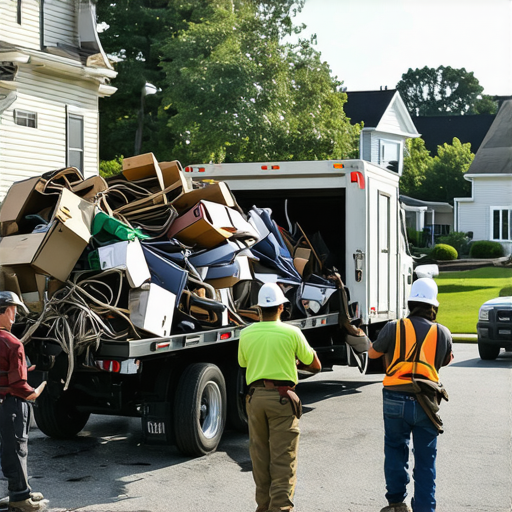

The illegal dumping trap
A business owner tried to save 500 dollars by hiring a guy with a pickup truck from a social media ad. Two weeks later, the police called him because his company’s confidential files were found in a ditch. Your junk is your liability until it hits the scale. I have spent 25 years watching people make this mistake. They see a low price and forget that the price of an environmental fine in Aurora is significantly higher. Waste management is not just about lifting heavy objects. It is about the legal chain of custody for every kilogram of debris. When we pull up to a site in the Fox Valley area, we are calculating the density of the load and the specific chemistry of the waste stream. If you do not have a paper trail that ends at a licensed transfer station like the one on Orchard Road, you are gambling with your reputation. Professional waste management is a defensive strategy against litigation and environmental decay. The scent of diesel and hydraulic fluid is the smell of a job done correctly. Every cubic yard of space in my 15-yard dump truck is a puzzle piece that must be fitted with precision to avoid the cardinal sin of hauling: transporting air. We focus on the math of the haul.
The phantom of the curbside
Junk Removal in Aurora requires a deep understanding of municipal ordinances and transfer station protocols. Professional haulers must distinguish between Class A recyclables and hazardous materials to ensure environmental compliance while managing logistics for residential clean outs or commercial debris. Most residents think that putting an old television on the curb is the end of their responsibility. It is not. Many of those units contain cathode ray tubes with several pounds of lead. If a scavenger smashes that tube to get the copper, the lead leaches into the Aurora soil. We treat Junk Removal as a surgical operation. We extract the items, categorize them by material density, and route them to the appropriate recovery facility. The local Aurora waste stream is complex, and navigating it requires more than just a strong back. It requires a manifest.
Geometry of a 15-yard steel box
Garage Clean outs are logistical exercises in volume optimization and spatial density. To maximize a 15-yard dumpster, one must break down particle board furniture and stack corrugated cardboard to eliminate void spaces. This process reduces the number of truck trips and lowers the carbon footprint of the waste removal process. The floor snapped. That was the sound of a structural failure I witnessed during a hoarding situation in a garage near Northgate. The owner had stacked 20 years of old National Geographic magazines. Each gallon of water absorbed by those magazines increased their weight by over eight pounds. The concrete pad was cracking under the localized pressure. When we perform Garage Clean outs, we calculate the load bearing capacity of the floor and the truck ramp. We do not just toss items in. We cube out the truck. We place the heavy, dense items like concrete rubble or old tiles at the bottom to maintain a low center of gravity. This is the science of the haul. A poorly loaded truck is a danger on the Reagan Memorial Tollway.
“Waste is merely a resource in the wrong place; professional removal is the science of putting it back where it belongs.” – Disposal Industry Maxim
The chemical ghost in the old refrigerator
Appliance removal involves the careful handling of chlorofluorocarbons (CFCs) and refrigerant gases regulated by the EPA under the Clean Air Act. Aurora residents must ensure that refrigerators and freezers are handled by certified technicians to prevent atmospheric ozone depletion. The hum of an old 1980s fridge is the sound of an energy vampire. These units can pull five times the electricity of a modern Energy Star appliance. When we perform Appliance removal, we are not just taking away a heavy box. We are removing a chemical hazard. The oil in the compressor can be contaminated with PCBs if the unit is old enough. We secure the doors with heavy-grade straps to prevent child entrapment, a tragic reality that many amateur haulers overlook. We then transport these units to a facility that can safely evacuate the Freon. It is a meticulous process that ensures the city of Aurora stays green and safe.
Why your sofa is an environmental hazard
Furniture Removal often deals with polyurethane foam and chemically treated textiles that do not decompose easily in landfills. Sustainable disposal focuses on stripping frames for reusable timber and metal springs to increase diversion rates from local waste sites. That old sofa in your basement is likely off-gassing flame retardants. When we handle Furniture Removal, we evaluate the piece for donation first. If the structural integrity is compromised, we dismantle it. A solid oak table from 1950 has a high BTU potential or can be refinished. A modern piece made of compressed sawdust and glue is a different story. It is a chemical cocktail that should never be burned. We ensure that these materials are processed at facilities that understand the difference between organic waste and industrial composites. In Aurora, the goal is to keep as much out of the landfill as possible. We look for the silver lining in the junk.
Comparing the weight of the world
Understanding the physics of waste helps in choosing the right service level. Below is a breakdown of common materials found in Aurora clean outs and their impact on the waste stream.
| Material Type | Decomposition Time | Recovery Potential | Aurora Disposal Logic |
|---|---|---|---|
| Untreated Timber | 10-15 Years | High (Mulch/Fuel) | Sent to local wood chippers |
| Corrugated Cardboard | 3 Months | Maximum (Pulp) | Processed at Aurora recycling hubs |
| Polyurethane Foam | 1000+ Years | Low (Chemical) | Requires specialized compression |
| Ferrous Metals | 50-100 Years | Infinite (Smelting) | Scrapped for high-value recovery |
| Old Drywall | Unknown | Low (Sulfur) | Must be kept dry to prevent gas |
The legal walls of the landfill
Dumpster Rentals Aurora are subject to strict prohibited item lists to prevent environmental contamination of the Fox River watershed. Contractors and homeowners must understand that mixing waste streams can lead to rejected loads and heavy surcharges at the transfer station. You cannot just throw anything into a roll-off. The chemicals will leach. The heavy metals will migrate. I have seen an entire load rejected because someone hid a car battery under a pile of drywall. That is a 1,000 dollar mistake. Professionalism means knowing what stays and what goes. Here is the checklist of what we cannot legally touch in a standard haul:
- Leaking lead-acid batteries from vehicles or UPS systems
- Pressurized propane cylinders or fire extinguishers
- Liquid oil-based paints and chemical thinners
- Industrial solvents or concentrated cleaning agents
- Biohazardous medical waste and sharps containers
- Asbestos-containing materials like old pipe insulation
The psychological weight of the hoard
Hoarder Clean Out aurora projects are complex logistical operations that require sensitivity, heavy-duty PPE, and a phased removal strategy. Professional crews focus on pathogen control and structural safety while navigating high-density debris environments. I once cleared a house where the junk was not just stuff. It was a structural hazard. We found the floor joists were bowing under the weight of 40 years of newspapers that had absorbed ten years of basement humidity. The air was thick with the smell of ammonia and decay. This is not a task for a Sunday afternoon with a few friends. This is a job for masks, suits, and a systematic approach to egress. We find the exits first. We stabilize the piles. Then we begin the long process of sorting the salvageable from the ruined. In Aurora, these situations often involve the fire marshal. We work alongside them to ensure the property is returned to a safe state. It is a battle against entropy.
“Modern waste management is the frontline of urban health; without it, the city eventually chokes on its own consumption.” – SWANA Technical Report
The math of the thermal recovery
While most people think recycling is always better, the carbon footprint of hauling low-grade plastics 500 miles often exceeds the impact of local, high-efficiency waste-to-energy incineration. This is a contrarian view, but the data supports it. In the Aurora region, we have to look at the net environmental gain. If we spend 40 gallons of diesel to move a ton of low-value plastic to a specialized plant, we might be doing more harm than good. My role is to calculate the most efficient path for every item. Sometimes that means mechanical recycling. Sometimes that means thermal recovery. We focus on the BTU value of waste that cannot be turned back into a product. This is how we achieve a 90 percent diversion rate for some of our commercial clients. We do not follow trends. We follow the carbon math. The load must make sense from a physics perspective and an environmental one.
The cost of the cheap option
The Dumpster Rentals Aurora market is flooded with operators who cut corners. They skip the permits, they ignore weight limits, and they dump in unauthorized areas. When you hire based on price alone, you are often subsidizing environmental crime. A real professional includes the tipping fees in the quote. We show you the scale tickets. We explain the fuel surcharges. There are no secrets in a 15-yard truck. If the price seems too good to be true, it is because someone else is paying the price in the form of a polluted creek or a ruined landscape. We stand by our Aurora roots. We know the streets, from the Far East Side to the West Side, and we know exactly where every piece of debris ends up. That is the peace of mind that comes with hiring a veteran. We do not just move junk. We manage resources. The job ends when the manifest is signed, not when the truck pulls out of the driveway.