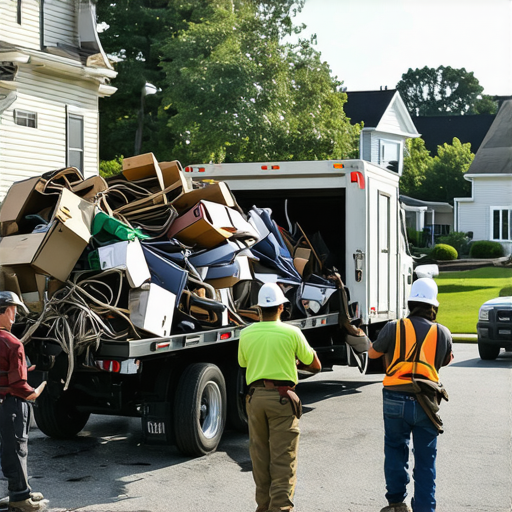

I smell like diesel and the acrid scent of old fiberglass insulation. After three decades in the cab of a roll-off truck, I do not see a home as a sanctuary. I see it as a collection of potential cubic yards that must be calculated, sorted, and hauled. My world is governed by the physics of load density and the harsh reality of tipping fees at the Denver Arapahoe Disposal Site. Every time I park a truck in an Aurora driveway, I am looking for the tetris. I am looking for how to fit two tons of suburban debris into a space designed for one. If you leave air in the truck, you are losing money. If you hide a lithium battery in a sofa, you are a fire hazard. I have no patience for the curbside cowboys who promise a cheap haul and then dump your life in a ditch near Cherry Creek. Your junk is your legal liability until the scale at the transfer station records the weight and the manifest is signed.
The suffocating floorboards of Aurora
Aurora crawl space cleaning involves extracting heavy, moisture-laden debris from confined subterranean environments to prevent structural rot and pest infestation. This specialized process requires the removal of degraded vapor barriers, contaminated insulation, and forgotten construction materials that have reached their volumetric limit. In the high-altitude environment of Aurora, the stack effect is a physical certainty. Air from the crawl space moves upward into the living quarters. If that space is filled with rotting organic matter or wet fiberglass, you are breathing the decay of decades. The logistics of extraction are brutal. We use low-profile sleds and heavy-duty polyethylene bags to move material through openings that are often less than 18 inches high. This is not just cleaning. It is a hazardous material operation performed in a claustrophobic void. I once cleared a crawl space where the owner had stored four hundred bundles of wet newspapers since the 1990s. The weight had literally bowed the floor joists. The humidity in the crawl space had turned the newsprint into a solid, moldy block of cellulose that weighed four times its dry mass. We had to use reciprocating saws just to break the junk into manageable chunks.
“Waste is merely a resource in the wrong place; professional removal is the science of putting it back where it belongs.” – Disposal Industry Maxim
The expensive shadow of a cheap truck
Hiring an unlicensed junk removal service in Aurora exposes you to significant legal liabilities and potential environmental fines if materials are dumped illegally. Under the Resource Conservation and Recovery Act, the generator of the waste is responsible for its final destination. A business owner in Aurora tried to save 500 dollars by hiring a guy with a pickup truck from a social media ad. Two weeks later, the police called him because his company confidential files and three old monitors were found in a ditch. Your junk is your liability until it hits the scale. Professional junk removal Aurora services provide a paper trail. We track the tonnage. We know the difference between Class I and Class II waste. The curbside cowboys do not have the insurance to cover a hydraulic leak on your driveway. They do not have the bonds to cover the damage they do to your door frames during a furniture removal. When you pay for a professional, you are paying for the transfer of liability. You are paying for the certainty that your old water heater will not end up in a local creek bed.
The cubic yard lie
The math of Aurora dumpster rentals and junk removal is based on the relationship between cubic volume and the specific gravity of the materials being hauled. Most people underestimate the volume of their debris by forty percent because they fail to account for the void space between irregular objects. A 15-yard dumpster is not just a container. It is a geometric puzzle. If you toss chairs and lamps in haphazardly, you will hit the fill line before you have loaded half of your actual waste. We calculate the angle of repose for loose debris and the structural load limits of the truck bed. Heavy materials like concrete, dirt, or brick must be hauled in specialized low-boy containers because of the weight limits of the hydraulic lifts. A single cubic yard of wet Aurora soil can weigh 3,000 pounds. A 20-yard dumpster full of dirt would snap the axles of a standard truck. We manage the density to ensure the load is safe for transport on Interstate 225. Table 1 below breaks down the density realities of common Aurora junk.
| Material Type | Weight per Cubic Yard (lbs) | Disposal Difficulty |
|---|---|---|
| Loose Household Junk | 250 to 400 | Low |
| Wet Fiberglass Insulation | 600 to 800 | High (Respiratory Hazard) |
| Construction Debris (C&D) | 800 to 1,200 | Medium |
| Old Concrete/Brick | 3,000 to 4,000 | Extreme (Weight Limit) |
| Green Waste (Yard Trimmings) | 300 to 500 | Low (Diversion Required) |
The garage as a chemical cemetery
Garage clean outs in Aurora often uncover hazardous household waste that requires specialized handling protocols to prevent environmental contamination and landfill rejection. Many residents store old paint, pesticides, and pool chemicals in the corner of the garage for years, ignoring the fact that containers degrade over time. These materials are prohibited in general dumpsters. We perform a visual manifest on every garage project. If we find a lead-acid battery, it is separated. If we find old cans of oil-based paint, we cannot legally toss them into the landfill bound load. The vapors from old chemical containers can build up in the confined space of a truck bed, creating a flash-fire risk. We look for the symbols on the labels. We look for the tell-tale smell of mercaptan or old fuel. We follow the strict guidelines set by the Solid Waste Association of North America. Our goal is to divert as much as possible to the Aurora Household Hazardous Waste programs, but that requires a level of sorting that the amateur hauler simply will not do. They will bury the chemicals under a pile of old rugs. When that truck hits the compactor at the landfill, those chemicals spray everywhere. That is how landfill fires start.
The heavy metals in your laundry room
Appliance removal in Aurora involves the decommissioning of bulky units that contain hazardous refrigerants, heavy metals, and electronic components that must be recycled. An old refrigerator is not just a box of steel. It is a pressurized system containing R-22 or R-410A gases that contribute to ozone depletion if released. Federal law requires that these refrigerants be recovered by a certified technician before the unit is scrapped. We manage the logistics of moving these 300 pound behemoths from basements and narrow laundry rooms without damaging the home. We use heavy duty dollies with non-marring tires and specialized straps. The metal is valuable, but the cost of the removal is in the labor and the environmental compliance. Washing machines, dryers, and stoves are primarily steel, but they also contain copper wiring and control boards that should stay out of the general waste stream. We ensure these items go to a scrap processor who will strip the components and return the raw materials to the manufacturing cycle. This is the science of material recovery.
“Managing waste effectively is a prerequisite for a sustainable city; the improper disposal of bulky items represents a failure of urban logistics.” – SWANA Technical Bulletin
The structural cost of a hoarded life
A hoarder clean out aurora project is a high-stakes logistical operation that requires a phased extraction strategy to protect the physical integrity of the building. When junk reaches the ceiling, it exerts lateral pressure on interior walls that were never designed to be load bearing in that direction. Removing the junk too quickly or in the wrong order can cause wall collapses or ceiling failures. We start with a safety path. We establish a staging area. We use industrial grade air scrubbers to manage the particulate matter that is kicked up the moment you move a pile that has been sitting for a decade. This is not just about clearing space. It is about biohazard management. We often find animal waste, rotted food, and sharp objects hidden within the layers. Every person on my team wears puncture resistant gloves and high grade respiratory protection. We calculate the truck cycles based on the density of the hoard. Paper-heavy hoards are deceptively heavy. A room full of old magazines can weigh more than a car. We have to be careful not to overload the truck or the house. This is a job for strategists, not just laborers.
The cheap plywood of modern living
Furniture removal highlights the rapid degradation of consumer goods and the increasing volume of low-value wood waste in the local disposal system. Modern flat-pack furniture is made of particle board and formaldehyde-based resins. It has no structural value and cannot be easily donated because it breaks during transport. When we remove this stuff, it is often easier to break it down into flat components to save truck space. Older furniture, made of solid oak or cherry, is a different story. It is heavy, but it has a lower environmental impact because it lasts for a century. The modern throwaway culture has tripled the volume of furniture in the waste stream over the last twenty years. In Aurora, we try to divert solid wood to mulch centers, but the resin-heavy particle board has to go to the landfill. It has zero BTU value for clean energy plants because of the toxic glues. We handle the disassembly and the hauling, ensuring that your home is not damaged by the sharp, splintered edges of cheap melamine.
- Lead-acid batteries and automotive fluids
- Pressurized propane tanks and fire extinguishers
- Wet paint and liquid solvents
- Asbestos-containing flooring or pipe wrap
- Biohazardous medical waste and needles
- Fluorescent ballasts and mercury switches
- Radioactive smoke detectors and industrial sensors
The landfill heat signature
The environmental impact of local disposal cycles is often misunderstood by consumers who believe that recycling is a universal solution for all waste types. In reality, the carbon footprint of hauling low-grade plastics 500 miles to a specialized processing center often exceeds the impact of local, high-efficiency waste-to-energy incineration or managed landfilling. In the Aurora region, our focus is on weight reduction and material diversion. We divert clean concrete to crushers for road base. We divert clean wood to mulch. But for the mixed-material junk, the most efficient logistical path is the regional landfill. Modern landfills are highly engineered cells that capture methane for energy and prevent leachate from hitting the groundwater. We are the gatekeepers. We ensure that only the right materials enter that cell. While some claim that every piece of plastic can be reborn as a new bottle, the physics of the market says otherwise. Contaminated junk from a crawl space or a garage clean out is rarely recyclable. The energy required to clean and sort it is too high. Our job is to dispose of it in a way that minimizes the footprint of the haul and maximizes the safety of the community. We manage the volume so the city can breathe. We are the engineers of the exit strategy. Every load we take is a calculated move in the game of urban survival.