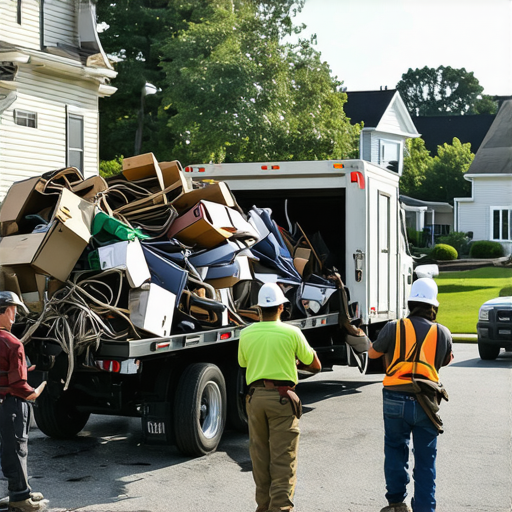

Disassembling the Backyard Fortress: Expert Logistics of Large Play Set Removal
I watched a rookie almost lose his eyebrows because a customer hid a half-full propane tank inside a pile of ‘harmless’ yard waste. We don’t just lift; we inspect. Every. Single. Item. That moment defined my approach to waste management. It is not about throwing things in a truck. It is about the science of volume, the physics of structural decay, and the legalities of the waste stream. When you look at a rotting cedar play set in an Aurora backyard, you see an eyesore. I see 800 pounds of pressure-treated lumber, 40 pounds of oxidized galvanized steel fasteners, and 150 cubic feet of non-compactable void space that will eat my profit margin if I don’t cube it out correctly. Waste management is a game of inches and ounces. If you fail to respect the load, the load will break you. Whether it is Junk Removal Aurora residents need for a simple garage clean out or a complex disassembly, the rules of the landfill are absolute.
The engineering failure of weathered timber
Removing a large play set requires a systematic deconstruction of load-bearing joints and the identification of material fatigue points to prevent structural collapse during the haul. You must understand the difference between structural integrity and the illusion of stability. A play set that has sat in the Illinois humidity for a decade is a different beast than one installed last summer. The wood fibers have undergone thousands of cycles of expansion and contraction. The lignin is breaking down. Those 3/8-inch lag bolts are no longer just metal; they are fused to the wood through a decade of oxidation. If you take a sledgehammer to a swing set beam without understanding the tension points, you are asking for a trip to the emergency room. We use reciprocating saws with carbide-tipped blades. We cut at the points of least resistance. We manage the weight. It is a calculated demolition.
“Waste is merely a resource in the wrong place; professional removal is the science of putting it back where it belongs.” – Disposal Industry Maxim
The hidden chemistry of pressure treated wood
Disposing of outdoor play structures involves managing Chromated Copper Arsenate (CCA) or Micronized Copper Azole (MCA) treated lumber which requires specific disposal protocols at local transfer stations. Most people do not realize that the wood in their backyard is a chemical cocktail. Older sets, built before 2003, often contain arsenic. You cannot just burn this wood in a bonfire. You cannot mulch it for your garden. If you do, you are leaching toxins into the soil. In the waste industry, we track these materials. When we provide Dumpster Rentals Aurora contractors use, we have to be clear about what goes into the bin. Treated wood is heavy. It is dense. It holds moisture like a sponge. A dry 4×4 post might weigh 40 pounds, but a waterlogged one can hit 60. That difference matters when you are hitting the scales at the transfer station and paying by the ton.
Mechanical logistics of the breakdown
The process starts with the removal of secondary attachments. Slides, swings, and rock-climbing grips are usually high-density polyethylene (HDPE). This is a recyclable material, but only if it is clean. We strip these first to reduce the ‘air’ in the truck. A slide is a logistical nightmare because it cannot be crushed easily. It takes up volume without adding significant weight. This is the enemy of the logistics manager. We look for ‘nesting’ opportunities. If I can tuck a folded swing seat inside the cavity of a plastic fort roof, I have optimized that cubic yard. Next comes the hardware. We don’t just pull the wood apart. We extract the steel. Scrap metal has value, but more importantly, it is a hazard at the landfill if left protruding from the timber. The floor snapped. That was the sound of a rotted joist giving way under its own weight during a recent Hoarder Clean Out Aurora project. We don’t take chances with gravity.
| DIY Pickup Truck | Slow | Low | High (Multiple trips) | |
| 15-Yard Dumpster | Medium | High | Medium | |
| Full-Service Removal | Fast | Medium | Low (Professional Sorting) |
The Aurora disposal ecosystem and tipping fees
Navigating the specific disposal regulations in Aurora requires knowledge of the Kane County solid waste ordinances and the current tipping fees at regional transfer stations. Every municipality has its quirks. In Aurora, the proximity to major arterial roads allows for faster turnaround times for Appliance removal and Furniture Removal, but the local landfills are tightening their belts on ‘bulky items.’ A play set is the definition of bulky. If you drop a whole play set in a landfill, it creates air pockets. Air pockets lead to uneven settling and methane migration. This is why we break it down. We are not just hauling junk; we are prepping feedstock for the waste stream. We know which stations take treated wood and which ones charge a premium for ‘mixed C&D’ (construction and demolition) loads. If you hire a guy with a trailer who doesn’t know these nuances, you are likely subsidizing his illegal dumping in a ditch somewhere. Your junk is your liability until it hits the scale and the manifest is signed.
Why your cheap hauler is a legal time bomb
The ‘curbside cowboy’ is the bane of the professional waste manager. These guys undercut the market because they don’t pay for insurance, they don’t pay for proper disposal, and they don’t understand the Resource Conservation and Recovery Act (RCRA). If a hauler takes your old play set and dumps it in a vacant lot, and the city finds your mail or a nameplate in that pile, you are the one getting the fine. We see this constantly with Junk Removal Aurora calls. People want the lowest price, but they forget that waste management is a regulated utility. We provide a chain of custody. When we perform a Garage Clean outs service, every item is accounted for. We prioritize diversion. If the wood can be salvaged, it goes to a recovery center. If the plastic can be ground down, it goes to a processor. The landfill is the last resort, not the first stop. Professionalism costs more because it protects you from the long-term costs of environmental negligence.
- Lead-acid batteries: These are fire hazards and must be handled via hazmat protocols.
- Propane tanks: Even ’empty’ tanks contain residual gas and can explode in a compactor.
- Tires: Most landfills ban these due to their tendency to ‘float’ to the surface over time.
- Wet paint: Must be dried with sawdust or kitty litter before it can enter the general waste stream.
- Biohazardous waste: Anything containing bodily fluids or medical sharps requires specialized disposal.
The heavy cost of keeping everything
While most people think recycling is always ‘better,’ the carbon footprint of hauling low-grade plastics 500 miles often exceeds the impact of local, high-efficiency waste-to-energy incineration. This is a hard truth many don’t want to hear. In the waste industry, we calculate the BTU value of our loads. A load of dry, non-treated wood waste has significant energy potential. If we can get that to a waste-to-energy plant, it is far more beneficial than letting it rot in a cell for 50 years. This is the ‘Logistical Zoom’ we apply to every job. We are looking at the molecular potential of the junk. Your old play set isn’t just trash; it is a complex assembly of carbon-based polymers and metallic alloys. Our job is to deconstruct that assembly and return it to the earth or the factory in the most efficient way possible. The physics of the load dictate the strategy. We respect the physics.
“Modern waste management is the silent heartbeat of a functional civilization; without it, the debris of progress would bury us.” – Solid Waste Association Perspective