
The night the sky turned orange over the Aurora transfer station
I watched a rookie almost lose his eyebrows because a customer hid a half-full propane tank inside a pile of harmless yard waste. We do not just lift. We inspect. Every. Single. Item. The pressure in that tank was a ticking bomb sitting under three tons of organic mulch. That is the reality of waste management in the Fox Valley area. If you live in Aurora and think throwing things away is simple, you are wrong. It is a high-stakes game of logistics, chemistry, and municipal law. The smell of hydraulic fluid and scorched metal stays in your clothes. It reminds you that junk removal is not just about clearing space. It is about preventing a disaster in the local landfill. Waste is a liability until it is properly manifested and tipped at a licensed facility.
The heavy cost of keeping everything in your garage
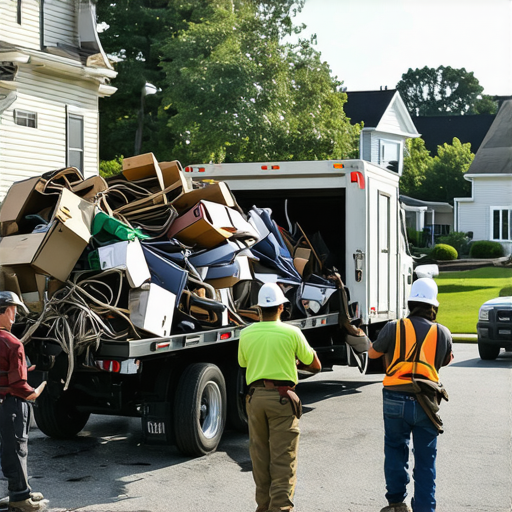
Garage clean outs in Aurora require a tactical understanding of cubic yard density and material segregation to ensure environmental compliance. Most residents underestimate the weight of accumulated debris which leads to structural failures in rental dumpsters or hazardous chemical leaks from forgotten automotive fluids and ancient paint cans stored in corners. When we talk about garage clean outs, we are talking about decades of forgotten decisions. A single shelf can hold twenty pounds of lead-acid batteries and five gallons of degraded motor oil. If those leak, you are looking at a soil remediation bill that makes our removal fee look like pocket change. We approach a garage like a hazardous materials site. We categorize. We sort. We pack the truck using a strict Tetris method to minimize air pockets. Air is expensive. If I am hauling air, I am losing money and burning extra diesel for no reason. Every cubic foot must be occupied by dense waste to optimize the carbon footprint of the trip to the Kane County recycling center.
“Waste is merely a resource in the wrong place; professional removal is the science of putting it back where it belongs.” – Disposal Industry Maxim
Why your appliance removal strategy is failing the planet
Appliance removal requires specialized recovery of ozone-depleting substances and heavy metals to prevent environmental degradation in the Aurora watershed. Professional haulers must capture refrigerants like R-22 or R-134a before the metal chassis can be processed for high-grade scrap at local industrial recovery facilities. Most people see an old fridge and think about the scrap value of the steel. I see a complex assembly of polyurethanes, copper coils, and pressurized gasses. If you hire a guy with a pickup truck, he might just vent those gasses into the atmosphere to get to the copper faster. That is a federal violation of the Clean Air Act. In 2026, the sensors at our regional transfer stations are tuned to detect even minor traces of refrigerant leakage. We use specialized recovery pumps to vacuum the lines. The metal then goes to a shredder where it is separated by magnets. The foam insulation is often the biggest problem. It is bulky and filled with blowing agents that need thermal destruction. This is why appliance removal costs more than just a simple labor fee.
The psychological and physical load of hoarder clean out aurora operations
Hoarder clean out aurora projects involve managing extreme volumetric loads while identifying biohazardous materials and structurally unsound debris piles. These situations often require professional grade respiratory protection and heavy-duty structural shoring to prevent floor collapses during the removal of high-density paper and textile accumulations. A house filled with newspapers is not just a fire trap. It is a dead weight that can exceed the load-bearing capacity of residential joists. I have seen floors bow four inches under the weight of wet magazines. The moisture in the air gets trapped in the paper. It turns into a solid, heavy mass. We do not just walk in and start tossing things. We create a path of egress. We check for mold spores that can cause permanent lung damage. In Aurora, the humidity from the river valley makes these situations worse. The paper starts to decompose while it is still inside the house. Our teams use 6-mil poly bags to seal the worst of it. We track every ton. We have to. The landfill needs to know if we are bringing in organic decay or inorganic household goods.
Dumpster rentals aurora and the permit nightmare you want to avoid
Dumpster rentals aurora residents choose must account for local right-of-way permits and the strict weight limits enforced by municipal code. Selecting the wrong container size leads to overweight penalties and street obstructions that result in significant fines from the city of Aurora code enforcement officers. You think a 20-yard dumpster is big. It is not. If you are throwing out concrete from a driveway, you will hit your weight limit before the bin is one-quarter full. That is the trap. The truck cannot lift a bin that weighs twelve tons. The hydraulics will fail. Or worse, the tires will pop. You need to know the math. A cubic yard of loose household junk weighs about 250 pounds. A cubic yard of wet dirt weighs 2,000 pounds. If you do not understand this ratio, you are going to get a bill that hurts. We also have to talk about placement. If you put that steel box on your asphalt driveway in the middle of a hot Aurora July, it will sink. You need wood blocking. You need a permit if it touches the street. It is a logistical puzzle.
| Material Type | Decomposition Time | Disposal Priority | Recycling Potential |
|---|---|---|---|
| Corrugated Cardboard | 3 Months | High | 95% |
| Untreated Wood Waste | 3 Years | Medium | 80% |
| Aluminum Siding | 200 Years | Critical | 100% |
| Low-Density Plastic | 450 Years | Low | 15% |
| Glass Bottles | 1 Million Years | High | 100% |
The myth of easy furniture removal and the landfill crisis
Furniture removal in the modern era is complicated by the use of composite materials and chemically treated fabrics that are difficult to recycle. Most low-cost furniture today is held together with formaldehyde-based glues which prevent the wood fibers from being safely mulched or composted. The old days of solid oak tables are gone. Today we haul particle board. It is basically sawdust and glue. When it gets wet, it expands and loses all structural integrity. You cannot donate it. No one wants it. It ends up in the landfill. But we try to do better. We strip the metal legs. We remove the cushions if the foam is clean. In 2026, we are seeing more furniture made with fire retardants that are actually classified as persistent organic pollutants. You cannot just burn this stuff. The BTU potential is high, but the emissions are toxic. We coordinate with specialized waste-to-energy plants that can handle the high temperatures required to break these chemicals down. It is a far cry from just tossing a couch in a ditch.
“Modern waste management is the final frontier of urban engineering; we are the ones who decide what the future finds in the earth.” – SWANA Technical Manual
The contrarian truth about plastic recycling in the Fox Valley
Most people think putting plastic in a blue bin is the ultimate eco-friendly move. They are wrong. In many cases, the carbon footprint of collecting, sorting, and hauling low-grade plastics 500 miles to a processing plant exceeds the environmental cost of local incineration. In Aurora, we are moving toward high-efficiency waste-to-energy. This means your non-recyclable junk is burned at such high temperatures that it creates electricity for the local grid. It is better to turn a plastic bag into light for a school than to ship it across the ocean on a diesel-burning freighter. We look at the total lifecycle. We look at the net carbon impact. Sometimes, the most eco-friendly thing you can do with junk is to get it to a facility that can extract its energy efficiently rather than pretending it will become a new park bench.
Prohibited items for Aurora haulers
- Propane tanks and pressurized cylinders
- Lead-acid automotive batteries
- Industrial solvents and thinners
- Asbestos-containing floor tiles or pipe wrap
- Medical waste and sharps
- Radioactive smoke detectors
- Unused ammunition or explosives
- Liquid oil-based paints
The physics of cubing out a 15-yard truck
When I stand at the back of my truck, I am calculating volume in my head. A 15-yard dump body is roughly 12 feet long, 8 feet wide, and 4.5 feet high. If I throw a sofa in there haphazardly, I have used 3 yards of space but only 150 pounds of weight. That is a failure. I need to break that sofa down. I need to put heavy boxes inside the frame. I need to stack flat items against the walls. This is cubing out. It ensures that every trip to the transfer station is maximized. If my guys leave six inches of gap at the top of the load, that is a gallon of wasted fuel. Over a year, that adds up to thousands of dollars and tons of unnecessary carbon. We treat every load like a puzzle. We use heavy blankets to protect the client’s walls, but once it hits the truck, it is all about density. The floor snapped once because a rookie put a cast iron tub on top of a hollow wooden crate. You learn quickly in this business. Gravity always wins. You have to work with it, not against it. We use heavy-duty straps to secure the load. A shifting load is a dangerous load. If the weight moves while we are taking a turn onto Orchard Road, the truck could tip. It is not just junk. It is mass in motion.