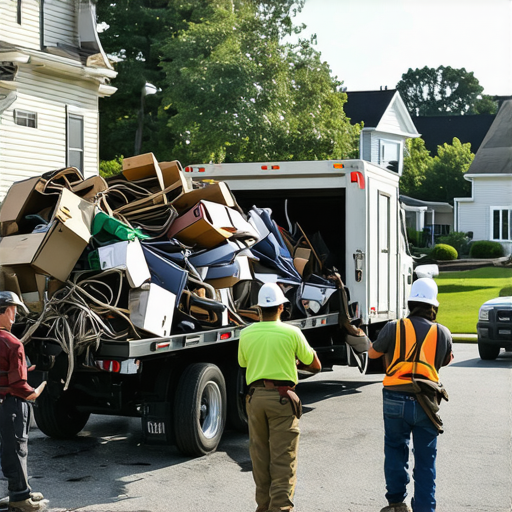

I watched a rookie almost lose his eyebrows because a customer hid a half-full propane tank inside a pile of ‘harmless’ yard waste. We don’t just lift. We inspect. Every. Single. Item. That incident taught me that junk removal is not just about muscle. It is about the chemistry of what sits in your garage. In the waste industry, we deal with the physical reality of mass and density. When you call for Junk Removal Aurora, you are not just paying for a truck. You are paying for the legal transfer of liability. If that propane tank had hit the shredder at the transfer station, the explosion would have triggered a Department of Labor investigation faster than you can say ‘tipping fee’. I have spent twenty-five years staring at the back of a hydraulic packer. I know the difference between a load that is ‘cubed out’ and one that is ‘weighed out’. In Aurora, the logistics of waste are dictated by the Fox River geography and the strict Kane County environmental ordinances. If you think you can just toss an old refrigerator into a ditch, you are ignoring the Resource Conservation and Recovery Act regulations that govern refrigerant recovery.
The hidden dangers of organic rot
Professional composting in Aurora involves local hubs like the Kane County Recycling centers, the municipal yard waste program, and specialized organic processors. These facilities prevent methane production in landfills by diverting organic mass into controlled aerobic decomposition environments. Proper use of these hubs reduces overall disposal costs for residential and commercial cleanouts.
The smell of a failing compost pile is the smell of anaerobic failure. It is a sharp, acidic stench that signals high moisture and low oxygen. When we perform a Hoarder Clean Out Aurora, we often find what I call ‘organic time bombs’. These are piles of old newspapers or cardboard that have absorbed basement humidity for a decade. They are no longer paper. They are a heavy, sodden mass of cellulose that has become a breeding ground for mold spores. To a logistics manager, this is a weight problem. A dry stack of newspapers weighs about 20 pounds per cubic foot. A wet stack? It can hit 50 pounds. That difference can blow out the suspension on a light-duty pickup truck. This is why we rely on specific Aurora hubs. The local yard waste program, usually managed by contractors like Groot or LRS, requires biodegradable paper bags for a reason. Plastic bags do not breathe. They trap moisture. They turn your grass clippings into a fermented slurry that composting facilities will reject. You must understand the physics of the load before you start the lift. Besides, the BTU potential of dry wood waste is a valuable resource. If we take that wood to a biomass facility instead of a landfill, we are recovering energy. If it goes to the landfill, it produces landfill gas which must be flared or piped. Professionalism is knowing where that material ends up.
“Waste is merely a resource in the wrong place; professional removal is the science of putting it back where it belongs.” – Disposal Industry Maxim
Why your Aurora garage is a structural liability
Garage clean outs in Aurora require a systematic approach to segregate hazardous household waste from general construction and demolition debris. By identifying items like old paint, solvents, and lead-acid batteries early, homeowners can avoid the heavy fines associated with illegal hazardous waste disposal at standard municipal landfills.
I have walked into garages in Aurora where the shelves were literally screaming. The wood was bowing under the weight of old paint cans. Paint is heavy. A five-gallon bucket of latex paint weighs nearly 60 pounds. If you have twenty of those, you have 1,200 pounds of liquid weight sitting on a shelf designed for Christmas decorations. That is a structural hazard. When we do Garage Clean outs, we look for the ‘leakers’. If a lead-acid battery from an old lawnmower has cracked, it is leaking sulfuric acid onto your concrete. That acid eats the lime in the concrete. It creates a permanent stain and a chemical burn hazard. We also see ‘curbside cowboys’ who think they can hide these things in a black trash bag. They cannot. Modern transfer stations use thermal imaging and radiation detectors. If you try to sneak a load of hazardous waste into the Orchard Hills Landfill, they will find it. They will find your address on a piece of mail in that bag. Then the fines start. For Appliance removal, the stakes are even higher. Old freezers contain CFCs or HCFCs. These are potent ozone-depleting substances. We must recovery those gases using EPA-certified equipment before the metal can be scrapped. It is not just about the heavy lift. It is about the federal paperwork that tracks that refrigerant from your garage to the destruction facility. Below is a breakdown of how we calculate the costs for these removals.
| Material Type | Disposal Priority | Aurora Facility Type | Cost Factor |
|---|---|---|---|
| Yard Waste | High Diversion | Compost Hub | Weight-Based |
| Old Furniture | Volume Load | Transfer Station | Cubic Yardage |
| Appliances | Regulated | Scrap Processor | Per Unit Fee |
| E-Waste | Hazardous | Electronic Recycler | Weight + Type |
The math of the fifteen yard dumpster
Dumpster rentals Aurora operate on a balance of volumetric capacity and weight limits defined by local DOT regulations. A fifteen-yard dumpster is ideal for residential cleanouts, but users must monitor the ‘angle of repose’ and avoid overfilling past the side walls to ensure safe transport on local roads.
Most people do not understand the math of a dumpster. They see a big metal box and think it is an infinite void. It is not. A 15-yard dumpster has a footprint of roughly 14 feet by 8 feet with 4-foot walls. If you fill that with concrete, you will exceed the weight limit of the truck before the box is half full. That is called ‘weighing out’. If you fill it with old sofas, you will run out of space before you hit the weight limit. That is ‘cubing out’. As a logistics manager, my goal is to mix the two. I want the heavy stuff on the bottom to lower the center of gravity. I want the light, bulky Furniture Removal items on top to fill the ‘air space’. Every cubic inch of air in that dumpster is money you are throwing away. I hate seeing a dumpster with a sofa thrown in the middle. It creates huge voids. We break that furniture down. We pull the cushions. We smash the frames. We make it flat. In Aurora, the narrow driveways in the older neighborhoods near the high school mean we have to be precise. We use wood blocking under the rollers to prevent the heavy steel from cracking your asphalt. We also have to watch for overhead lines. A dumpster being winched onto a rail can reach 15 feet in the air. If there is a low-hanging ComEd line, you are looking at a blackout for the whole block. Information gain: while people think recycling is always better, the carbon footprint of hauling low-grade plastics 500 miles often exceeds the impact of local, high-efficiency waste-to-energy incineration. Sometimes, the most ‘eco-friendly’ thing you can do is dispose of it locally in a high-heat facility that captures the energy.
- Wet Lead-Acid Batteries
- Unspent Propane Cylinders
- Liquid Industrial Solvents
- Medical Pathological Waste
- Radioactive Smoke Detectors
- Unlabeled Chemical Jugs
The logistics of a Hoarder Clean Out Aurora
Hoarder clean outs in Aurora demand a logistical strategy that prioritizes technician safety and material segregation. These projects often involve ‘Level 3’ hoarding environments where structural integrity is compromised by the extreme weight of accumulated materials and potential biohazards must be professionally mitigated.
A hoarding house is an autopsy of a life. It is also a logistical nightmare. The floor joists in these homes are often under three times the load they were engineered for. I have seen floors in Aurora homes sagging four inches in the center because of ‘paper creep’. That is when stacks of magazines move slowly over time, pushing against load-bearing walls. When we enter, we start at the ‘egress points’. We clear the doors and windows first. This is for fire safety. If a fire starts in a hoarding house, the ‘fuel load’ is so high that the house becomes a blast furnace in minutes. We categorize everything into three streams: Donatable, Recyclable, and MSW (Municipal Solid Waste). We work with local Aurora charities for the donatable items, but we are strict. If a sofa has been in a hoarding environment for years, it likely has ‘environmental odors’ or pests. We do not donate those. We dispose of them. For the recyclables, we focus on the metals and the clean paper. The rest goes to the transfer station. The Junk Removal Aurora process for these homes can take days. We use 30-yard roll-offs because the volume is simply too high for smaller trucks. Every load is documented. Every hazardous item, like an old TV with a cathode ray tube, is separated. Those CRTs contain several pounds of lead. They cannot go in the landfill. We ensure they go to a certified e-waste processor who can handle the hazardous glass safely.
“Modern waste management is the silent pillar of public health; without the professional hauler, the city ceases to function.” – Solid Waste Association of North America
Final Logistics
The last mile of waste disposal is the most important. Whether you are using the 3 local Aurora composting hubs or hiring a full-service crew for Junk Removal Aurora, the goal is the same. You want the stuff gone without creating a future liability. I have seen the results of the ‘cheap’ option. I have seen the illegal dump sites in the forest preserves. It is disgusting. It is also a crime. When you hire a professional, you are buying a chain of custody. You are buying the peace of mind that your old refrigerator is not sitting in a creek bed leaking Freon. You are buying the certainty that your yard waste is becoming soil, not methane. In the waste business, we do not just move junk. We manage the lifecycle of materials. We are the stewards of the ‘discarded economy’. Next time you look at that pile in your garage, do not just see ‘junk’. See the weight, the volume, and the chemical reality of what you own. Then call someone who knows how to handle the physics of it.