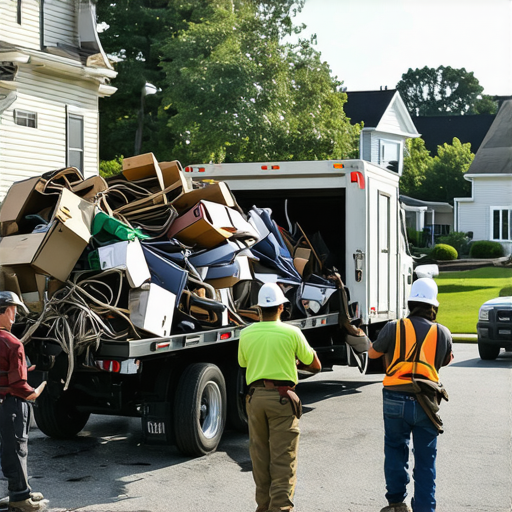

I watched a rookie almost lose his eyebrows because a customer hid a half-full propane tank inside a pile of harmless yard waste. We do not just lift. We inspect. Every. Single. Item. That moment remains etched in my mind because it represents the core failure of the modern waste management mindset. People assume that once an item is out of their sight, the risk vanishes. In the reality of heavy hauling in Aurora, the risk is only beginning. Your junk is a logistical footprint that carries physical weight, legal liability, and chemical volatility. I have spent twenty-five years navigating the tipping scales of Aurora landfills and private transfer stations. I have seen the structural failure of floor joists under the weight of saturated mattresses and the environmental decay caused by illegal dumping on the outskirts of Arapahoe County. Disposal is not a simple act of throwing things away. It is the science of resource redirection and hazard mitigation.
The hidden danger in the yard waste
Furniture removal and mattress disposal in Aurora require a deep understanding of local ordinances and the mechanical properties of the waste. A standard mattress is a logistical nightmare consisting of tempered steel coils, polyurethane foam, and flame-retardant chemicals that resist compaction. When you throw a mattress into a truck, you are essentially transporting eighty percent air. This inefficiency drives up costs for every homeowner. Professional haulers focus on the cubic yard density because air space in a truck is lost revenue. In Aurora, the proximity to the Denver Arapahoe Disposal Site means we must account for the specific gate fees which vary based on volume and material type. If you hide a propane tank or a lead-acid battery in a pile of furniture, you are not just being sneaky. You are creating a potential explosion in the back of a hydraulic packer truck. The pressure of the blade can rupture a tank, leading to a flash fire that consumes a hundred-thousand-dollar vehicle and endangers the driver. Logistics managers hate surprises. We want a clean, manifested load that hits the scale with predictable weights and zero hazards.
“Waste is merely a resource in the wrong place; professional removal is the science of putting it back where it belongs.” – Disposal Industry Maxim
The physics of the steel coil
Mattress disposal Aurora involves managing the high-tension steel found in traditional inner-spring units which can destroy industrial shredders. These coils are designed to support human weight for a decade, meaning they do not collapse easily under the weight of other junk. When we pack a truck, we utilize a method called cubing out. We place the heaviest, flattest items like dressers or table leaves at the bottom to create a floor. The mattresses are then used as walls to secure the load. This prevents the cargo from shifting during transit on the I-225 or E-470. A single queen-size mattress takes up roughly twenty-five cubic feet of space. If you are doing a garage clean out, that single item can dictate the entire layout of your dumpster or truck bed. Most people do not realize that once a mattress becomes wet, its weight can triple. The polyurethane foam acts as a giant sponge. If you leave a mattress on an Aurora curb during a summer thunderstorm, you have just turned a fifty-pound item into a hundred-and-fifty-pound liability that most municipal crews will refuse to touch due to safety limits.
Aurora landfill gate fees and regulations
Junk removal Aurora is governed by strict local codes that dictate how much bulk waste can be placed on a curb and when it must be removed. The city has specific dates for bulky item collection, but for many, the wait is too long. This leads to the use of private haulers or dumpster rentals. When you rent a dumpster in Aurora, you are paying for the convenience of time, but you are also assuming the responsibility for what goes into that bin. Overfilling a dumpster is a primary cause of road hazards. If the debris is higher than the side rails, it is an illegal load. I have seen countless DIYers get hit with a three-hundred-dollar dry run fee because the driver could not safely tarp the bin. The math of junk removal is simple. You pay for the space you use, the weight you generate, and the labor required to move the mass from point A to point B. If you are dealing with an appliance removal, you must also factor in the Clean Air Act requirements for refrigerant recovery. You cannot simply smash a refrigerator. The Freon must be extracted by a certified technician before the steel shell can be scrapped.
Items that never cross the scale
Dumpster rentals Aurora and professional hauling services have a strict list of prohibited items based on the Resource Conservation and Recovery Act guidelines. These items are excluded because they pose a threat to the landfill liners or the groundwater. While some might think a small jug of old motor oil is harmless, when it is crushed in a landfill, it leaks into the leachate system, complicating the water treatment process. Here is the technical reality. Landfills are not just holes in the ground. They are engineered containment cells. Any material that can leach chemicals or cause a fire is a threat to that engineering.
- Wet paint and flammable solvents.
- Lead-acid batteries and lithium-ion cells.
- Pressurized cylinders including propane and CO2.
- Tires which trap methane gas and float to the surface of landfills.
- Medical waste or biohazardous materials.
- Asbestos-containing materials from old renovations.
- Fluorescent tubes containing mercury vapor.
The cost of the garage clean out
Garage clean outs often reveal the true weight of a homeowner’s history. A standard two-car garage can hold upwards of three tons of debris if it is packed to the ceiling. The heavy cost of keeping everything becomes apparent when the bill for the disposal arrives. In the waste industry, we look at the material recovery potential. Old tools and metal shelving have scrap value. Old couches and particle-board desks have zero value. In fact, they have negative value because we must pay to dispose of them. The carbon footprint of hauling low-grade plastics and treated wood often exceeds the impact of local waste-to-energy incineration. This is the contrarian truth of the industry. Sometimes, the most environmental choice is high-efficiency incineration rather than hauling low-quality recyclables across three states. In Aurora, we aim for the highest diversion rate possible, but the reality is that much of the modern furniture is made of composite materials that cannot be easily separated for recycling.
| Service Type | Pricing Basis | Best Use Case | Speed of Disposal |
|---|---|---|---|
| Full-Service Hauling | By Volume (Cubic Yards) | Mattresses, Furniture, Junk | Immediate |
| Dumpster Rental | Flat Fee + Overweight | Construction, Whole House | Slow / Multi-day |
| Municipal Pickup | Fixed Schedule | Single Bulky Items | Very Slow |
| Scrap Metal Pickup | Weight Credit | Appliances, Steel Frames | Variable |
Hoarder clean out logistics in Colorado
Hoarder clean out Aurora operations are the special forces missions of the waste world. These are not simple pick-ups. They are tactical extractions. I have entered homes where the air quality was so poor we had to wear respirators. The junk becomes a monolithic mass. It is no longer individual items. It is a compressed layers of history. The moisture trapped at the bottom of these piles often leads to mold growth that compromises the drywall and the flooring. When we tackle these jobs in Aurora, we have to consider the seasonal heat. Working in a non-ventilated house in July to remove three tons of debris requires a strict hydration and rotation schedule for the crew. We also have to be mindful of the neighbors. A massive pile of junk on a driveway is a visual blight and a potential rodent magnet. We prefer the live-load method for these situations. The truck arrives, the crew loads it continuously, and the waste is gone within hours, leaving the property clean and the liability removed. This approach prevents the secondary issues of dumpster diving and illegal additions to the pile by passersby.
“Managing waste is the ultimate test of a city’s logistical infrastructure and environmental conscience.” – SWANA Technical Report
The heavy cost of appliance removal
Appliance removal is a technical task that most people underestimate. An old washing machine can weigh two-hundred pounds and is often located in a basement with narrow stairs. The physics of the move are unforgiving. If you drop a washer, you are not just breaking the machine. You are breaking the stairs or the person underneath it. We use specialized appliance dollies and high-tensile straps to manage the center of gravity. Once the item is out, the logistics shift to EPA compliance. Every refrigerator and air conditioner contains refrigerants that must be recovered. We keep a log of every unit handled. If a company tells you they can take your fridge for twenty dollars, they are likely venting the gas into the atmosphere or dumping the unit in a ditch. Your junk is your liability until it hits the scale at a certified facility. If your name is on a piece of mail found in an illegal dump site, the Aurora police will be at your door, regardless of who you hired to haul it away. Professionalism is the only shield against these risks. We provide a chain of custody for your waste, ensuring it ends up in a lined landfill or a recycling center rather than a local creek bed.
The myth of the free furniture pickup
Furniture removal in a town like Aurora is often complicated by the low quality of modern manufacturing. In the past, furniture was made of solid wood and could be donated or sold. Today, most items are made of medium-density fiberboard or particle board. These materials break easily and have no resale value. When you try to give away a modern dresser, you often find no takers. This leads to the curbside graveyard. People put items out with a free sign, hoping someone will take them. When the items get rained on, they become heavy, moldy, and impossible to donate. The fast way to discard an old mattress or a broken couch is to recognize its status as waste immediately. Waiting only increases the difficulty of the removal. In the waste industry, we see this cycle constantly. The faster the item is removed, the lower the risk of property damage and the lower the overall cost of the logistical chain. We prioritize speed and efficiency because in the world of hauling, time is the only thing we cannot recycle.