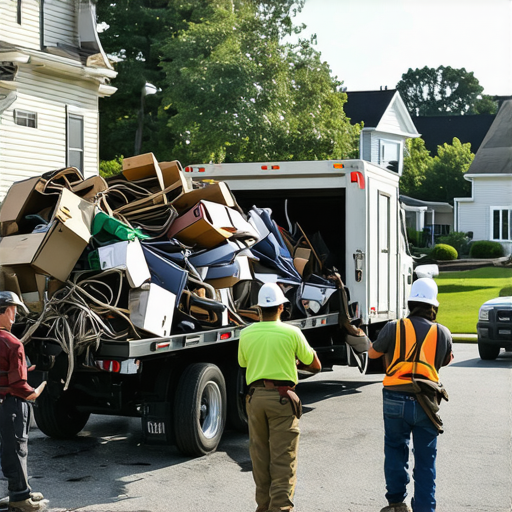

I watched a rookie almost lose his eyebrows because a customer hid a half-full propane tank inside a pile of harmless yard waste. We do not just lift. We inspect. Every. Single. Item. It happened on a scorching Tuesday in Aurora while we were clearing a 1980s kitchen. The homeowner swore it was just wood and laminate. It was not. Junk removal is a high stakes game of hidden risks and logistical precision. When you are hauling three tons of debris through Aurora traffic, every pound must be accounted for. People think kitchen cabinets are just empty boxes. They are wrong. They are dense packages of particle board, urea-formaldehyde resins, and heavy hardware that can snap a floor joist or blow a truck tire if handled by an amateur. This is the reality of waste management. It is about mass, density, and the laws of physics.
The heavy burden of Aurora kitchen waste
Aurora kitchen cabinet removal requires a detailed understanding of material weight and local disposal regulations at the Denver Regional Landfill. Professional crews calculate the total cubic yardage against the maximum weight capacity of the vehicle to prevent hazardous transport conditions and ensure efficient tipping at the transfer station. When we talk about clearing a kitchen in Aurora, we are talking about managing hundreds of pounds of medium density fiberboard. MDF is not your friend. It is heavy. It is brittle. It absorbs moisture like a sponge. If those cabinets have been sitting in a damp garage or a leaky kitchen, their weight has doubled. We see people try to do this themselves in a pickup truck. They overload the bed. The suspension bottoms out. They become a hazard on I-225. A standard 15-yard dump truck has a specific load limit. If we hit that limit before we fill the volume, we have cubed out. This is a logistical failure that costs money and time.
Landfill gate fees and the weight calculation
The cost of disposing of kitchen debris in Aurora is dictated by the weight based tipping fees at local facilities like the Aurora Transfer Station. Professional junk removal services use volumetric pricing to provide consistency, but the underlying logistics are driven by the weight of the materials. You have to understand the math of the haul. A typical kitchen might produce five to seven cubic yards of loose debris. If that debris is solid oak, it has a different disposal profile than if it is cheap laminate. We look at the density. We look at the hardware. We look at the potential for salvage.
“Waste is merely a resource in the wrong place; professional removal is the science of putting it back where it belongs.” – Disposal Industry Maxim
Every trip to the landfill involves a scale. You weigh in. You dump. You weigh out. The difference is what you pay. If you hire a guy with a trailer who does not understand these fees, he is going to dump your cabinets in a ditch on the outskirts of Arapahoe County to save a buck. That is your liability. Your name is often on the mail or the receipts inside that junk. We do things by the book because the book keeps you out of legal trouble.
The chemistry of vintage cabinet materials
Old kitchen cabinets often contain hazardous materials such as lead based paint or formaldehyde adhesives that require specialized handling under the Resource Conservation and Recovery Act. Professional removal ensures that these contaminants are identified before they are crushed and released into the air or local groundwater. If your Aurora home was built before 1978, those cabinets might be coated in lead. When we rip them out, we are not just smashing wood. We are managing a hazardous site. We use N95 respirators. We contain the dust. The adhesives used in 20th century cabinetry are another nightmare. Urea-formaldehyde was the industry standard. It off-gases. It is a respiratory irritant. When we load a truck, we have to consider the airflow. We do not just toss things in. We stack to minimize breakage and dust. It is about protecting our crew and your property. The physics of the extraction are just as complex. A wall cabinet is held up by three inch screws into the studs. If you pull it wrong, you take the drywall with it. You might even hit a hidden electrical line or a copper pipe. We use sensors. We use experience.
| Material Type | Average Weight per Cubic Yard | Decomposition Time in Landfill |
|---|---|---|
| Solid Oak Wood | 700 lbs | 15 to 25 Years |
| Particle Board (MDF) | 950 lbs | 25 to 50 Years |
| Laminate Countertops | 1,200 lbs | Permanent |
| Steel Hardware | 2,500 lbs | 50 to 100 Years |
Prohibited hazardous materials in residential loads
Federal and local regulations strictly prohibit the disposal of certain hazardous items within general residential junk loads in Aurora. Identifying these items early prevents legal penalties and environmental damage at the municipal waste facility during the kitchen clearing process. Every load is a potential crime scene if you are not careful. We have seen it all. Hidden bottles of drain cleaner. Old cans of oil based paint tucked in the back of a corner cabinet. Lithium batteries from a forgotten flashlight. These are bombs in a garbage truck.
“Proper management of construction and demolition debris reduces the burden on municipal landfills and prevents the leaching of hazardous finishes into local groundwater tables.” – EPA Waste Management Guidelines
Our crew is trained to spot the signs of hazmat. If we find it, we flag it. We cannot legally transport certain chemicals without a specific manifest. Here is what we cannot touch:
- Propane tanks and pressurized cylinders
- Liquid paint and chemical solvents
- Asbestos containing floor tiles or insulation
- Unlabeled industrial cleaners
- Automotive fluids and lead acid batteries
- Medical waste or biohazardous materials
Physics of the kitchen demolition process
The structural extraction of kitchen cabinets involves managing gravitational force and leverage to prevent damage to the surrounding residential structure. Professional teams utilize specialized tools to decouple units from the wall studs without compromising the integrity of the home. When you are standing on a ladder holding a 60 pound upper cabinet, you are fighting physics. The screws are the only thing between you and a trip to the emergency room. We use a systematic approach. We empty the units. We remove the doors to shift the center of gravity closer to the wall. We back out the screws while a second person supports the load. This is not a task for a weekend warrior. The risk of a structural collapse is real if the cabinets were improperly installed. We also have to watch the floor. Dragging a cabinet across a hardwood floor in an Aurora kitchen is a crime against property value. We use sliders. We use ramps. We use logic. We do not just muscle it. We outthink the weight. This is the difference between a professional junk removal company and a random guy with a truck. We understand the load paths.
The hidden environmental cost of free disposal
While many homeowners seek the cheapest possible disposal option, the environmental impact of low quality waste management often results in higher long term costs for the Aurora community. High efficiency waste to energy incineration is frequently a superior alternative to traditional landfilling for contaminated kitchen materials. Most people think recycling is always better. In the world of old cabinets, that is a myth. Particle board is full of glue. It cannot be recycled into new wood products. If you haul it 500 miles to a specialty plant, the carbon footprint of the diesel fuel outweighs the benefit of the recycling. We look for local solutions. Sometimes that means a high efficiency incinerator that turns that wood waste into electricity for Aurora homes. This is information gain. It is contrarian, but it is the truth of the industry. We are not just movers. We are waste strategists. We decide the final destination of every cubic inch of your kitchen based on its material makeup and the current state of the waste market. We navigate the tipping fees. We navigate the traffic. We navigate the law. Your kitchen becomes our logistical puzzle to solve. We solve it with precision and a respect for the scale.