
The high price of amateur hauling
A business owner tried to save 500 dollars by hiring a guy with a pickup truck from a social media ad. Two weeks later, the police called him because his company’s confidential files were found in a ditch. Your junk is your liability until it hits the scale. This reality applies to residential carpet just as much as corporate paper. If your old Aurora carpet ends up in a Cherry Creek drainage pipe, the authorities track that material back to the source. Professional waste management is not about owning a truck. It is about chain of custody. It is about knowing the tipping fees at the Denver Arapahoe Disposal Site. It is about understanding that a roll of wet carpet can weigh 200 pounds and snap a human lumbar spine in a fraction of a second. I have spent twenty five years watching people underestimate the mass of their own debris. They see a pile of old rugs. I see a logistical puzzle involving cubic yard density and potential hazardous leachate. Most homeowners do not realize that the carpet they have walked on for twenty years is a bio-trap. It holds skin cells, pet dander, and chemical flame retardants that become airborne the moment you break the tack strip. You need a strategy, not just a pair of gloves.
The toxic reality of the bottom layer
Old carpet padding and synthetic fibers contain complex chemical compounds like PFAS and polybrominated diphenyl ethers that require specific disposal protocols at Aurora transfer stations. Professional removal ensures these materials do not contaminate local soil or release volatile organic compounds into the household environment during the heavy extraction process. The physics of the carpet pull is violent. You are prying thousands of rusted staples from a subfloor while disturbing a micro-ecosystem of dust. If the padding has fused to the particle board, you are no longer just doing a clean out. You are performing a surgical structural intervention. I have seen floors where the moisture from a hidden leak turned the padding into a gelatinous sludge. That sludge is a breeding ground for stachybotrys. You do not just throw that in a bin. You seal it. You treat it as a biohazard. This is where the curbside cowboys fail. They toss it in an open bed and drive down I-225, letting spores fly into the Aurora breeze. Logistics managers know better. We use 6-mil poly sheeting. We isolate the zone. We protect the air quality of the rest of the structure. It is about the science of containment.
“Waste is merely a resource in the wrong place; professional removal is the science of putting it back where it belongs.” – Disposal Industry Maxim
[IMAGE_PLACEHOLDER]
The math behind a full truckload in Aurora
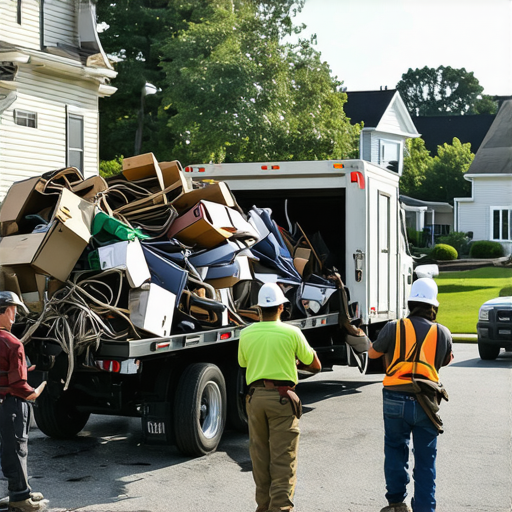
Residential carpet disposal requires calculating the density of rolled nylon versus the cubic volume of the truck bed to ensure maximum efficiency. A typical 1,500 square foot home produces approximately 600 pounds of carpet and padding, necessitating a 10-yard dumpster or a specialized junk removal vehicle. When I pull up to an Aurora job site, I am mentally cubing out the truck. I hate air. Air in a truck is a waste of fuel and time. To maximize the load, we do not just toss rolls in like cordwood. We flat-pack the padding because it is compressible. We perimeter-load the heavy carpet rolls to stabilize the center of gravity. This is the Tetris of waste. If the load is unbalanced, the hydraulic system on the dump bed works harder. It wears out the seals. It costs money. We look at the BTU potential of the material too. Some Aurora recycling programs can process clean nylon 6,6 into new plastic resins. We sort on-site. We do not dump everything into the same heap. It is a matter of diversion rates. If I can keep 40 percent of a hoarder clean out aurora out of the landfill, I have done my job. I have saved the client money on weight-based tipping fees and I have kept the local environment cleaner. It is a win for the balance sheet and the planet.
Why local Aurora landfills demand strict sorting
Municipal waste ordinances in Aurora and the surrounding Arapahoe County area mandate the separation of hazardous materials from general construction and demolition debris to prevent environmental contamination. Failure to comply with these sorting rules can lead to significant fines for both the hauler and the original property owner. You cannot just bury everything. The Denver Regional Landfill has eyes. They use radiation portals and chemical sniffers. If you hide a lead-acid battery under a pile of old carpet, they will find it. I once saw a load rejected because of a single gallon of old latex paint hidden in a box of kitchen junk. That rejection cost the hauler three hours of drive time and a 250 dollar dry-run fee. That is why we inspect every pile. We look for the hidden hazards. Appliances, furniture removal, and garage clean outs often overlap. People think they can hide an old microwave inside a rolled rug. That is a violation of the Resource Conservation and Recovery Act. It is lazy and it is dangerous.
“Proper management of bulky waste, including synthetic flooring, is essential to prevent the leaching of flame retardants into the local groundwater supply.” – Environmental Logistics Standards
| Material Type | Decomposition Time | Tipping Fee Impact | | :— | :— | :— | | Nylon Carpet | 50-100 Years | High Volume | | Polyurethane Pad | 20-50 Years | High Compression | | Tack Strips | 10-15 Years | Minimal | | Adhesive Residue | Variable | Hazardous Potential |
Tactical extraction of commercial grade flooring
Removing glued-down commercial carpet in Aurora requires specialized floor scrapers and an understanding of adhesive chemistry to avoid damaging the underlying concrete slab or releasing asbestos-containing materials. This process is significantly more labor-intensive than residential carpet removal and requires a dedicated crew of heavy-load specialists for efficient transport. Commercial jobs are a different beast. The adhesive is often a pressure-sensitive resin that has bonded with the dust of thirty years. When you rip it, the friction generates heat. The smell of burning rubber and old chemicals fills the room. You need high-volume HEPA filtration. You need a crew that knows how to swing a sledge and operate a walk-behind scraper without gouging the foundation. Once it is up, the debris is heavy. It is dense. It does not roll. It breaks into jagged, heavy shards. Loading this into a truck requires a different strategy. We use palletized bins for commercial waste. It allows for mechanical loading. It saves the backs of my men. We minimize the manual touches. In this industry, every time a human hand touches a piece of junk, the profit margin drops. Efficiency is the only way to survive the rising costs of fuel and disposal in Colorado. Junk removal Aurora is a game of inches and ounces.
The hidden hazards of hoarding and hidden debris
A hoarder clean out aurora often involves layers of decayed organic matter trapped beneath decades of old carpeting, creating a complex bio-load that requires professional personal protective equipment and specialized disposal routes. These projects go beyond simple junk removal and enter the realm of environmental remediation and structural salvage operations. I have walked into homes where the floor joists were bowing. The weight of the accumulated material was literally crushing the house. We found newspapers from the eighties that had absorbed so much basement humidity they weighed five pounds each. When you pull the carpet in a situation like that, you are often looking at a complete subfloor replacement. The urine from pets, the spills from years of neglect, it all settles into the wood. The smell hits you like a physical wall. We use industrial hydroxyl generators to neutralize the odor molecules. We do not just spray some perfume and leave. We solve the problem at the molecular level. We clear the paths. We create exit routes. We manage the flow of material like a conveyor belt. It is about logistics. It is about safety. It is about getting the job done so the property can be reclaimed from the chaos.
- Wet Paint and Solvent Cans
- Sealed Propane or Gas Tanks
- Loose Asbestos Siding or Insulation
- Unbound Medical Waste and Sharps
- Lead-Acid Automotive Batteries
- Industrial Grade Pesticides
Resource recovery and the circular economy
The future of waste management in Aurora centers on material recovery facilities that can separate carpet fibers from backing materials to create post-consumer recycled content for the automotive and textile industries. By choosing a professional hauler who prioritizes recycling, residents contribute to a circular economy that reduces the need for virgin plastic production. Most people think recycling is always better. The reality is more complex. The carbon footprint of hauling low-grade plastics 500 miles often exceeds the impact of local, high-efficiency waste-to-energy incineration. We look at the numbers. We choose the route that makes the most sense for the specific material. If the carpet is too contaminated, it goes to the landfill. If it is clean, we track the diversion. This data is important for commercial clients who need to meet LEED certification or corporate sustainability goals. We provide the manifests. We provide the proof. We are the link between the cluttered house and the recovery facility. We are the gatekeepers of the waste stream. We take the burden off the homeowner and put it on the scale where it belongs. The job is done when the truck is empty and the floor is bare. The logistics of the haul are over. The next cycle begins.